


Factors associated with persistent and nonpersistent chronic constipation, over 20 years
- PMID: 22289877
- PMCID: PMC3589972
- DOI: 10.1016/j.cgh.2011.12.041
Factors associated with persistent and nonpersistent chronic constipation, over 20 years
Abstract
Background & aims: The prevalence of chronic constipation (CC) has been reported to be as high as 20% in the general population, but little is known about its natural history. We estimated the natural history of CC and characterized features of persistent CC and nonpersistent CC, compared with individuals without constipation.
Methods: In a prospective cohort study, we analyzed data collected from multiple, validated surveys (minimum of 2) of 2853 randomly selected subjects, over a 20-year period (median, 11.6 years). Based on responses, subjects were characterized as having persistent CC, nonpersistent CC, or no constipation. We assessed the association between constipation status and potential risk factors using logistic regression models, adjusting for age and sex.
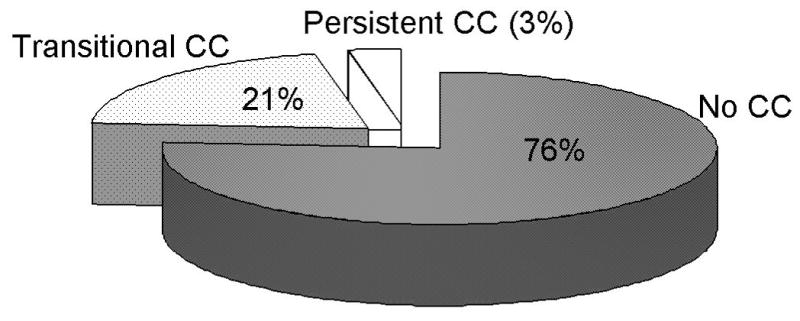
Results: Of the respondents, 84 had persistent CC (3%), 605 had nonpersistent CC (21%), and 2164 had no symptoms of constipation (76%). High scores from the somatic symptom checklist (odds ratio [OR] = 2.1; 95% confidence interval [CI], 1.3-3.4) and frequent doctor visits (OR = 2.0; 95% CI, 1.0-3.8) were significantly associated with persistent CC, compared with subjects with no constipation symptoms. The only factor that differed was increased use of laxatives or fiber among subjects with persistent CC (OR = 3.0; 95% CI, 1.9-4.9).
Conclusions: The prevalence of constipation might be exaggerated-the proportion of the population with persistent CC is low (3%). Patients with persistent and nonpersistent CC have similar clinical characteristics, although individuals with persistent CC use more laxatives or fiber. CC therefore appears and disappears among certain patients, but we do not have enough information to identify these individuals in advance.
Copyright © 2012 AGA Institute. Published by Elsevier Inc. All rights reserved.
Figures
References
-
- Pare P, Ferrazzi S, Thompson WG, et al. An epidemiological survey of constipation in canada: definitions, rates, demographics, and predictors of health care seeking. Am J Gastroenterol. 2001;96:3130–7. - PubMed
-
- Talley NJ, Weaver AL, Zinsmeister AR, et al. Functional constipation and outlet delay: a population-based study. Gastroenterology. 1993;105:781–90. - PubMed
-
- Drossman DA, Li Z, Andruzzi E, et al. U.S. householder survey of functional gastrointestinal disorders. Prevalence, sociodemography, and health impact. Dig Dis Sci. 1993;38:1569–80. - PubMed
-
- Stewart WF, Liberman JN, Sandler RS, et al. Epidemiology of constipation (EPOC) study in the United States: relation of clinical subtypes to sociodemographic features. Am J Gastroenterol. 1999;94:3530–40. - PubMed
Publication types
MeSH terms
Substances
Grants and funding
LinkOut - more resources
Full Text Sources
Medical
