


Restoration of lordosis and disk height after single-level transforaminal lumbar interbody fusion
- PMID: 22290814
- PMCID: PMC6583197
- DOI: 10.1111/j.1757-7861.2011.00165.x
Restoration of lordosis and disk height after single-level transforaminal lumbar interbody fusion
Abstract
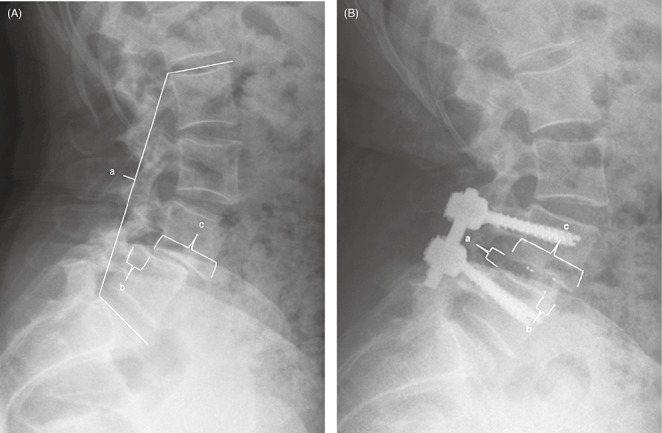
Objective: To study radiographic and clinical outcomes after transforaminal lumbar interbody fusion (TLIF) in order to determine the impact of TLIF on lumbar lordosis, intervertebral height and improvement in clinical outcome measures.
Methods: Forty-five patients who had undergone a single-level TLIF procedure for a single-level degenerative condition were retrospectively reviewed and their clinical histories, degree of pre- and post-operative lumbar lordosis, intervertebral height, and cage position recorded. Clinical assessment included use of modified Odom's criteria and a visual analog scale (VAS) for back and leg pain.
Results: At 21 months, the patients had gained an average of 3.6° of lumbar lordosis and 4.5 mm disc height. Change in disc height was significantly associated with an anterior cage position while lumbar lordosis was unaffected by cage position. A spondylolisthesis subgroup demonstrated 31% reduction in the magnitude of anterior slip. Less lordosis was associated with worse back and leg pain as assessed by VAS and greater disk heights were associated with higher Odom's criteria scores. Patients with persistent leg pain at final follow-up had less lumbar lordosis and intervertebral height than patients without leg pain.
Conclusions: Intervertebral height and lumbar lordosis reconstruction are important for achieving good surgical results; guidance regarding the likely changes in lumbar lordosis and disk height after TLIF is provided by our findings.
© 2012 Tianjin Hospital and Blackwell Publishing Asia Pty Ltd.
Figures
References
-
- Schwab FJ, Smith VA, Biserni M, et al Adult scoliosis: a quantitative radiographic and clinical analysis. Spine, 2002, 27: 387–392. - PubMed
-
- Daffner SD, Vaccaro AR. Adult degenerative lumbar scoliosis. Am J Orthop, 2003, 32: 77–82. - PubMed
-
- Tribus CB. Degenerative lumbar scoliosis: evaluation and management. J Am Acad Orthop Surg, 2003, 11: 174–183. - PubMed
-
- Berven SH, Deviren V, Mitchell B, et al Operative management of degenerative scoliosis: an evidence‐based approach to surgical strategies based on clinical and radiographic outcomes. Neurosurg Clin N Am, 2007, 18: 261–272. - PubMed
-
- Ploumis A, Liu H, Mehbod AA, et al A correlation of radiographic and functional measurements in adult degenerative scoliosis. Spine, 2009, 34: 1581–1584. - PubMed
MeSH terms
LinkOut - more resources
Full Text Sources
Other Literature Sources
Medical
