


Phase I trial of anti-CS1 monoclonal antibody elotuzumab in combination with bortezomib in the treatment of relapsed/refractory multiple myeloma
- PMID: 22291084
- PMCID: PMC4874204
- DOI: 10.1200/JCO.2011.37.7069
Phase I trial of anti-CS1 monoclonal antibody elotuzumab in combination with bortezomib in the treatment of relapsed/refractory multiple myeloma
Abstract
Purpose: To evaluate the maximum-tolerated dose (MTD), safety, and efficacy of elotuzumab in combination with bortezomib in patients with relapsed or relapsed and refractory multiple myeloma (MM).
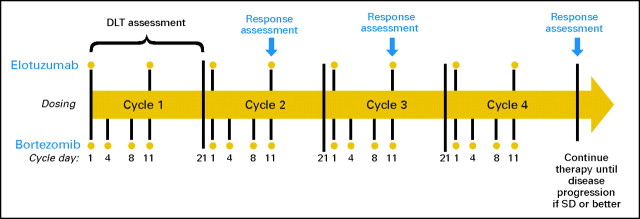
Patients and methods: Elotuzumab (2.5, 5.0, 10, or 20 mg/kg intravenously [IV]) and bortezomib (1.3 mg/m(2) IV) were administered on days 1 and 11 and days 1, 4, 8, and 11, respectively, in 21-day cycles by using a 3 + 3 dose-escalation design. Patients with stable disease or better after four cycles could continue treatment until disease progression or unexpected toxicity. Responses were assessed during each cycle by using European Group for Blood and Marrow Transplantation (EBMT) criteria.
Results: Twenty-eight patients with a median of two prior therapies were enrolled; three patients each received 2.5, 5.0, and 10 mg/kg of elotuzumab and 19 received 20 mg/kg (six during dose escalation and 13 during an expansion phase). No dose-limiting toxicities were observed during cycle 1 of the dose-escalation phase, and the MTD was not reached up to the maximum planned dose of 20 mg/kg. The most frequent grade 3 to 4 adverse events (AEs) were lymphopenia (25%) and fatigue (14%). Two elotuzumab-related serious AEs of chest pain and gastroenteritis occurred in one patient. An objective response (a partial response or better) was observed in 13 (48%) of 27 evaluable patients and in two (67%) of three patients refractory to bortezomib. Median time to progression was 9.46 months.
Conclusion: The combination of elotuzumab and bortezomib was generally well-tolerated and showed encouraging activity in patients with relapsed/refractory MM.
Conflict of interest statement
Authors' disclosures of potential conflicts of interest and author contributions are found at the end of this article.
Figures

Comment in
-
Incorporating monoclonal antibodies into the therapy of multiple myeloma.J Clin Oncol. 2012 Jun 1;30(16):1904-6. doi: 10.1200/JCO.2011.40.4178. Epub 2012 Jan 30. J Clin Oncol. 2012. PMID: 22291081 No abstract available.
References
-
- Kyle RA, Rajkumar SV. Multiple myeloma. N Engl J Med. 2004;351:1860–1873. - PubMed
-
- Jemal A, Siegel R, Xu J, et al. Cancer statistics, 2010. CA Cancer J Clin. 2010;60:277–300. - PubMed
-
- Imrie K, Esmail R, Meyer RM. The role of high-dose chemotherapy and stem-cell transplantation in patients with multiple myeloma: A practice guideline of the Cancer Care Ontario Practice Guidelines Initiative. Ann Intern Med. 2002;136:619–629. - PubMed
-
- Mark T, Niesvizky R, Coleman M. Novel agents in myeloma: An exciting saga. Cancer. 2009;115:236–242. - PubMed
Publication types
MeSH terms
Substances
Grants and funding
LinkOut - more resources
Full Text Sources
Other Literature Sources
Medical
Miscellaneous
