. 2012 Feb 13;209(2):407-21.
doi: 10.1084/jem.20111493. Epub 2012 Jan 30.

Crucial role of SLP-76 and ADAP for neutrophil recruitment in mouse kidney ischemia-reperfusion injury

Affiliations

Crucial role of SLP-76 and ADAP for neutrophil recruitment in mouse kidney ischemia-reperfusion injury

Helena Block et al. J Exp Med. .

Abstract

Neutrophils trigger inflammation-induced acute kidney injury (AKI), a frequent and potentially lethal occurrence in humans. Molecular mechanisms underlying neutrophil recruitment to sites of inflammation have proved elusive. In this study, we demonstrate that SLP-76 (SH2 domain-containing leukocyte phosphoprotein of 76 kD) and ADAP (adhesion and degranulation promoting adaptor protein) are involved in E-selectin-mediated integrin activation and slow leukocyte rolling, which promotes ischemia-reperfusion-induced AKI in mice. By using genetically engineered mice and transduced Slp76(-/-) primary leukocytes, we demonstrate that ADAP as well as two N-terminal-located tyrosines and the SH2 domain of SLP-76 are required for downstream signaling and slow leukocyte rolling. The Tec family kinase Bruton tyrosine kinase is downstream of SLP-76 and, together with ADAP, regulates PI3Kγ (phosphoinositide 3-kinase-γ)- and PLCγ2 (phospholipase Cγ2)-dependent pathways. Blocking both pathways completely abolishes integrin affinity and avidity regulation. Thus, SLP-76 and ADAP are involved in E-selectin-mediated integrin activation and neutrophil recruitment to inflamed kidneys, which may underlie the development of life-threatening ischemia-reperfusion-induced AKI in humans.


Figures
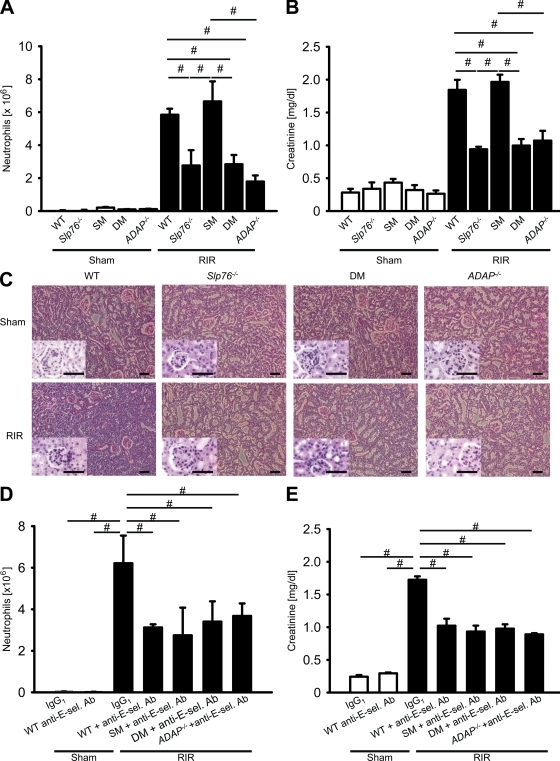
Figure 1.
Figure 1.
Deficiency in ADAP or SLP-76 attenuates neutrophil recruitment and protects mice from AKI. (A and B) Irradiated WT mice were reconstituted with BM from WT (n = 4), Slp76−/− (n = 4), Slp76Y112/128 (DM; n = 4), Slp76Y145 (SM; n = 4), and ADAP−/− mice (n = 4). 6–8 wk later, mice were subjected to RIR or sham injury, and the number of neutrophils recruited into the kidney (A) and plasma creatinine were assessed 24 h later (B). (C) Representative H&E staining of kidney outer medulla from chimeric mice was assessed 24 h after sham operation or renal IRI. Insets show a twofold magnified image. Bars, 50 µm. (D and E) Chimeric mice were pretreated with an IgG control antibody or a blocking anti–E-selectin antibody (Ab) 10 min after sham or renal IRI. 24 h later, the number of neutrophils in the kidney (D) and creatinine levels in the plasma (E) were determined. Results are presented as mean ± SEM. #, P < 0.05.
Figure 2.
Figure 2.
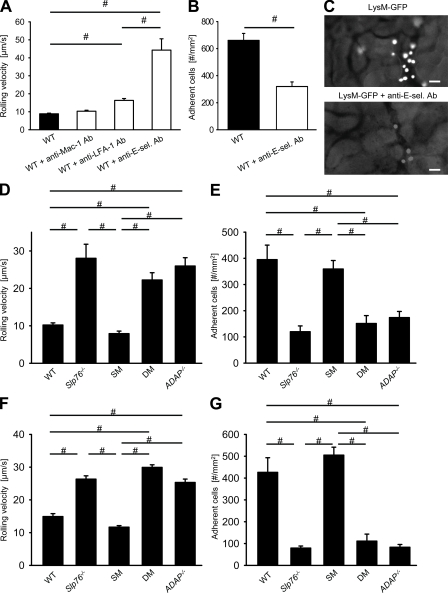
Leukocyte rolling and adhesion in kidney or cremaster venules after ischemia-reperfusion is dependent on SLP-76 and ADAP. (A and B) Untreated LysM-GFP mice or LysM-GFP mice pretreated with different antibodies (anti–Mac-1 antibody [M1-70], n = 3; anti–LFA-1 antibody [TIB217], n = 3; and anti–E-selectin antibody [9A9], n = 3) were subjected to RIR, and the rolling velocity (A) and the number of adherent leukocytes (B) in venules of the kidney were determined. (C) Representative pictures of cremaster muscle postcapillary venules of untreated LysM-GFP mice and LysM-GFP mice pretreated with a blocking anti–E-selectin antibody (Ab) 4 h after renal IRI. Bars, 25 µm. (D and E) 2 h after RIR, WT mice were injected i.v. with fluorescently labeled BM cells from WT (n = 3), Slp76−/− (n = 3), Slp76Y145 (SM; n = 3), Slp76Y112/128 (DM; n = 3) or ADAP−/− (n = 3) mice. 2 h later, leukocyte rolling velocity (D) and the number of adherent cells (E) in venules of the kidney were determined. (F and G) The cremaster muscle of WT (n = 3), Slp76−/− (n = 3), Slp76Y145 (n = 3), Slp76Y112/128 (n = 3), and ADAP−/− (n = 3) mice was subjected to ischemia (30 min)/reperfusion (120 min) injury, and mean rolling velocity (F) and the number of adherent cells (G) in postcapillary venules of the cremaster muscle were determined. Results are presented as means ± SEM. #, P < 0.05.
Figure 3.
Figure 3.
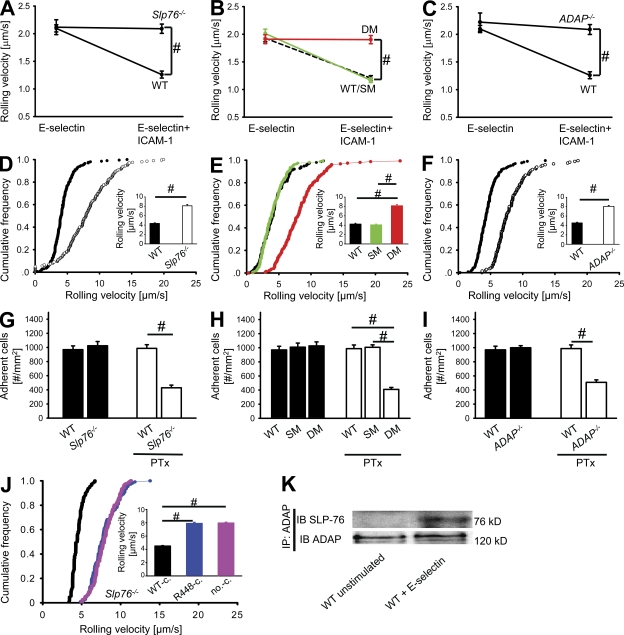
SLP-76 tyrosines are required for E-selectin–mediated slow leukocyte rolling and Gαi-independent adhesion. (A–C) The carotid artery of chimeric mice reconstituted with BM from WT (n = 3) or Slp76−/− (n = 3) mice (A), with WT (n = 3), SM (n = 3), or DM (n = 3) mice (B), or with WT (n = 3) or ADAP (n = 3) mice (C) was cannulated with a catheter, which was connected to autoperfused flow chambers. Mean rolling velocity of neutrophils on E-selectin (left) and E-selectin and ICAM-1 (right) is presented as means ± SEM. The wall shear stress in all flow chamber experiments was 5–6 dyn/cm2. #, P < 0.05. (D–F) Mixed chimeric mice were generated by injecting BM cells from LysM-GFP+ WT (WT; D–F) mice and Slp76−/− (Slp76−/−; D), SM (E) and DM mice (E), or ADAP−/− mice (ADAP−/−; F) into lethally irradiated WT mice. Cumulative histogram of rolling velocities of 100 GFP+ (WT) and 100 GFP leukocytes in inflamed cremaster muscle venules of mixed chimeric mice (n = 4) treated with PTx and a monoclonal blocking P-selectin antibody (RB40.34). The insets show the mean rolling velocity ± SEM. #, P < 0.05. (G–I) Numbers of adherent cells per square millimeter in murine cremaster muscle venules. The cremaster muscle was exteriorized 2 h after intrascrotal injection of 500 ng TNF or after injection of TNF and PTx in chimeric mice reconstituted with BM from WT mice (G–I; n = 3) or Slp76−/− (G; n = 3), SM and DM (H), or ADAP−/− (I) mice. Results are presented as means ± SEM. #, P < 0.05. (J) Mixed chimeric mice were generated by injecting retrovirally transduced hematopoietic stem cells (Slp-76–WT construct, WT-c.; Slp76-R448K construct, R448-c.; empty vector, no-c.) from Slp76−/− mice into lethally irradiated WT mice. Cumulative histogram of rolling velocities of transduced (WT-c., n = 100; R448-c., n = 100; no-c., n = 100) leukocytes in inflamed cremaster muscle venules of mixed chimeric mice (n = 3) treated with PTx and a monoclonal blocking P-selectin antibody. The inset shows the mean rolling velocity ± SEM. #, P < 0.05. (K) Coimmunoprecipitation of SLP-76 and ADAP. BM-derived WT neutrophils were plated on uncoated (unstimulated) or E-selectin–coated wells for 10 min, and then lysates were prepared followed by immunoprecipitation (IP) with ADAP antibody. Precipitates were immunoblotted (IB) with antibodies to total SLP-76 (top) and total ADAP (bottom).
Figure 4.
Figure 4.
E-selectin modulates integrin adhesiveness by regulating integrin affinity and avidity. (A and B) HL-60 cells were transfected with control shRNA or with shRNAs against SLP-76 or ADAP and subjected to immunoblot to verify down-regulation of SLP-76 (A) and ADAP down-regulation (B). Total p38 MAPK expression was used as loading control. (C) HL-60 cells were transfected with control shRNA or with shRNAs against SLP-76 or ADAP and were used in a flow chamber adhesion assay. Flow chambers were coated with E-selectin and a control IgG antibody (open bars) or KIM127 antibody, recognizing the intermediate affinity conformation of LFA-1 (closed bars) and perfused with transfected HL-60 cells. Bars represent the number of adherent cells per field of view as mean ± SEM of three independent experiments. #, P < 0.05. (D) Flow chamber adhesion assay with human leukocytes in whole blood pretreated with DMSO or specific inhibitors against PLC (U73122), PI3Kγ, or Btk (LFM-A13). Flow chambers were coated with E-selectin and a control IgG antibody (open bars) or KIM127 antibody (closed bars). Bars show the number of adherent cells per field of view as mean ± SEM of three independent experiments. #, P < 0.05. (E) Chimeric mice reconstituted with BM from WT, Slp76Y112/128, ADAP−/−, Btk−/−, Pik3cg−/−, or Plcg2−/− mice were used to investigate LFA-1 clustering on rolling cells in vivo. Mice were pretreated with TNF and PTx 2 h before the experiments, and a blocking P-selectin antibody and an Alexa Fluor–conjugated LFA-1 antibody were injected immediately before preparing the cremaster muscle for intravital microscopy analysis. Cells were classified as clustered if fluorescence was >1.5 times increased at one edge of the cell. Data are shown as percentage of clustered cells as mean ± SEM of three independent measurements with at least 100 cells per group. #, P < 0.05; *, P < 0.05 versus other groups. (F) Representative images of rolling leukocytes in inflamed cremaster venules of WT and Btk−/− mice stained for LFA-1 clustering. Bars, 10 µm.
Figure 5.
Figure 5.
i-independent leukocyte extravasation and neutrophil recruitment is defective in Slp76−/−, Slp76Y112/128, and ADAP−/− mice. (A) Numbers of extravasated leukocytes in cremasteric venules of TNF–treated chimeric mice reconstituted with BM from WT (n = 4), Slp76−/− (n = 4), Slp76Y145 (SM; n = 4), Slp76Y112/128 (DM; n = 4), or ADAP−/− mice (n = 4) per 1.5 × 10⁴–µm2 tissue area. The measurements were performed 2 h after intrascrotal TNF injection. The same groups were also analyzed after pretreatment with 4 µg PTx i.v. (+PTx; WT mice + PTx, n = 4; Slp76−/− mice + PTx, n = 4; Slp76Y145 mice + PTx, n = 4; Slp76Y112/128 mice + PTx, n = 4; and ADAP−/− mice + PTx, n = 4). (B) Neutrophil influx into the peritoneal cavity 8 h after 1-ml injection of 3% thioglycollate into chimeric mice reconstituted with BM from WT (n = 5), Slp76−/− (n = 4), Slp76Y112/128 (n = 4), or ADAP−/− mice (n = 4). The same groups were also analyzed after pretreatment with 4 µg PTx i.v. (WT mice + PTx, n = 4; Slp76−/− mice + PTx, n = 4; Slp76Y112/128 mice + PTx, n = 4; and ADAP−/− mice + PTx, n = 4). Total numbers of neutrophils in the peritoneal lavage fluid were determined by flow cytometry and hemocytometer count. Results are presented as means ± SEM. #, P < 0.05.
Figure 6.
Figure 6.
SLP-76 is required for the activation of Btk, PLCγ2, PI3Kγ, and p38 MAPK after E-selectin engagement. BM-derived neutrophils were plated on uncoated (unstimulated) or E-selectin–coated wells for 10 min, and then lysates were prepared. (A and B) Lysates of WT, Tyrobp−/−Fcrg−/− (A; n = 3), and Btk−/− (B; n = 3) were immunoprecipitated (IP) with a SLP-76 antibody followed by immunoblotting (IB) with a general phosphotyrosine (PY; 4G10) antibody or total SLP-76 antibody. (C) Lysates of WT and Slp76−/− neutrophils were immunoprecipitated with an Syk (n = 3) or Btk antibody (n = 3) followed by immunoblotting with a general phosphotyrosine (4G10) antibody, total Syk antibody (n = 3), or total Btk antibody (n = 3). Lysates were immunoblotted with antibody to phosphorylated PLCγ2 (p-PLCγ2 [Tyr1217]; n = 3), total PLCγ2 (n = 3), phosphorylated Akt (n = 3), total Akt (n = 3), phosphorylated p38 MAPK (p-p38), or total p38 MAPK (n = 3). (D) Lysates of WT and Slp76Y112/128 neutrophils were immunoprecipitated with Btk antibody (n = 3) followed by immunoblotting with a general phosphotyrosine (4G10) antibody or total Btk antibody (n = 3). Lysates were immunoblotted with antibody to phosphorylated PLCγ2 (Tyr1217; n = 3), total PLCγ2 (n = 3), phosphorylated Akt (n = 3), total Akt (n = 3), phosphorylated p38 MAPK, or total p38 MAPK (n = 3). (E and F) Lysates of WT, Tyrobp−/−Fcrg−/− (E; n = 3), and Btk−/− neutrophils (F; n = 3) were immunoprecipitated with an ADAP antibody followed by immunoblotting with a general phosphotyrosine (4G10) antibody or total ADAP antibody. (G) Lysates of WT and ADAP−/− neutrophils were immunoprecipitated with an Syk (n = 3) or Btk antibody (n = 3) followed by immunoblotting with a general phosphotyrosine (4G10) antibody, total Syk antibody (n = 3), or total Btk antibody (n = 3). Lysates were immunoblotted with antibody to phosphorylated PLCγ2 (Tyr1217; n = 3), total PLCγ2 (n = 3), phosphorylated Akt (n = 3), total Akt (n = 3), phosphorylated p38 MAPK, or total p38 MAPK (n = 3). (H) Lysates of WT and Slp76Y145 neutrophils were immunoprecipitated with Btk antibody followed by immunoblotting with a general phosphotyrosine antibody (4G10). Lysates were also immunoblotted with antibody to phosphorylated PLCγ2 (Tyr1217; n = 3), total PLCγ2 (n = 3), phosphorylated Akt (n = 3), total Akt (n = 3), phosphorylated p38 MAPK, or total p38 MAPK (n = 3).

References

    1. Abtahian F., Guerriero A., Sebzda E., Lu M.M., Zhou R., Mocsai A., Myers E.E., Huang B., Jackson D.G., Ferrari V.A., et al. 2003. Regulation of blood and lymphatic vascular separation by signaling proteins SLP-76 and Syk. Science. 299:247–251 10.1126/science.1079477 - DOI - PMC - PubMed
    1. Altavilla D., Squadrito F., Ioculano M., Canale P., Campo G.M., Zingarelli B., Caputi A.P. 1994. E-selectin in the pathogenesis of experimental myocardial ischemia-reperfusion injury. Eur. J. Pharmacol. 270:45–51 - PubMed
    1. Baker R.G., Hsu C.J., Lee D., Jordan M.S., Maltzman J.S., Hammer D.A., Baumgart T., Koretzky G.A. 2009. The adapter protein SLP-76 mediates “outside-in” integrin signaling and function in T cells. Mol. Cell. Biol. 29:5578–5589 10.1128/MCB.00283-09 - DOI - PMC - PubMed
    1. Bezman N.A., Lian L., Abrams C.S., Brass L.F., Kahn M.L., Jordan M.S., Koretzky G.A. 2008. Requirements of SLP76 tyrosines in ITAM and integrin receptor signaling and in platelet function in vivo. J. Exp. Med. 205:1775–1788 10.1084/jem.20080240 - DOI - PMC - PubMed
    1. Bonventre J.V., Weinberg J.M. 2003. Recent advances in the pathophysiology of ischemic acute renal failure. J. Am. Soc. Nephrol. 14:2199–2210 10.1097/01.ASN.0000079785.13922.F6 - DOI - PubMed

Publication types

MeSH terms