


Healthy lifestyle through young adulthood and the presence of low cardiovascular disease risk profile in middle age: the Coronary Artery Risk Development in (Young) Adults (CARDIA) study
- PMID: 22291127
- PMCID: PMC3353808
- DOI: 10.1161/CIRCULATIONAHA.111.060681
Healthy lifestyle through young adulthood and the presence of low cardiovascular disease risk profile in middle age: the Coronary Artery Risk Development in (Young) Adults (CARDIA) study
Abstract
Background: A low cardiovascular disease risk profile (untreated cholesterol <200 mg/dL, untreated blood pressure <120/<80 mm Hg, never smoking, and no history of diabetes mellitus or myocardial infarction) in middle age is associated with markedly better health outcomes in older age, but few middle-aged adults have this low risk profile. We examined whether adopting a healthy lifestyle throughout young adulthood is associated with the presence of the low cardiovascular disease risk profile in middle age.
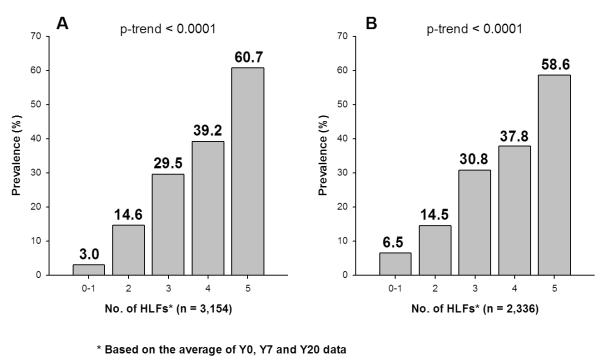
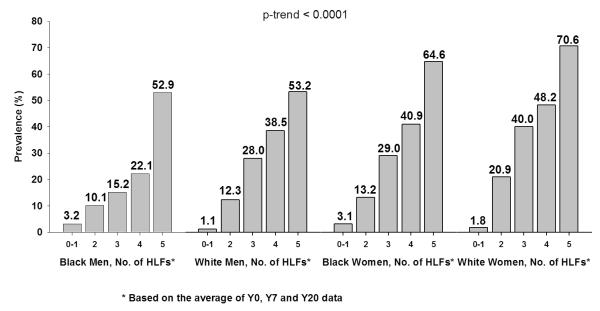
Methods and results: The Coronary Artery Risk Development in (Young) Adults (CARDIA) study sample consisted of 3154 black and white participants 18 to 30 years of age at year 0 (1985-1986) who attended the year 0, 7, and 20 examinations. Healthy lifestyle factors defined at years 0, 7, and 20 included average body mass index <25 kg/m(2), no or moderate alcohol intake, higher healthy diet score, higher physical activity score, and never smoking. Mean age (25 years) and percentage of women (56%) were comparable across groups defined by number of healthy lifestyle factors. The age-, sex-, and race-adjusted prevalences of low cardiovascular disease risk profile at year 20 were 3.0%, 14.6%, 29.5%, 39.2%, and 60.7% for people with 0 or 1, 2, 3, 4, and 5 healthy lifestyle factors, respectively (P for trend <0.0001). Similar graded relationships were observed for each sex-race group (all P for trend <0.0001).
Conclusions: Maintaining a healthy lifestyle throughout young adulthood is strongly associated with a low cardiovascular disease risk profile in middle age. Public health and individual efforts are needed to improve the adoption and maintenance of healthy lifestyles in young adults.
Figures
Comment in
-
Empirical support for cardiovascular health: the case gets even stronger.Circulation. 2012 Feb 28;125(8):973-4. doi: 10.1161/CIRCULATIONAHA.111.088542. Epub 2012 Jan 30. Circulation. 2012. PMID: 22291125 No abstract available.
References
-
- Stamler J, Stamler R, Neaton JD, Wentworth D, Daviglus ML, Garside D, Dyer AR, Liu K, Greenland P. Low risk-factor profile and long-term cardiovascular and noncardiovascular mortality and life expectancy: findings for 5 large cohorts of young adult and middle-aged men and women. JAMA. 1999;282:2012–2018. - PubMed
-
- Daviglus ML, Liu K, Pirzada A, Yan LL, Garside DB, Feinglass J, Guralnik JM, Greenland P, Stamler J. Favorable cardiovascular risk profile in middle age and health-related quality of life in older age. Arch Intern Med. 2003;163:2460–2468. - PubMed
-
- Daviglus ML, Liu K, Greenland P, Dyer AR, Garside DB, Manheim L, Lowe LP, Rodin M, Lubitz J, Stamler J. Benefit of a favorable cardiovascular risk-factor profile in middle age with respect to Medicare costs. N Engl J Med. 1998;339:1122–1129. - PubMed
Publication types
MeSH terms
Grants and funding
LinkOut - more resources
Full Text Sources
Medical
