. 2012 Apr;63(7):2809-23.
doi: 10.1093/jxb/err466. Epub 2012 Jan 30.

Genome-wide identification and characterization of novel genes involved in terpenoid biosynthesis in Salvia miltiorrhiza

Affiliations

Genome-wide identification and characterization of novel genes involved in terpenoid biosynthesis in Salvia miltiorrhiza

Yimian Ma et al. J Exp Bot. 2012 Apr.

Abstract

Terpenoids are the largest class of plant secondary metabolites and have attracted widespread interest. Salvia miltiorrhiza, belonging to the largest and most widely distributed genus in the mint family, is a model medicinal plant with great economic and medicinal value. Diterpenoid tanshinones are the major lipophilic bioactive components in S. miltiorrhiza. Systematic analysis of genes involved in terpenoid biosynthesis has not been reported to date. Searching the recently available working draft of the S. miltiorrhiza genome, 40 terpenoid biosynthesis-related genes were identified, of which 27 are novel. These genes are members of 19 families, which encode all of the enzymes involved in the biosynthesis of the universal isoprene precursor isopentenyl diphosphate and its isomer dimethylallyl diphosphate, and two enzymes associated with the biosynthesis of labdane-related diterpenoids. Through a systematic analysis, it was found that 20 of the 40 genes could be involved in tanshinone biosynthesis. Using a comprehensive approach, the intron/exon structures and expression patterns of all identified genes and their responses to methyl jasmonate treatment were analysed. The conserved domains and phylogenetic relationships among the deduced S. miltiorrhiza proteins and their homologues isolated from other plant species were revealed. It was discovered that some of the key enzymes, such as 1-deoxy-D-xylulose 5-phosphate synthase, 4-hydroxy-3-methylbut-2-enyl diphosphate reductase, hydroxymethylglutaryl-CoA reductase, and geranylgeranyl diphosphate synthase, are encoded by multiple gene members with different expression patterns and subcellular localizations, and both homomeric and heteromeric geranyl diphosphate synthases exist in S. miltiorrhiza. The results suggest the complexity of terpenoid biosynthesis and the existence of metabolic channels for diverse terpenoids in S. miltiorrhiza and provide useful information for improving tanshinone production through genetic engineering.


Figures
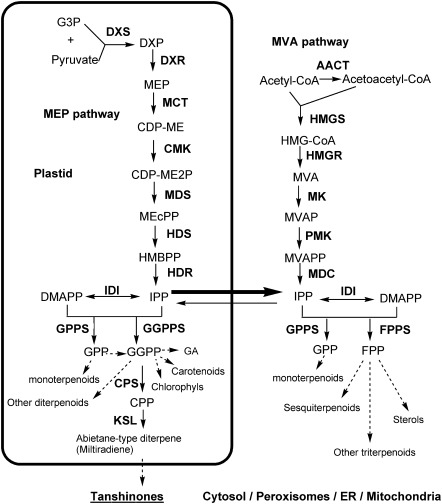
Fig. 1.
Fig. 1.
Proposed pathways of terpenoid biosynthesis in S. miltiorrhiza.
Fig. 2.
Fig. 2.
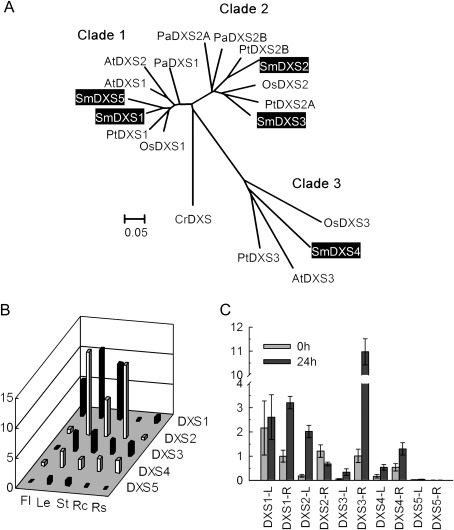
Expression patterns of SmDXS genes and the phylogenetic relationship of their deduced proteins with various other plant species. (A) Phylogenetic relationship of plant DXSs. The rooted Neighbor–Joining tree was constructed using the MEGA program (version 4.0) with default parameters. CrDXS (Chlamydomonas reinhardtii, CAA07554) was used as an outgroup. Transit peptides of DXSs were trimmed for the analysis of sequence data. DXSs included are Arabidopsis thaliana AtDXS1 (At4g15560), AtDXS2 (At3g21500), AtDXS3 (At5g11380), Oryza sativa OsDXS1 (NP_001055524), OsDXS2 (NP_001059086), OsDXS3 (BAA83576), Populus trichocarpa PtDXS1 (XP_002312717), PtDXS2A (XP_002303416), PtDXS2B (XP_002331678), PtDXS3 (XP_002308644), Picea abies PaDXS1 (ABS50518), PaDXS2A (ABS50519), PaDXS2B (ABS50520), and five S. miltiorrhiza SmDXSs (highlighted). (B) Fold changes of SmDXS genes in flowers (Fl), leaves (Le), stems (St), root cortices (Rc), and root steles (Rs) of S. miltiorrhiza plants grown in soil. The expression level of SmDXS1 in root steles was arbitrarily set to 1. (C) Fold changes of SmDXS genes in leaves (L) and roots (R) of S. miltiorrhiza plantlets treated with MeJA for 0 h and 24 h. The level of SmDXS1 in roots of plantlets without treatment was arbitrarily set to 1.
Fig. 3.
Fig. 3.
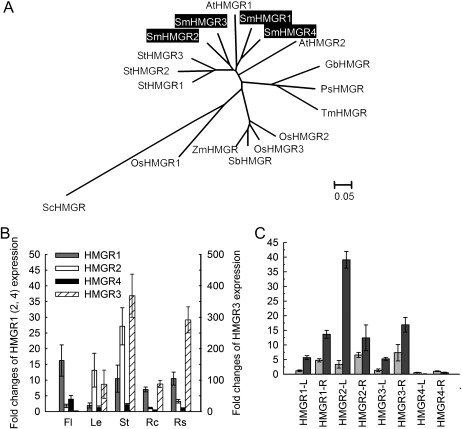
Expression patterns of SmHMGR genes and the phylogenetic relationship of their deduced proteins with various other plant species. (A) Phylogenetic relationship of HMGRs in various plant species. The rooted Neighbor–Joining tree was constructed using the MEGA program (version 4.0) with default parameters. ScHMGR (Saccharomyces cerevisiae, AAA34676) was used as an outgroup. HMGRs included are Arabidopsis AtHMGR1 (CAA33139), AtHMGR2 (AAA67317), Solanum tuberosum StHMGR1 (AAA93498), StHMGR2 (AAB52551), StHMGR3 (AAB52552), rice OsHMGR1 (AAA21720), OsHMGR2 (AAD08820), OsHMGR3 (AF110382), Zea mays ZmHMGR (O24594), Sorghum bicolor SbHMGR (XP_002445887), Ginkgo biloba GbHMGR (AAU89123), Picea sitchensis PsHMGR (ACN40476), Taxus×media TmHMGR (AAQ82685), and four S. miltiorrhiza SmHMGRs (highlighted). (B) Fold changes of SmHMGR genes in flowers (Fl), leaves (Le), stems (St), root cortices (Rc), and root steles (Rs) of S. miltiorrhiza plants grown in soil. The expression level of SmHMGR4 in root steles was arbitrarily set to 1. (C) Fold changes of SmHMGRs in leaves (L) and roots (R) of S. miltiorrhiza plantlets treated with MeJA for 0 h and 24 h. The level of SmHMGR4 in roots of plantlets without treatment was arbitrarily set to 1.
Fig. 4.
Fig. 4.
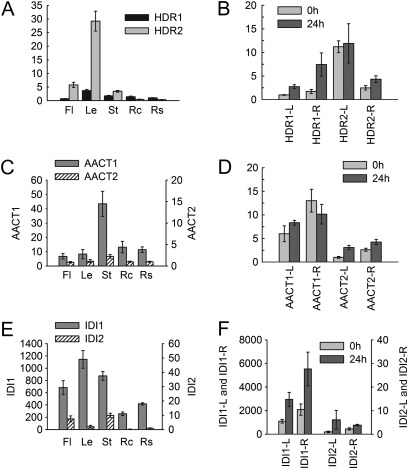
Expression patterns of SmHDR, SmAACT, and SmIDI genes. (A, C, and E) Fold changes of SmHDR genes (A), SmAACT genes (C), and SmIDI genes (E) in flowers (Fl), leaves (Le), stems (St), root cortices (Rc), and root steles (Rs) of S. miltiorrhiza plants grown in soil. The expression level of SmHDR1 (A), SmAACT2 (B), and SmIDI2 (C) in root steles was arbitrarily set to 1. (B, D, and F) Fold changes of SmHDR genes (B), SmAACT genes (D), and SmIDI genes (F) in leaves (L) and roots (R) of S. miltiorrhiza plantlets treated with MeJA for 0 h and 24 h. The level of SmHDR1 (B), SmAACT2 (D), and SmIDI2 (F) in leaves of plantlets without treatment was arbitrarily set to 1.
Fig. 5.
Fig. 5.
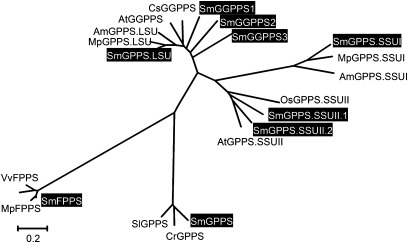
Phylogenetic analysis of homomeric and heteromeric GPPSs, GGPPSs, and FPPSs in S. miltiorrhiza and various other plant species. The unrooted Neighbor–Joining tree was constructed using the MEGA program (version 4.0) with default parameters. Proteins included are Mentha×piperita MpGPPS.LSU (AF182828), Antirrhinum majus AmGPPS.LSU (AAS82860), Croton sublyratus CsGGPPS (BAA86284), Arabidopsis AtGGPPS (AAM65107); MpGPPS.SSUI (AF182827), AmGPPS.SSUI (AAS82859), rice OsGPPS.SSUII (EAY87007), AtGPPS.SSUII (At4g38460), Solanum lycopersicum SlGPPS (ABB88703), Catharanthus roseus CrGPPS (ACC77966), Hevea brasiliensis HbFPPS (AAM98379), Vitis vinifera VvFPPS (AAX76910), MpFPPS (AF384040), and nine S. miltiorrhiza SmIDSs (highlighted).
Fig. 6.
Fig. 6.
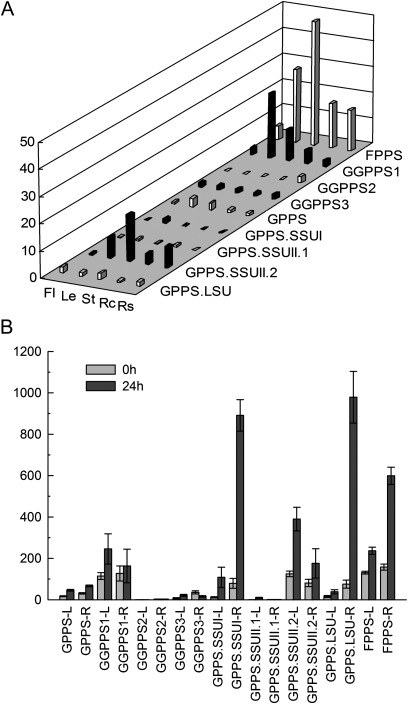
Expression patterns of SmIDS genes. (A) Tissue-specific expression patterns of SmIDS genes. Fold changes of SmIDS genes in flowers (Fl), leaves (Le), stems (St), root cortices (Rc), and root steles (Rs) of S. miltiorrhiza plants grown in soil. The relative abundance of genes is determined using a comparative Ct method, and the expression level of SmGPPS in root steles was arbitrarily set to 1. (B) The expression of SmIDS genes with or without MeJA treatment. Fold changes of SmIDI genes in leaves (L) and roots (R) of S. miltiorrhiza plantlets treated with MeJA for 0 h and 24 h. The level of SmGPPS.SSUII.1 in roots of plantlets without treatment was arbitrarily set to 1.
Fig. 7.
Fig. 7.
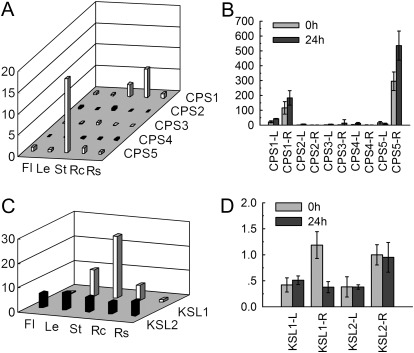
Expression patterns of SmCPS and SmKSL genes. (A and C) Fold changes of SmCPS genes (A) and SmKSL genes (C) in flowers (Fl), leaves (Le), stems (St), root cortices (Rc), and root steles (Rs) of S. miltiorrhiza plants grown in soil. The expression level of SmCPS1 (A) and SmKSL1 (C) in root steles was arbitrarily set to 1. (B and D) Fold changes of SmCPS genes (B) and SmKSL genes (D) in leaves (L) and roots (R) of S. miltiorrhiza plantlets treated with MeJA for 0 h and 24 h. The level of SmCPS2 (B) and SmKSL2 (D) in roots of plantlets without treatment was arbitrarily set to 1.

References

    1. Altschul SF, Madden TL, Schaffer AA, Zhang J, Zhang Z, Miller W, Lipman DJ. Gapped BLAST and PSI-BLAST: a new generation of protein database search programs. Nucleic Acids Research. 1997;25:3389–3402. - PMC - PubMed
    1. Bjellqvist B, Basse B, Olsen E, Celis JE. Reference points for comparisons of two-dimensional maps of proteins from different human cell types defined in a pH scale where isoelectric points correlate with polypeptide compositions. Electrophoresis. 1994;15:529–539. - PubMed
    1. Bohlmann J, Keeling CI. Terpenoid biomaterials. The Plant Journal. 2008;54:656–669. - PubMed
    1. Botella-Pavia P, Besumbes O, Phillips MA, Carretero-Paulet L, Boronat A, Rodriguez-Concepcion M. Regulation of carotenoid biosynthesis in plants: evidence for a key role of hydroxymethylbutenyl diphosphate reductase in controlling the supply of plastidial isoprenoid precursors. The Plant Journal. 2004;40:188–199. - PubMed
    1. Bouvier F, Suire C, d’Harlingue A, Backhaus RA, Camara B. Molecular cloning of geranyl diphosphate synthase and compartmentation of monoterpene synthesis in plant cells. The Plant Journal. 2000;24:241–252. - PubMed

Publication types