. 2012 Apr;158(4):2028-41.
doi: 10.1104/pp.111.191262. Epub 2012 Jan 30.

Loss of function of FATTY ACID DESATURASE7 in tomato enhances basal aphid resistance in a salicylate-dependent manner

Affiliations

Loss of function of FATTY ACID DESATURASE7 in tomato enhances basal aphid resistance in a salicylate-dependent manner

Carlos A Avila et al. Plant Physiol. 2012 Apr.

Abstract

We report here that disruption of function of the ω-3 FATTY ACID DESATURASE7 (FAD7) enhances plant defenses against aphids. The suppressor of prosystemin-mediated responses2 (spr2) mutation in tomato (Solanum lycopersicum), which eliminates the function of FAD7, reduces the settling behavior, survival, and fecundity of the potato aphid (Macrosiphum euphorbiae). Likewise, the antisense suppression of LeFAD7 expression in wild-type tomato plants reduces aphid infestations. Aphid resistance in the spr2 mutant is associated with enhanced levels of salicylic acid (SA) and mRNA encoding the pathogenesis-related protein P4. Introduction of the Naphthalene/salicylate hydroxylase transgene, which suppresses SA accumulation, restores wild-type levels of aphid susceptibility to spr2. Resistance in spr2 is also lost when we utilize virus-induced gene silencing to suppress the expression of NONEXPRESSOR OF PATHOGENESIS-RELATED PROTEINS1 (NPR1), a positive regulator of many SA-dependent defenses. These results indicate that FAD7 suppresses defenses against aphids that are mediated through SA and NPR1. Although loss of function of FAD7 also inhibits the synthesis of jasmonate (JA), the effects of this desaturase on aphid resistance are not dependent on JA; other mutants impaired in JA synthesis (acx1) or perception (jai1-1) show wild-type levels of aphid susceptibility, and spr2 retains aphid resistance when treated with methyl jasmonate. Thus, FAD7 may influence JA-dependent defenses against chewing insects and SA-dependent defenses against aphids through independent effects on JA synthesis and SA signaling. The Arabidopsis (Arabidopsis thaliana) mutants Atfad7-2 and Atfad7-1fad8 also show enhanced resistance to the green peach aphid (Myzus persicae) compared with wild-type controls, indicating that FAD7 influences plant-aphid interactions in at least two plant families.


Figures
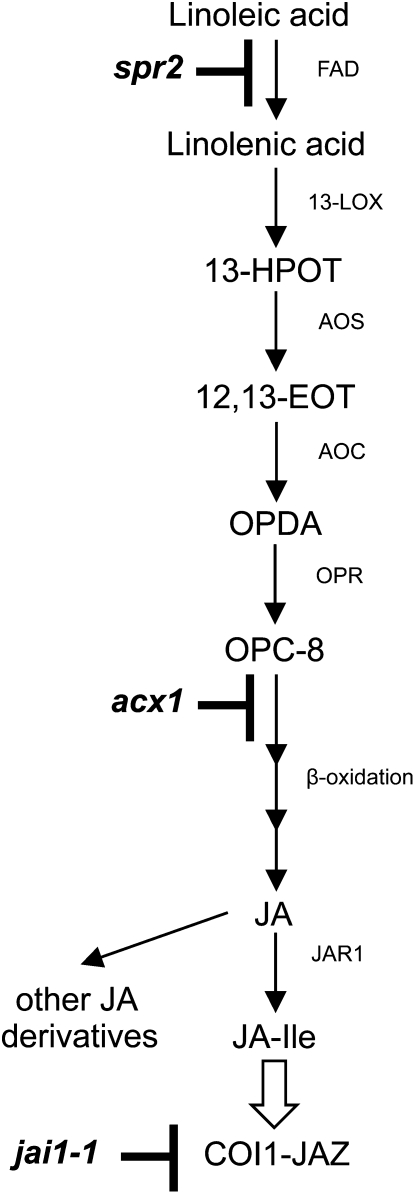
Figure 1.
Figure 1.
JA synthesis and perception in plants. Mutations in tomato that block JA synthesis or perception are represented in boldface. Abbreviations are as follows: AOC, allene oxide cyclase; AOS, allene oxide synthase; COI1, coronatine insensitive 1; EOT, epoxy-9,11,15-octadecatrienoic acid; JA-Ile, jasmonic acid-isoleucine conjugate; JAR1, jasmonic acid resistant 1; JAZ, jasmonate ZIM domain protein; HPOT, hydroperoxy-octadecatrienoic acid; LOX, lipoxygenase; OPC, 3-oxo-2(2′(Z)-pentenyl)-cyclopentane-1-octanoic acid; OPDA, 2-oxo-phytodienoic acid; OPR, 12-oxo-phytodienoic acid reductase. Black arrows represent biosynthetic steps, whereas the white arrow represents recognition of JA-Ile by the COI1/JAZ coreceptor (Sheard et al., 2010). This figure was modified from Schaller (2001).
Figure 2.
Figure 2.
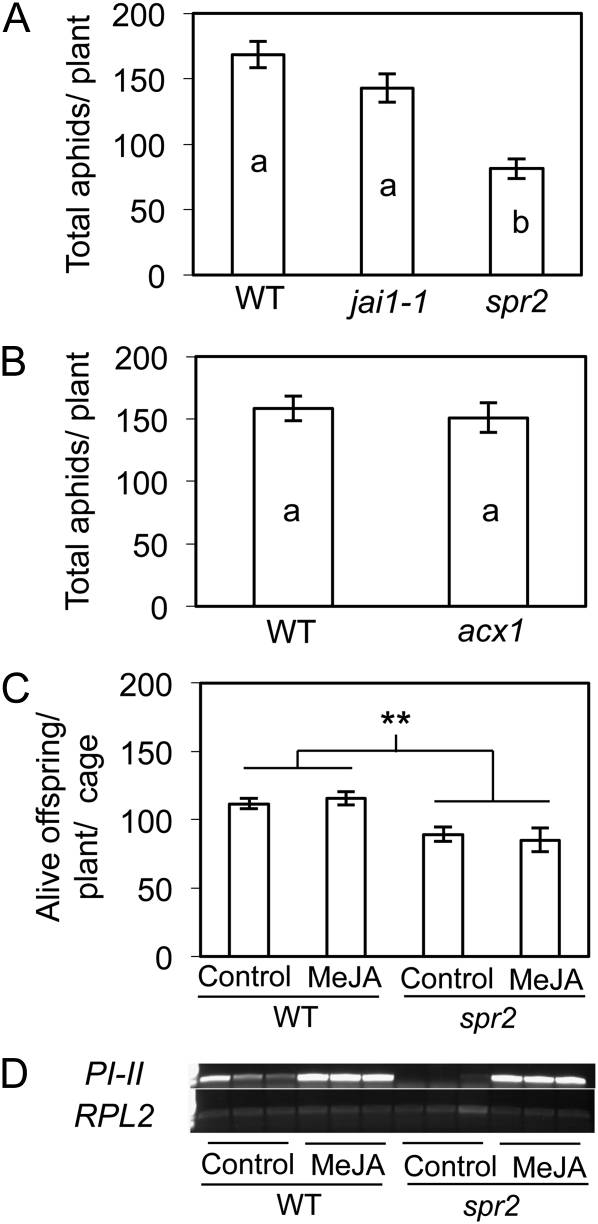
Aphid infestations are reduced on spr2 but are unaffected by MeJA treatment or by other mutations that impair JA signaling. A and B, Wild-type (WT; cv Castlemart) and mutant (spr2, jai1-1, and acx1) tomato plants were inoculated with 15 aphids per plant, which were not confined to cages and were free to leave the plants. The total number of remaining aphids and their progeny per plant were counted 5 d after inoculation and analyzed by one-way ANOVA. Mean separations were performed using Student’s t test. Values ± se labeled with different letters differ significantly at α = 0.05. C, Wild-type and spr2 plants were treated with MeJA (75 μm) and inoculated with aphids 24 h after treatment (five aphids per cage; three clip cages per plant; 10 plants per treatment group). Live offspring were counted 6 d after inoculation, and the average numbers of offspring per cage per plant were analyzed by two-way ANOVA. ** Significant main effect of genotype at P < 0.0001. D, Expression of JA-responsive PI-II was monitored by RT-PCR 24 h after MeJA treatment. Expression of constitutive RPL2 is presented as a loading control. n = 10 for A, n = 8 for B, and n = 10 for C.
Figure 3.
Figure 3.
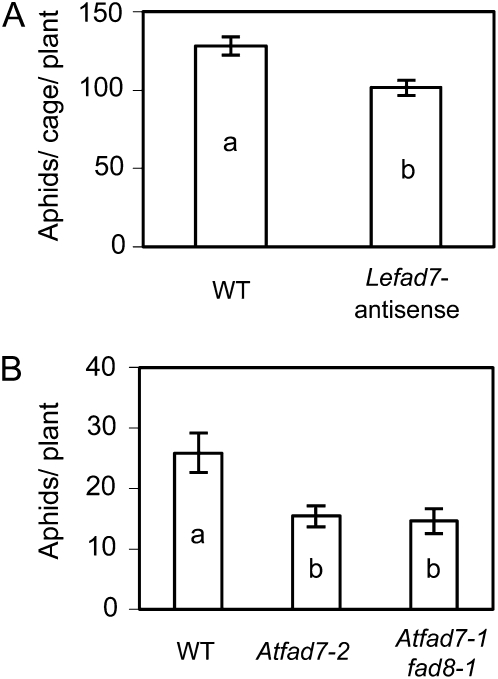
Loss of function of FAD7 confers aphid resistance in both tomato and Arabidopsis. A, Adult potato aphids were confined to individual leaflets of intact tomato plants using clip cages (five aphids per cage; three cages per plant; 12 plants per genotype), and the total number of aphids was recorded after 6 d. Cultivar L402 was used as the untransformed wild-type (WT) control. B, Adult green peach aphids were confined on individual Arabidopsis plants using sleeve cages (two aphids per plant; 18 plants per genotype), and the total number of aphids per plant was recorded after 7 d. Aphid numbers were analyzed by one-way ANOVA, and mean separations were performed using Student’s t test. Values ± se labeled with different letters differ significantly at α = 0.05.
Figure 4.
Figure 4.
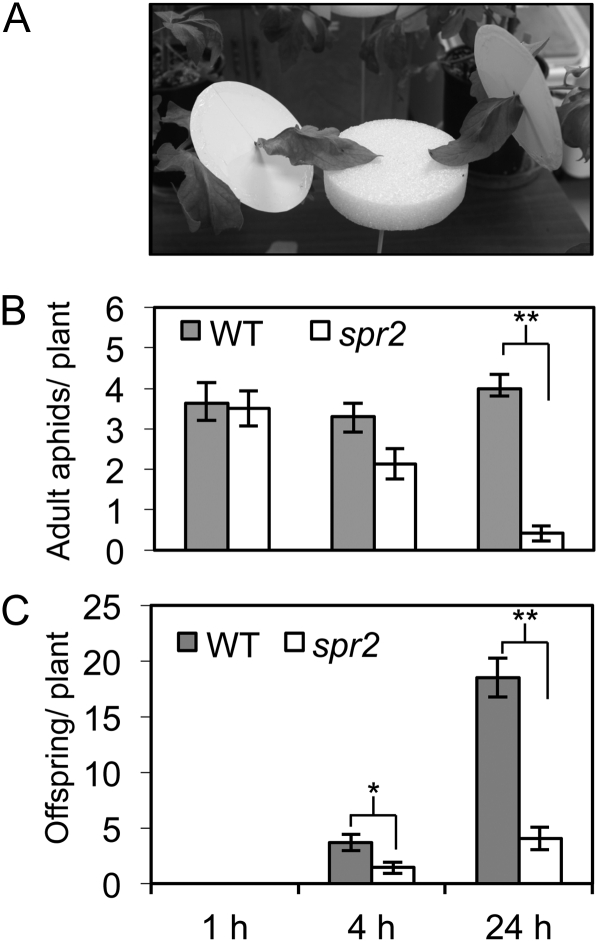
Loss of function of FAD7 reduces aphid host acceptance. A, Wingless adult aphids (10 adults per arena) were placed on choice arenas between paired 6-week-old plants of spr2 and the wild-type (WT) control (cv Castlemart). The majority of aphids moved off the choice arena onto the plants within minutes of release. Aphids were free to move back and forth between the two plants. B and C, The number of adults on each plant (B) and the offspring they produced (C) were counted at 1, 4, and 24 h after aphids were placed on the arenas. Marked pairwise comparisons denote significant differences according to paired t tests at α = 0.05 (*) or α = 0.001 (**). Error bars indicate ± se (n = 10 pairs).
Figure 5.
Figure 5.
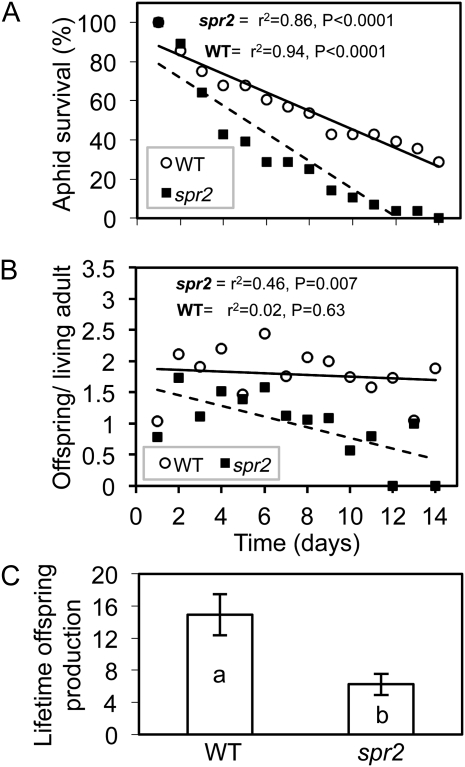
Loss of function of FAD7 decreases aphid survival and fecundity. Newly emerged adult female aphids were caged on spr2 or wild-type (WT; cv Castlemart) plants (one aphid per cage; two cages per plant; 14 plants per genotype), and the cages were monitored daily to track the survival (A) and daily offspring production (B) of each aphid as well as their lifetime totals for offspring production (C). Regression analyses were performed to estimate aphid mortality rates and changes over time in daily fecundity. Lifetime offspring production was analyzed by one-way ANOVA, and values ± se having different letters are significantly different at α = 0.05.
Figure 6.
Figure 6.
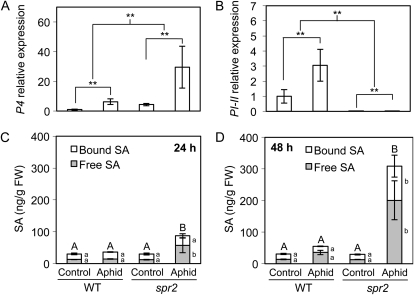
Loss of function of FAD7 enhances the expression of the SA-responsive gene P4 and local SA accumulation in response to aphid feeding but suppresses the expression of the JA-responsive gene PI-II. A and B, Wild-type (WT; cv Castlemart) and spr2 tomato plants were challenged with the potato aphid (100 aphids confined to a single leaf with a sleeve cage) or mock inoculated with empty cages, and P4 and PI-II transcript abundance was analyzed 48 h after inoculation. Expression values were calculated by RT-qPCR relative to the wild-type mock-inoculated control, normalized using the RPL2 gene, and analyzed by two-way ANOVA. Error bars represent ± se (n = 4). ** P < 0.001. C and D, Wild-type (cv Castlemart) and spr2 tomato plants were challenged with potato aphids or mock inoculated with empty cages (60 aphids confined to the three terminal leaflets with a sleeve cage; five plants per genotype per time point). At 24 and 48 h after inoculation, total, free, and bound SA were quantified by HPLC in infested or mock-inoculated leaflets. Values were analyzed by ANOVA, and mean separations were performed using Student’s t test. Bars of the same pattern ± se with different lowercase letters are significantly different at α = 0.05; bars with different uppercase letters show significant differences in total SA content (free + bound). FW, Fresh weight.
Figure 7.
Figure 7.
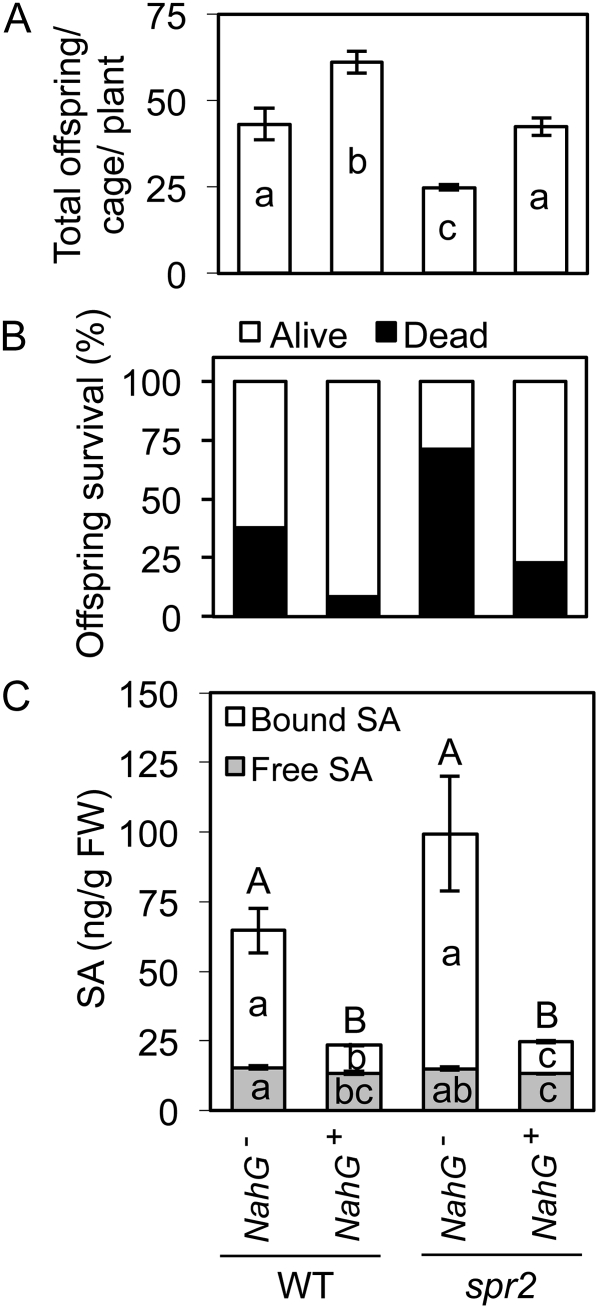
Aphid resistance conferred by loss of function of FAD7 is compromised by the NahG transgene. The spr2 and NahG tomato lines were crossed, the F1 progeny were self-pollinated, and the F2 generation was screened by PCR for the presence or absence of the NahG transgene, the wild-type (WT) LeFAD7 allele, and the spr2 mutation in LeFAD7. Four phenotypic bulks were selected: (1) WT/NahG = plants carrying at least one copy of the wild-type LeFAD7 allele and lacking the NahG transgene; (2) WT/NahG+ = plants carrying the wild-type LeFAD7 allele and NahG; (3) spr2/NahG = plants homozygous for the spr2 mutation in LeFAD7 but lacking NahG; and (4) spr2/NahG+ = double mutant plants homozygous for the spr2 mutation and carrying NahG. All four bulks were inoculated with potato aphids (five aphids per cage; three cages per plant; 14–17 plants per bulk), and 6 d after inoculation, total offspring (dead and alive) were counted to measure adult fecundity (A) and offspring survival (B). One day after the aphids were counted, total, free, and bound SA content was measured in six randomly selected samples per bulk (C). The average number of total, dead, and living aphids per cage per plant was Box Cox transformed (Box and Cox, 1964) to stabilize variances, all values were analyzed by one-way ANOVA, and means were separated using Student’s t tests. Bars of the same pattern ± se with different letters differ significantly at α = 0.05. Uppercase letters above the bars in C denote significant differences in total (free + bound) SA content. FW, Fresh weight.
Figure 8.
Figure 8.
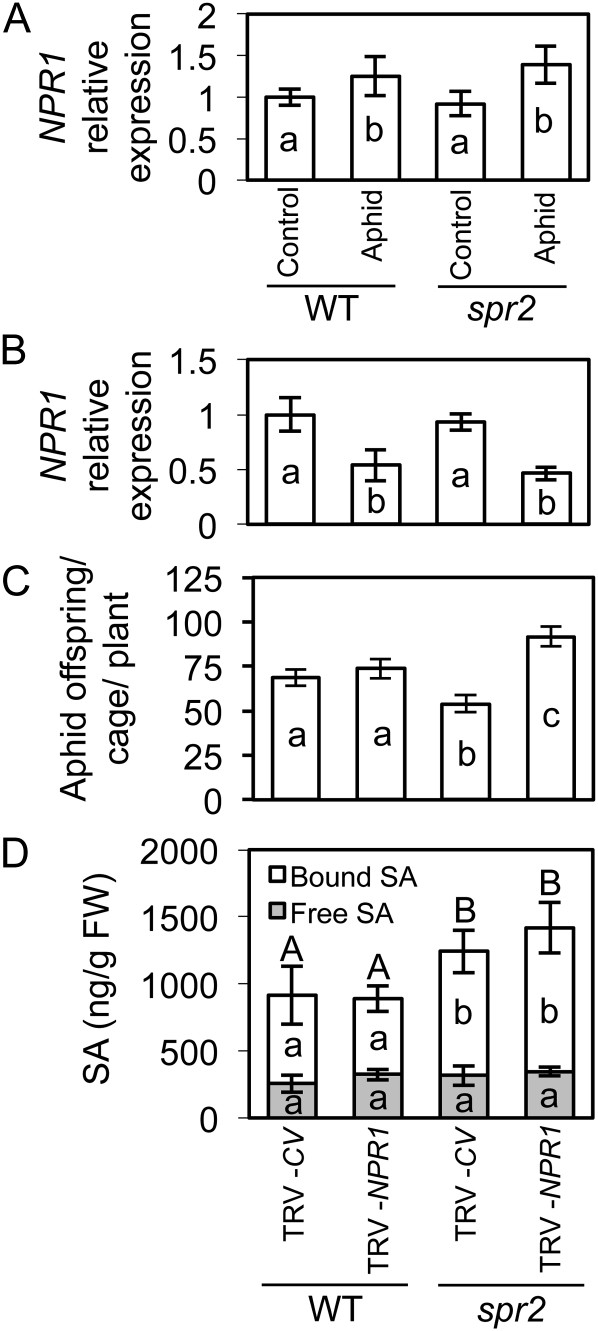
NPR1 is up-regulated by aphid feeding and contributes to aphid resistance in the spr2 mutant. A, Expression of the NPR1 gene was measured 48 h after inoculation in spr2 and wild-type (WT; cv Castlemart) plants infested with aphids by RT-qPCR using RPL2 as the reference gene. B to D, VIGS using TRV was performed to suppress the expression of NPR1 in tomato, and a construct of similar size that does not silence any endogenous genes in tomato was used as a control vector (TRV-CV). Silencing of NPR1 was corroborated by RT-qPCR using RPL2 as the reference gene (B). Plants were challenged with the potato aphid (four aphids per cage; four cages per plant; eight plants per treatment group), and the total number of live adults and offspring was recorded 6 d after inoculation (C). Local total, free, and bound SA was measured 1 d after aphid count (D). Values were analyzed by ANOVA, and mean separations were performed using Student’s t test. Values ± se with different letters are statistically different at α = 0.05. Uppercase letters above bars in C denote significant differences in total (free + bound) SA content. (n = 7, 8, 6, and 8 respectively). FW, Fresh weight.

References

    1. Aharoni A, Giri AP, Deuerlein S, Griepink F, de Kogel WJ, Verstappen FWA, Verhoeven HA, Jongsma MA, Schwab W, Bouwmeester HJ. (2003) Terpenoid metabolism in wild-type and transgenic Arabidopsis plants. Plant Cell 15: 2866–2884 - PMC - PubMed
    1. Berberich T, Harada M, Sugawara K, Kodama H, Iba K, Kusano T. (1998) Two maize genes encoding ω-3 fatty acid desaturase and their differential expression to temperature. Plant Mol Biol 36: 297–306 - PubMed
    1. Bhattarai KK, Xie Q-G, Pourshalimi D, Younglove T, Kaloshian I. (2007) Coil-dependent signaling pathway is not required for Mi-1-mediated potato aphid resistance. Mol Plant Microbe Interact 20: 276–282 - PubMed
    1. Blée E. (2002) Impact of phyto-oxylipins in plant defense. Trends Plant Sci 7: 315–322 - PubMed
    1. Bleeker PM, Diergaarde PJ, Ament K, Guerra J, Weidner M, Schütz S, de Both MTJ, Haring MA, Schuurink RC. (2009) The role of specific tomato volatiles in tomato-whitefly interaction. Plant Physiol 151: 925–935 - PMC - PubMed

Publication types

MeSH terms