


Effect of rosiglitazone and ramipril on macrovasculopathy in patients with type 2 diabetes: needs longer treatment and/or higher doses?
- PMID: 22291490
- PMCID: PMC3262381
- DOI: 10.2147/CPAA.S8863
Effect of rosiglitazone and ramipril on macrovasculopathy in patients with type 2 diabetes: needs longer treatment and/or higher doses?
Abstract
Introduction: The aim of the study is to investigate whether standard doses of rosiglitazone (4 mg/daily) and ramipril (5 mg/daily) can reverse pre-clinical macrovasculopathy in newly diagnosed never treated type 2 diabetes (T2DM) patients.
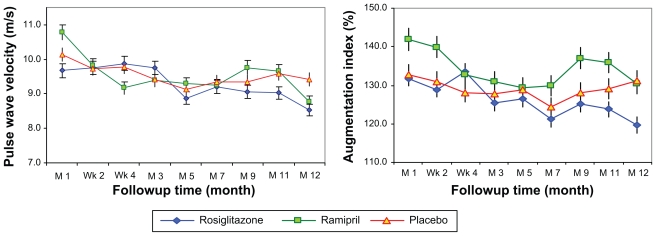
Methods: In this randomized, double-blind, placebo-controlled study, 33 T2DM patients were randomized to rosiglitazone (4 mg/daily) or ramipril (5 mg/daily) or placebo for 1 year. Hemodynamic variables were measured at 3 treatment phases and pulse wave velocity (PWV) and augmentation index (AI) were measured throughout the treatment period.
Result: In diabetic patients, PWV (P = 0.037) and AI (P = 0.005) with ramipril and AI (P < 0.001) with rosiglitazone were significantly reduced during overall treatment period from the baseline; however, these differences were not significant in comparison to placebo.
Discussion and conclusion: The present study showed that treatment with standard doses of rosiglitazone and ramipril are not adequate to reverse pre-clinical vasculopathy in T2DM. The lack of benefit in newly diagnosed T2DM may be because of the relatively short-term intervention and/or the use of lower doses of rosiglitazone/ramipril. Further trials are needed for a longer period of time, possibly with higher doses, to show whether rosiglitazone/ramipril can reverse pre-clinical vasculopathy in T2DM (ClinicalTrials.gov number, NCT00489229).
Keywords: diabetic vasculopathy; ramipril; rosiglitazone.
Figures
References
-
- Stamler J, Vaccaro O, Neaton JD, Wentworth D. Diabetes, other risk factors, and 12-yr cardiovascular mortality for men screened in the multiple risk factor intervention trial. Diabetes Care. 1993;16(2):434–444. - PubMed
-
- Rahman S, Rahman T, Ismail AA, Rahman ARA. Diabetes-associated macrovasculopathy: pathophysiology and pathogenesis. Diab Obes Metab. 2007;9(6):767–780. - PubMed
-
- Shargorodsky S, Wainstein G, Gavish E, Leibovitz Z, Matas D, Zimlichman R. Treatment with rosiglitazone reduces hyperinsulinemia and improves arterial elasticity in patients with type 2 diabetes mellitus. Am J Hyperten. 2003;16(8):617–622. - PubMed
-
- Pistrosch F, Passauer J, Fischer S, Fuecker K, Hanefeld M, Gross P. In Type 2 diabetes rosiglitazone therapy for insulin resistance ameliorates endothelial dysfunction independent of glucose control. Diabetes Care. 2004;27(2):484–490. - PubMed
-
- Langenfeld MR, Forst T, Hohberg C, et al. Pioglitazone decreases carotid intima-media thickness independently of glycemic control in patients with type 2 diabetes: Results from a controlled randomized study. Circulation. 2005;111(19):2525–2531. - PubMed
Associated data
LinkOut - more resources
Full Text Sources
Medical
