. 2012 Jan 24:3:3.
doi: 10.3389/fpsyg.2012.00003. eCollection 2012.

Face adaptation effects show strong and long-lasting transfer from lab to more ecological contexts

Affiliations

Face adaptation effects show strong and long-lasting transfer from lab to more ecological contexts

Claus-Christian Carbon et al. Front Psychol. .

Abstract

A review on recent experiments on figural face aftereffects reveals that adaptation effects in famous faces can last for hours up to days. Such adaptations seem to be highly reliable regarding test-retest designs as well as regarding the generalizability of adaptation across different adaptation routines and adaptations toward different kinds of facial properties. However, in the studies conducted so far, adaptation and the subsequent test phase were carried out in typical laboratory environments. Under these circumstances, it cannot be ruled out that the observed effects are, in fact, episodic learn-test compatibility effects. To test for ecological validity in adaptation effects we used an adaptation paradigm including environmental and social properties that differed between adaptation and test phase. With matched samples (n1 = n2 = 54) we found no main effects of experimental setting compatibility resulting from varying where the tests where conducted (environmental condition) nor any interaction with effects of stimulus compatibility resulting from varying stimulus similarity between adaptation and test phase using the same picture, different pictures of the same person, or different persons (transfer). This indicates that these adaptation effects are not artificial or merely lab-biased effects. Adaptation to face stimuli may document representational adaptations and tuning mechanisms that integrate new visual input in a very fast, reliable, and sustainable way.

Keywords: ecological testing; external validity; face adaptation; face representation; face veridicality aftereffect; familiar faces; figural aftereffects; plasticity.


Figures

Figure 1
Figure 1
Illustration of the stimulus continuum with the original face in the center (0), the adapting stimuli at the far ends (−5 and +5), and the test stimuli in between (−2 and +2).
Figure 2
Figure 2
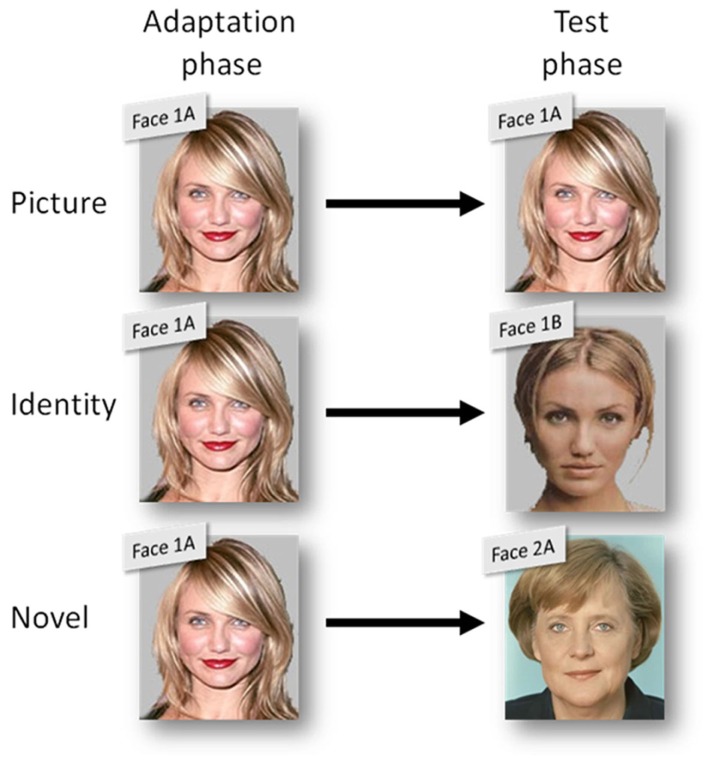
Illustration of the three stimulus compatibility conditions (between adaptation and test phase): picture with same pictures of the same person (e.g., face picture 1A and 1A), identity with different pictures of the same person (e.g., 1A and 1B), and novel with pictures of different persons (e.g., 1A and 2A).
Figure 3
Figure 3
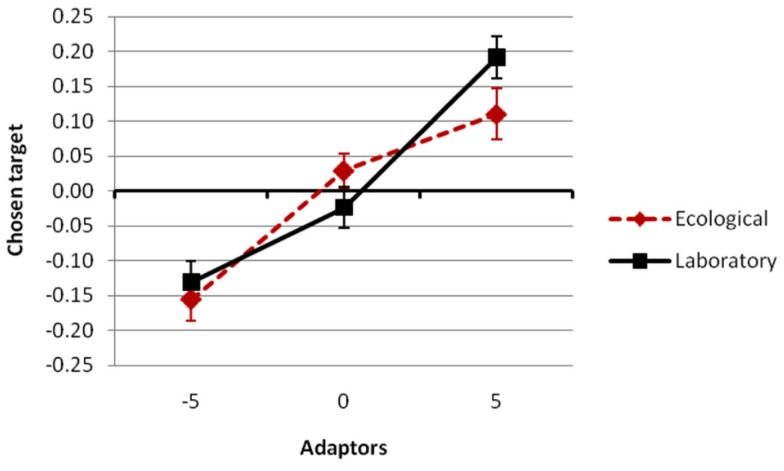
Overall adaptation effect for the two episodic compatibility conditions ecological (leisure condition in the test phase; red dotted line) and laboratory (laboratory condition in the test phase; black solid line). Three kinds of adaptors were used varied across groups: −5 (participants adapted to strongly compressed versions of the faces), 0 (participants adapted to the original faces), and 5 (participants adapted to strongly extended versions). The average distortion value of the selected faces during test served as the dependent variable (Chosen target; y-axis). See Section “Results” for details.
Figure 4
Figure 4
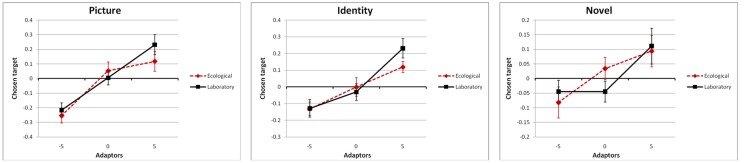
Adaptation effects for the stimulus compatibility conditions picture (same depiction of the same persons in the adaptation and test phase), identity (different depictions of the same persons), and novel (depictions of different persons), split by the episodic compatibility conditions ecological (red dotted line) and laboratory (black solid line).

References

    1. Barrett S. E., O’Toole A. J. (2009). Face adaptation to gender: does adaptation transfer across age categories? Vis. Cogn. 17, 700–715 10.1080/13506280802332197 - DOI
    1. Benton C. P., Jennings S. J., Chatting D. J. (2006). Viewpoint dependence in adaptation to facial identity. Vision Res. 46, 3313–3325 10.1016/j.visres.2006.06.002 - DOI - PubMed
    1. Carbon C. C. (2010). The cycle of preference: long-term dynamics of aesthetic appreciation. Acta Psychol. (Amst.) 134, 233–244 10.1016/j.actpsy.2010.02.004 - DOI - PubMed
    1. Carbon C. C. (2011). Cognitive mechanisms for explaining dynamics of aesthetic appreciation. i-Perception 2, 708–719 10.1068/i0463aap - DOI - PMC - PubMed
    1. Carbon C. C., Ditye T. (2011). Sustained effects of adaptation on the perception of familiar faces. J. Exp. Psychol. Hum. Percept. Perform. 37, 615–625 10.1037/a0019949 - DOI - PubMed