. 2012 Jan 20:3:4.
doi: 10.3389/fmicb.2012.00004. eCollection 2012.

Methanogenic pathway and archaeal communities in three different anoxic soils amended with rice straw and maize straw

Affiliations

Methanogenic pathway and archaeal communities in three different anoxic soils amended with rice straw and maize straw

Ralf Conrad et al. Front Microbiol. .

Abstract

Addition of straw is common practice in rice agriculture, but its effect on the path of microbial CH(4) production and the microbial community involved is not well known. Since straw from rice (C3 plant) and maize plants (C4 plant) exhibit different δ(13)C values, we compared the effect of these straw types using anoxic rice field soils from Italy and China, and also a soil from Thailand that had previously not been flooded. The temporal patterns of production of CH(4) and its major substrates H(2) and acetate, were slightly different between rice straw and maize straw. Addition of methyl fluoride, an inhibitor of acetoclastic methanogenesis, resulted in partial inhibition of acetate consumption and CH(4) production. The δ(13)C of the accumulated CH(4) and acetate reflected the different δ(13)C values of rice straw versus maize straw. However, the relative contribution of hydrogenotrophic methanogenesis to total CH(4) production exhibited a similar temporal change when scaled to CH(4) production irrespectively of whether rice straw or maize straw was applied. The composition of the methanogenic archaeal communities was characterized by terminal restriction fragment length polymorphism (T-RFLP) analysis and was quantified by quantitative PCR targeting archaeal 16S rRNA genes or methanogenic mcrA genes. The size of the methanogenic communities generally increased during incubation with straw, but the straw type had little effect. Instead, differences were found between the soils, with Methanosarcinaceae and Methanobacteriales dominating straw decomposition in Italian soil, Methanosarcinaceae, Methanocellales, and Methanobacteriale in China soil, and Methanosarcinaceae and Methanocellales in Thailand soil. The experiments showed that methanogenic degradation in different soils involved different methanogenic population dynamics. However, the path of CH(4) production was hardly different between degradation of rice straw versus maize straw and was also similar for the different soil types.

Keywords: archaea; methanogenesis; pathway; rice field soil; straw.


Figures
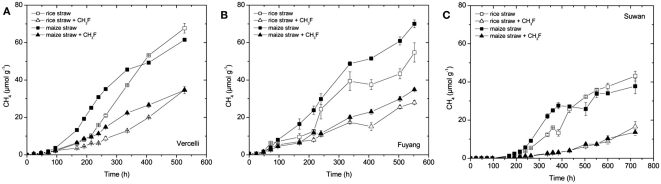
Figure 1
Figure 1
Accumulation of CH4 in soil from (A) Vercelli, (B) Fuyang, and (C) Suwan, amended with either rice straw or maize straw and incubated under anoxic conditions in the absence or presence of CH3F (1, 2, and 2% in Vercelli, Fuyang, and Suwan soil, respectively); mean ± SE, n = 3.
Figure 2
Figure 2
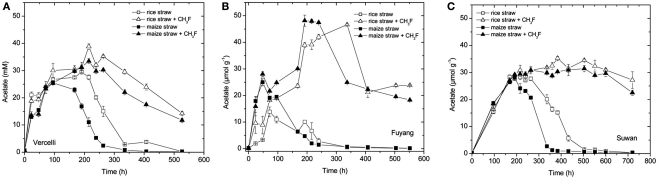
Transient accumulation of acetate in soil from (A) Vercelli, (B) Fuyang, and (C) Suwan, amended with either rice straw or maize straw and incubated under anoxic conditions in the absence or presence of CH3F (1, 2, and 2% in Vercelli, Fuyang, and Suwan soil, respectively); mean ± SE, n = 3.
Figure 3
Figure 3
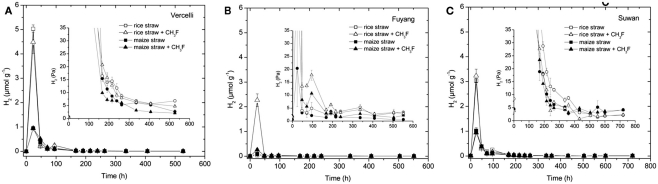
Transient accumulation of H2 in soil from (A) Vercelli, (B) Fuyang, and (C) Suwan, amended with either rice straw or maize straw and incubated under anoxic conditions in the absence or presence of CH3F (1, 2, and 2% in Vercelli, Fuyang, and Suwan soil, respectively); mean ± SE, n = 3. The insert shows the H2 accumulated in units of partial pressure (Pa).
Figure 4
Figure 4
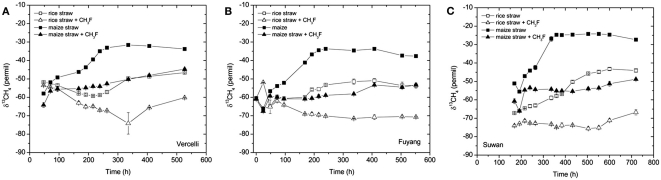
Values of δ13C of the CH4 accumulated in soil from (A) Vercelli, (B) Fuyang, and (C) Suwan, amended with either rice straw or maize straw and incubated under anoxic conditions in the absence or presence of CH3F (1, 2, and 2% in Vercelli, Fuyang, and Suwan soil, respectively); mean ± SE, n = 3.
Figure 5
Figure 5
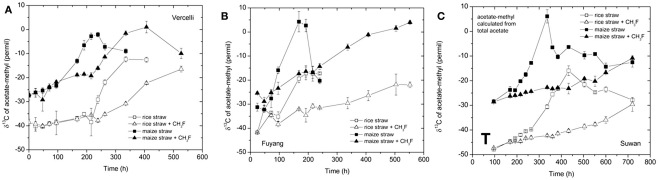
Values of δ13C of the methyl group of acetate accumulated in soil from (A) Vercelli, (B) Fuyang, and (C) Suwan, amended with either rice straw or maize straw and incubated under anoxic conditions in the absence or presence of CH3F (1, 2, and 2% in Vercelli, Fuyang, and Suwan soil, respectively); mean ± SE, n = 3. The data in Vercelli and Fuyang soil were directly measured; those in Suwan soil were calculated from measured δ13C of total acetate using δ13Cac-methyl = δ13Cac − 10‰.
Figure 6
Figure 6
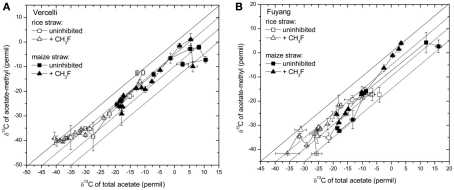
Relation between the δ13C of acetate-methyl and the δ13C of total acetate measured in soil from (A) Vercelli, and (B) Fuyang, amended with either rice straw or maize straw and incubated under anoxic conditions in the absence or presence of CH3F (1 and 2% in Vercelli and Fuyang soil, respectively); mean ± SE, n = 3.
Figure 7
Figure 7
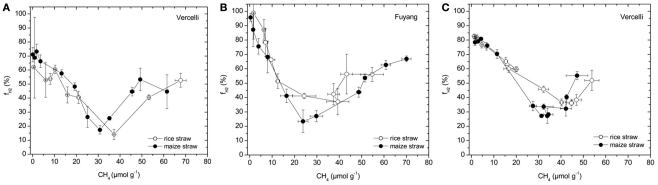
Percentage of CH4 produced from H2/CO2 (fH2) in soil from (A) Vercelli, (B) Fuyang, and (C) Suwan, amended with either rice straw or maize straw, as calculated using Equation 4, and the data shown in Figures 4 and 5.
Figure 8
Figure 8
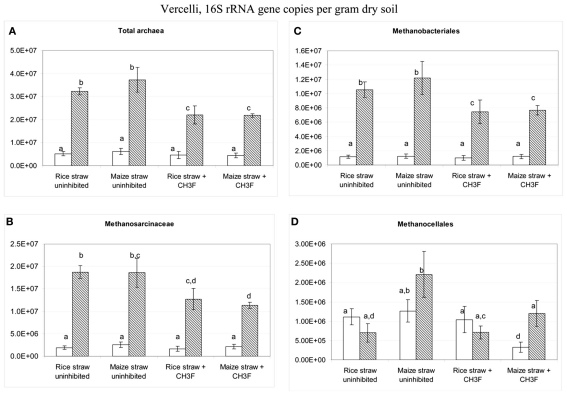
Copy numbers in Vercelli soil of (A) total archaeal 16S rRNA genes, and of those archaeal 16S rRNA genes belonging to (B) Methanosarcinceae, (C) Methanobacteriales, and (D) Methanocellales at the beginning (left column) and the end (right column) of incubation of Vercelli soil with either rice straw or maize straw in the presence and absence of CH3F; mean ± SE, n = 3. Different letters indicate significant (p < 0.05) differences between columns. Beginning and end of incubation are as in Figure 1.
Figure 9
Figure 9
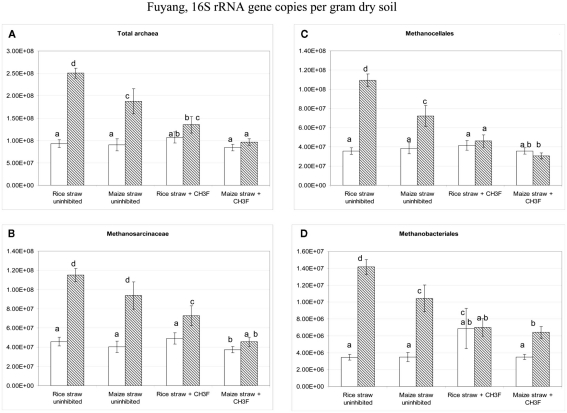
Copy numbers in Fuyang soil of (A) total archaeal 16S rRNA genes, and of those archaeal 16S rRNA genes belonging to (B) Methanosarcinceae, (C) Methanocellales, and (D) Methanobacteriales at the beginning (left column) and the end (right column) of incubation of Fuyang soil with either rice straw or maize straw in the presence and absence of CH3F; mean ± SE, n = 3. Different letters indicate significant (p < 0.05) differences between columns. Beginning and end of incubation are as in Figure 1.
Figure 10
Figure 10
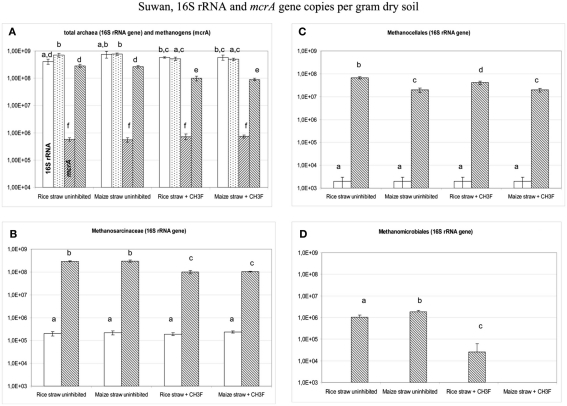
Copy numbers in Suwan soil of (A) total archaeal 16S rRNA genes (the two left columns in each group) and total mcrA genes (the two right columns in each group), and of 16S rRNA genes belonging to (B) Methanosarcinceae, (C) Methanocellales, and (D) Methanomicrobiales at the beginning (left column) and the end (right column) of incubation of Suwan soil with either rice straw or maize straw in the presence and absence of CH3F; mean ± SE, n = 3. Different letters indicate significant (p < 0.05) differences between columns. Beginning and end of incubation are as in Figure 1.

References

    1. Amelung W., Brodowski S., Sandhage-Hofmann A., Bol R. (2008). Combining biomarker with stable isotope analyses for assessing the transformation and turnover of soil organic matter. Adv. Agron. 100, 155–250 10.1016/S0065-2113(08)00606-8 - DOI
    1. Angel R., Claus P., Conrad R. (2012). Methanogenic archaea are globally ubiquitous in aerated soils and become active under wet anoxic conditions. ISME J. (in press). 10.1038/ismej.2011.141 - DOI - PMC - PubMed
    1. Angel R., Matthies D., Conrad R. (2011). Activation of methanogenesis in arid biological soil crusts despite the presence of oxygen. PLoS ONE 6, e20453. 10.1371/journal.pone.0020453 - DOI - PMC - PubMed
    1. Balesdent J., Balabane M. (1992). Maize root-derived soil organic carbon estimated by natural C-13 abundance. Soil Biol. Biochem. 24, 97–101 10.1016/0038-0717(92)90264-X - DOI
    1. Bilek R. S., Tyler S. C., Sass R. L., Fisher F. M. (1999). Differences in CH4 oxidation and pathways of production between rice cultivars deduced from measurements of CH4 flux and δ13C of CH4 and CO2. Global Biogeochem. Cycles 13, 1029–1044 10.1029/1999GB900040 - DOI