


Baseline tissue Doppler imaging-derived echocardiographic parameters and left ventricle reverse remodelling following cardiac resynchronization therapy introduction
- PMID: 22291826
- PMCID: PMC3258807
- DOI: 10.5114/aoms.2011.25556
Baseline tissue Doppler imaging-derived echocardiographic parameters and left ventricle reverse remodelling following cardiac resynchronization therapy introduction
Abstract
Introduction: The aim of the study was to assess the relation of baseline mechanical dyssynchrony with the left ventricular end-systolic volume (LVESV) decrease following cardiac resynchronization (CRT) therapy introduction.
Material and methods: Sixty consecutive patients (aged 66.3 ± 8.7 years; 57 men) with chronic heart failure (71.7% of ischaemic and 28.3% of non-ischaemic origin) and current indications for CRT were assessed before and 3 months after biventricular heart stimulator implantation. Longitudinal movements of twelve segments of the left ventricle (LV) (6 basal and 6 midlevel) and two segments of the right ventricle (RV) were analysed using tissue Doppler imaging (TDI) techniques with time from onset of Q wave in ECG to peak systolic velocity in colour-coded TDI (T(TDI)), time to peak strain (T(strain)) and time to peak strain rate (T(strain) (rate)). Minimal and maximal time differences within LV and between LV and RV walls were calculated.
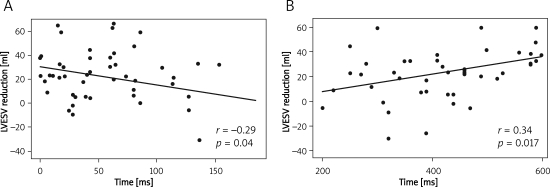
Results: In the study group LVEF and 6-min walk test distance increased, while NYHA class, NT-proBNP level, left ventricular end-diastolic volume and LVESV decreased. Significant correlations between the magnitude of LVESV reduction with maximal time differences between T(strain) of 12 LV segments (r=0.34, p = 0.017) and time differences between T(TDI) basal LV-RV segments (r = -0.29, p=0.041) were found.
Conclusions: Only a few TDI-derived parameters such as maximal time differences between T(strain) of 12 LV segments and T(TDI) difference of LV-RV basal segments can be useful to predict the magnitude of left ventricle reverse remodelling after CRT introduction.
Keywords: Doppler dyssynchrony; echocardiography; heart failure; pacemakers.
Figures
References
-
- Dickstein K, Cohen-Solal A, Filippatos G, et al. ESC guidelines for the diagnosis and treatment of acute and chronic heart failure : the Task Force for the diagnosis and treatment of acute and chronic heart failure 2008 of the European Society of Cardiology. Developed in collaboration with the Heart Failure Association of the ESC (HFA) and endorsed by the European Society of Intensive Care Medicine (ESICM) Eur J Heart Fail. 2008;10:933–89. - PubMed
-
- Dickstein K, Vardas PE, Auricchio A, et al. focused update of ESC Guidelines on device therapy in heart failure: an update of the 2008 ESC Guidelines for the diagnosis and treatment of acute and chronic heart failure and the 2007 ESC Guidelines for cardiac and resynchronization therapy. Developed with the special contribution of the Heart Failure Association and the European Heart Rhythm Association. Eur J Heart Fail. 2010;12:1143–53. - PubMed
-
- Adamson PB, Kleckner KJ, VanHout WL, Srinivasan S, Abraham WT. Cardiac resynchronization therapy improves heart rate variability in patients with symptomatic heart failure. Circulation. 2003;108:266–9. - PubMed
-
- Lappegard KT, Bjornstad H. Anti-inflammatory effect of cardiac resynchronization therapy. Pacing Clin Electrophysiol. 2006;29:753–8. - PubMed
-
- Sarzi Braga S, La Rovere M, Pedretti R. Baroreflex sensitivity normalization after cardiac resynchronization therapy (Case report) Int J Cardiol. 2006;109:118–20. - PubMed
LinkOut - more resources
Full Text Sources
Research Materials
