


Novel use of surveillance data to detect HIV-infected persons with sustained high viral load and durable virologic suppression in New York City
- PMID: 22291892
- PMCID: PMC3265470
- DOI: 10.1371/journal.pone.0029679
Novel use of surveillance data to detect HIV-infected persons with sustained high viral load and durable virologic suppression in New York City
Abstract
Background: Monitoring of the uptake and efficacy of ART in a population often relies on cross-sectional data, providing limited information that could be used to design specific targeted intervention programs. Using repeated measures of viral load (VL) surveillance data, we aimed to estimate and characterize the proportion of persons living with HIV/AIDS (PLWHA) in New York City (NYC) with sustained high VL (SHVL) and durably suppressed VL (DSVL).
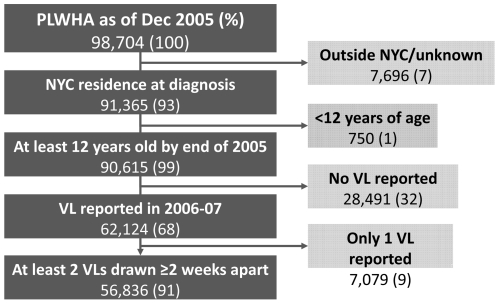
Methods/principal findings: Retrospective cohort study of all persons reported to the NYC HIV Surveillance Registry who were alive and ≥12 years old by the end of 2005 and who had ≥2 VL tests in 2006 and 2007. SHVL and DSVL were defined as PLWHA with 2 consecutive VLs ≥100,000 copies/mL and PLWHA with all VLs ≤400 copies/mL, respectively. Logistic regression models using generalized estimating equations were used to model the association between SHVL and covariates. There were 56,836 PLWHA, of whom 7% had SHVL and 38% had DSVL. Compared to those without SHVL, persons with SHVL were more likely to be younger, black and have injection drug use (IDU) risk. PLWHA with SHVL were more likely to die by 2007 and be younger by nearly ten years, on average.
Conclusions/significance: Nearly 60% of PLWHA in 2005 had multiple VLs, of whom almost 40% had DSVL, suggesting successful ART uptake. A small proportion had SHVL, representing groups known to have suboptimal engagement in care. This group should be targeted for additional outreach to reduce morbidity and secondary transmission. Measures based on longitudinal analyses of surveillance data in conjunction with cross-sectional measures such as community viral load represent more precise and powerful tools for monitoring ART effectiveness and potential impact on disease transmission than cross-sectional measures alone.
Conflict of interest statement
Figures

References
-
- Mellors JW, Munoz A, Giorgi JV, Margolick JB, Tassoni CJ, et al. Plasma viral load and CD4+ lymphocytes as prognostic markers of HIV-1 infection. Ann Intern Med. 1997;126:946–954. - PubMed
-
- Sterling TR, Vlahov D, Astemborski J, Hoover DR, Margolick JB, et al. Initial plasma HIV-1 RNA levels and progression to AIDS in women and men. N Engl J Med. 2001;344:720–725. - PubMed
-
- Dybul M, Fauci AS, Bartlett JG, Kaplan JE, Pau AK. Guidelines for using antiretroviral agents among HIV-infected adults and adolescents. Ann Intern Med. 2002;137:381–433. - PubMed
-
- Attia S, Egger M, Muller M, Zwahlen M, Low N. Sexual transmission of HIV according to viral load and antiretroviral therapy: systematic review and meta-analysis. AIDS. 2009;23:1397–1404. - PubMed
-
- Lohse N, Kronborg G, Gerstoft J, Larsen CS, Pedersen G, et al. Virological control during the first 6–18 months after initiating highly active antiretroviral therapy as a predictor for outcome in HIV-infected patients: a Danish, population-based, 6-year follow-up study. Clin Infect Dis. 2006;42:136–144. - PubMed
MeSH terms
LinkOut - more resources
Full Text Sources
Medical
