


Vitamin D binding protein and monocyte response to 25-hydroxyvitamin D and 1,25-dihydroxyvitamin D: analysis by mathematical modeling
- PMID: 22292037
- PMCID: PMC3265504
- DOI: 10.1371/journal.pone.0030773
Vitamin D binding protein and monocyte response to 25-hydroxyvitamin D and 1,25-dihydroxyvitamin D: analysis by mathematical modeling
Abstract
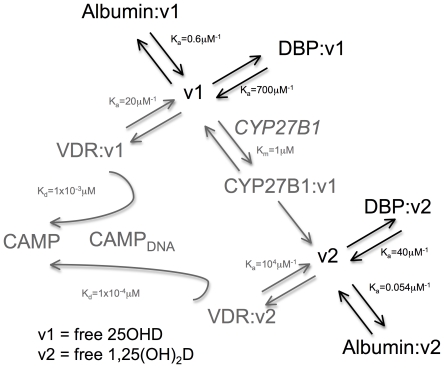
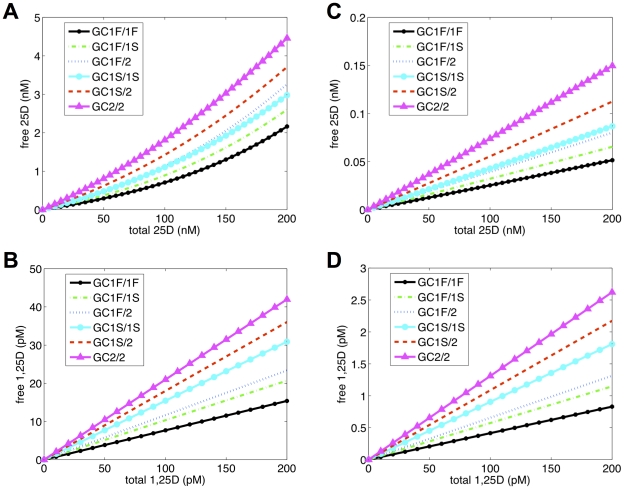
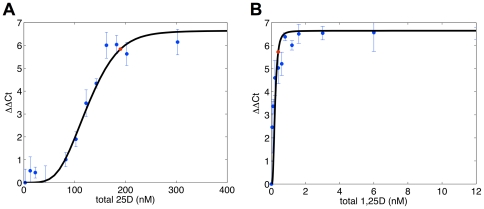
Vitamin D binding protein (DBP) plays a key role in the bioavailability of active 1,25-dihydroxyvitamin D (1,25(OH)(2)D) and its precursor 25-hydroxyvitamin D (25OHD), but accurate analysis of DBP-bound and free 25OHD and 1,25(OH)(2)D is difficult. To address this, two new mathematical models were developed to estimate: 1) serum levels of free 25OHD/1,25(OH)(2)D based on DBP concentration and genotype; 2) the impact of DBP on the biological activity of 25OHD/1,25(OH)(2)D in vivo. The initial extracellular steady state (eSS) model predicted that 50 nM 25OHD and 100 pM 1,25(OH)(2)D), <0.1% 25OHD and <1.5% 1,25(OH)(2)D are 'free' in vivo. However, for any given concentration of total 25OHD, levels of free 25OHD are higher for low affinity versus high affinity forms of DBP. The eSS model was then combined with an intracellular (iSS) model that incorporated conversion of 25OHD to 1,25(OH)(2)D via the enzyme CYP27B1, as well as binding of 1,25(OH)(2)D to the vitamin D receptor (VDR). The iSS model was optimized to 25OHD/1,25(OH)(2)D-mediated in vitro dose-responsive induction of the vitamin D target gene cathelicidin (CAMP) in human monocytes. The iSS model was then used to predict vitamin D activity in vivo (100% serum). The predicted induction of CAMP in vivo was minimal at basal settings but increased with enhanced expression of VDR (5-fold) and CYP27B1 (10-fold). Consistent with the eSS model, the iSS model predicted stronger responses to 25OHD for low affinity forms of DBP. Finally, the iSS model was used to compare the efficiency of endogenously synthesized versus exogenously added 1,25(OH)(2)D. Data strongly support the endogenous model as the most viable mode for CAMP induction by vitamin D in vivo. These novel mathematical models underline the importance of DBP as a determinant of vitamin D 'status' in vivo, with future implications for clinical studies of vitamin D status and supplementation.
Conflict of interest statement
Figures
References
-
- Holick MF. Vitamin D deficiency. N Engl J Med. 2007;357:266–281. - PubMed
-
- Holick MF. Vitamin D: importance in the prevention of cancers, type 1 diabetes, heart disease, and osteoporosis. Am J Clin Nutr. 2004;79:362–371. - PubMed
-
- Spina CS, Tangpricha V, Uskokovic M, Adorinic L, Maehr H, et al. Vitamin D and cancer. Anticancer Res. 2006;26:2515–2524. - PubMed
