


doi: 10.1155/2012/628070.
Epub 2012 Jan 15.
Targeting Beta amyloid: a clinical review of immunotherapeutic approaches in Alzheimer's disease
Affiliations
- PMID: 22292124
- PMCID: PMC3265072
- DOI: 10.1155/2012/628070
Item in Clipboard
Targeting Beta amyloid: a clinical review of immunotherapeutic approaches in Alzheimer's disease
Int J Alzheimers Dis.
2012.
Abstract
As the societal and economic burdens of Alzheimer's disease (AD) continue to mount, so does the need for therapies that slow the progression of the illness. Beta amyloid has long been recognized as the pathologic hallmark of AD, and the past decade has seen significant progress in the development of various immunotherapeutic approaches targeting beta amyloid. This paper reviews active and passive approaches aimed at beta amyloid, with a focus on clinical trial data.
Figures
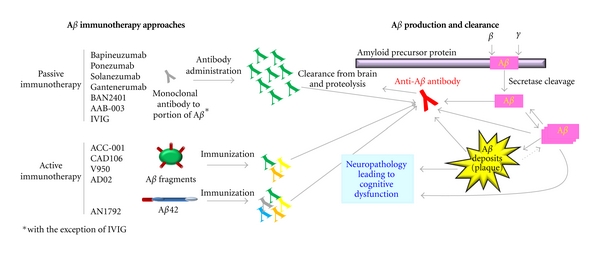
Passive and active immunotherapeutic approaches to beta-amyloid clearance. Beta-amyloid immunotherapeutic compounds currently in clinical trials utilize anti-beta-amyloid antibodies, generated through either passive or active immunotherapy approaches (left), to target beta amyloid and promote its clearance from the brain and proteolysis (right), potentially reversing the neuropathology that leads to cognitive dysfunction. Aβ: beta amyloid.
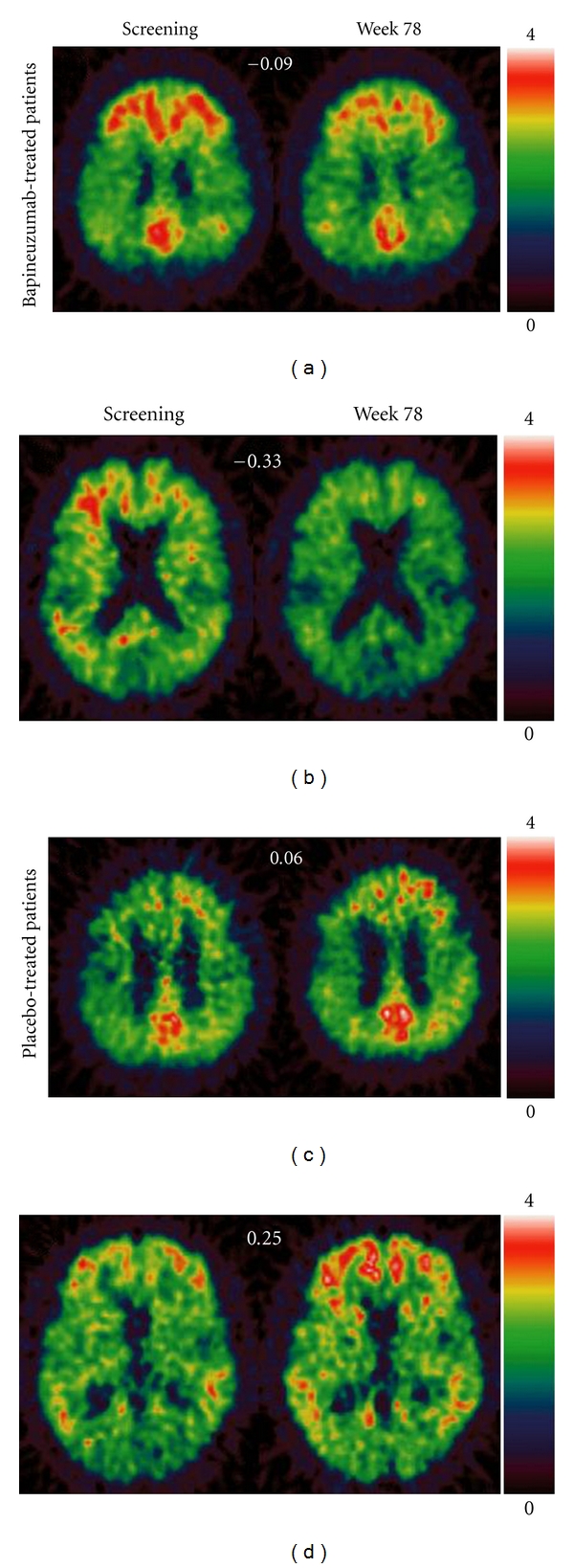
Positron emission tomography (PET) carbon-11-labelled Pittsburgh compound B (11C-PiB) images from patients treated with bapineuzumab and those given placebo [57]. Reprinted from [57] with permission from Elsevier. Changes from screening to week 78 in patients treated with bapineuzumab (a, b) and in patients treated with placebo (c, d). Mean 11C-PiB PET changes are shown at the top center of each panel for each patient. The scale bar shows the PiB uptake ratios relative to cerebellum by color. The scans before and after treatment are from MRI coregistered images in the same plane.
References
-
- Wimo A, Prince M. World Alzheimer Report 2010: The Global Economic Impact of Dementia. London, UK: Alzheimers’ Disease International; 2010. - PubMed
-
- Wimo A, Winblad B, Jönsson L. The worldwide societal costs of dementia: estimates for 2009. Alzheimer’s and Dementia. 2010;6(2):98–103. - PubMed
-
- Alzheimer A. Über eine eigenartige Erkrankung der Hirnrinde [On a peculiar disease of the cerebral cortex] Allgemeine Zeitschrift fur Psychiatrie und Psychisch-Gerichtliche Medizin. 1907;64:146–148.
-
- Hardy J, Selkoe DJ. The amyloid hypothesis of Alzheimer’s disease: progress and problems on the road to therapeutics. Science. 2002;297(5580):353–356. - PubMed
-
- Caccamo A, Oddo S, Sugarman MC, Akbari Y, LaFerla FM. Age- and region-dependent alterations in Aβ-degrading enzymes: implications for Aβ-induced disorders. Neurobiology of Aging. 2005;26(5):645–654. - PubMed
LinkOut - more resources
Full Text Sources
Other Literature Sources
Research Materials
Miscellaneous
