


Genetic diversity of recently acquired and prevalent HIV, hepatitis B virus, and hepatitis C virus infections in US blood donors
- PMID: 22293432
- PMCID: PMC3282564
- DOI: 10.1093/infdis/jir862
Genetic diversity of recently acquired and prevalent HIV, hepatitis B virus, and hepatitis C virus infections in US blood donors
Abstract
Background: Genetic variations of human immunodeficiency virus (HIV), hepatitis C virus (HCV), and hepatitis B virus (HBV) can affect diagnostic assays and therapeutic interventions. Recent changes in prevalence of subtypes/genotypes and drug/immune-escape variants were characterized by comparing recently infected vs more remotely infected blood donors.
Methods: Infected donors were identified among approximately 34 million US blood donations, 2006-2009; incident infections were defined as having no or low antiviral antibody titers. Viral genomes were partially sequenced.
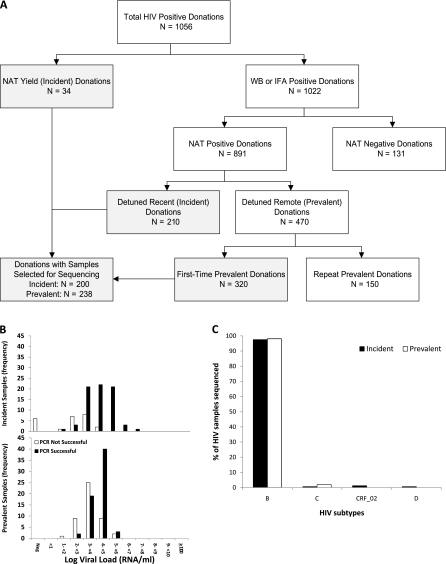
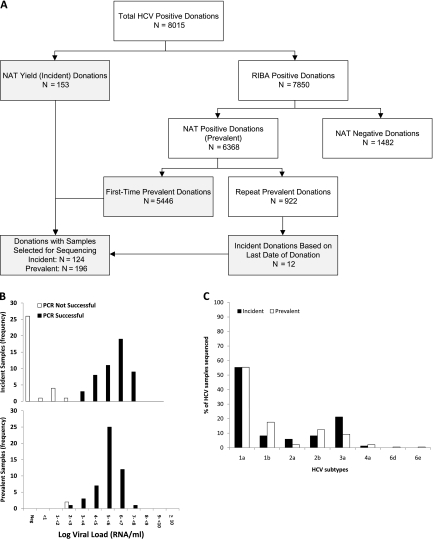
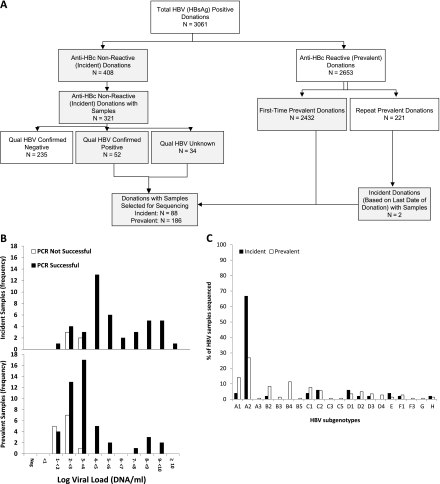
Results: Of 321 HIV strains (50% incident), 2.5% were non-B HIV subtypes. Protease and reverse transcriptase (RT) inhibitor resistance mutations were found in 2% and 11% of infected donors, respectively. Subtypes in 278 HCV strains (31% incident) yielded 1a>1b>3a>2b>2a>4a>6d, 6e: higher frequencies of 3a in incident cases vs higher frequencies of 1b in prevalent cases were found (P = .04). Twenty subgenotypes among 193 HBV strains (26% incident) yielded higher frequencies of A2 in incident cases and higher frequencies of A1, B2, and B4 in prevalent cases (P = .007). No HBV drug resistance mutations were detected. Six percent of incident vs 26% of prevalent HBV contained antibody neutralization escape mutations (P = .01).
Conclusions: Viral genetic variant distribution in blood donors was similar to that seen in high-risk US populations. Blood-borne viruses detected through large-scale routine screening of blood donors can complement molecular surveillance studies of highly exposed populations.
Figures
Comment in
-
How can the blood transfusion medicine community contribute to public health in tough economic times?J Infect Dis. 2012 Mar 15;205(6):867-9. doi: 10.1093/infdis/jir866. Epub 2012 Jan 31. J Infect Dis. 2012. PMID: 22293430 No abstract available.
References
-
- Zou S, Stramer SL, Notari EP, et al. Current incidence and residual risk of hepatitis B infection among blood donors in the United States. Transfusion. 2009;49:1609–20. - PubMed
-
- Zou S, Dorsey KA, Notari EP, et al. Prevalence, incidence, and residual risk of human immunodeficiency virus and hepatitis C virus infections among United States blood donors since the introduction of nucleic acid testing. Transfusion. 2010;50:1495–504. - PubMed
-
- Brennan CA, Stramer SL, Holzmayer V, et al. Identification of human immunodeficiency virus type 1 non-B subtypes and antiretroviral drug-resistant strains in United States blood donors. Transfusion. 2009;49:125–33. - PubMed
-
- Stramer SL, Wend U, Candotti D, et al. Nucleic acid testing to detect HBV infection in blood donors. N Engl J Med. 2011;364:236–47. - PubMed
-
- Busch MP, Pilcher CD, Mastro TD, et al. Beyond detuning: 10 years of progress and new challenges in the development and application of assays for HIV incidence estimation. AIDS. 2010;24:2763–71. - PubMed
Publication types
MeSH terms
Grants and funding
LinkOut - more resources
Full Text Sources
Other Literature Sources
Medical
Molecular Biology Databases
