


1000 Genomes-based imputation identifies novel and refined associations for the Wellcome Trust Case Control Consortium phase 1 Data
- PMID: 22293688
- PMCID: PMC3376268
- DOI: 10.1038/ejhg.2012.3
1000 Genomes-based imputation identifies novel and refined associations for the Wellcome Trust Case Control Consortium phase 1 Data
Abstract
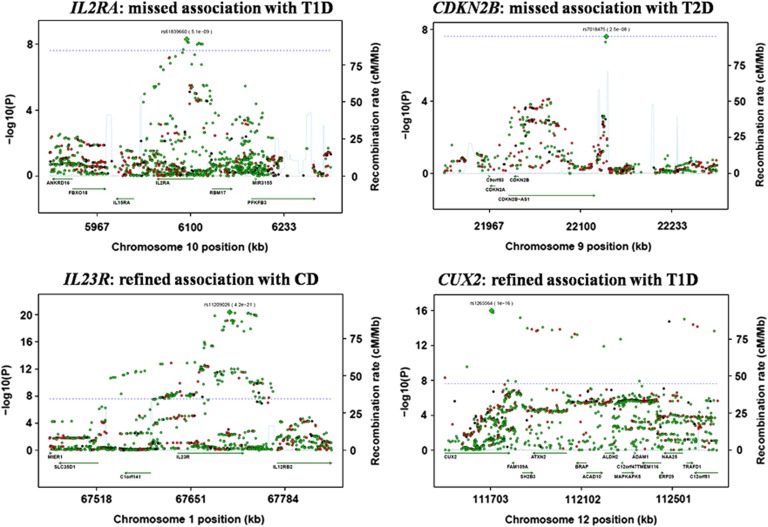
We hypothesize that imputation based on data from the 1000 Genomes Project can identify novel association signals on a genome-wide scale due to the dense marker map and the large number of haplotypes. To test the hypothesis, the Wellcome Trust Case Control Consortium (WTCCC) Phase I genotype data were imputed using 1000 genomes as reference (20100804 EUR), and seven case/control association studies were performed using imputed dosages. We observed two 'missed' disease-associated variants that were undetectable by the original WTCCC analysis, but were reported by later studies after the 2007 WTCCC publication. One is within the IL2RA gene for association with type 1 diabetes and the other in proximity with the CDKN2B gene for association with type 2 diabetes. We also identified two refined associations. One is SNP rs11209026 in exon 9 of IL23R for association with Crohn's disease, which is predicted to be probably damaging by PolyPhen2. The other refined variant is in the CUX2 gene region for association with type 1 diabetes, where the newly identified top SNP rs1265564 has an association P-value of 1.68 × 10(-16). The new lead SNP for the two refined loci provides a more plausible explanation for the disease association. We demonstrated that 1000 Genomes-based imputation could indeed identify both novel (in our case, 'missed' because they were detected and replicated by studies after 2007) and refined signals. We anticipate the findings derived from this study to provide timely information when individual groups and consortia are beginning to engage in 1000 genomes-based imputation.
Figures
References
-
- Marchini J, Howie B. Genotype imputation for genome-wide association studies. Nat Rev Genet. 2010;11:499–511. - PubMed
Publication types
MeSH terms
Substances
Grants and funding
LinkOut - more resources
Full Text Sources
Medical
