Thermal ablation of unresectable liver tumors: factors associated with partial ablation and the impact on long-term survival
- PMID: 22293882
- PMCID: PMC3560593
- DOI: 10.12659/msm.882463
Thermal ablation of unresectable liver tumors: factors associated with partial ablation and the impact on long-term survival
Abstract
Background: Thermal ablation procedures, including radiofrequency ablation (RFA) or laser-induced interstitial thermotherapy (LITT), are now well established in the treatment of malignant unresectable hepatic tumors. But the impact of partial ablation (PA) on long-term survival following computed tomography (CT)-guided radiofrequency ablation and laser- induced interstitial thermotherapy of unresectable malignant liver lesions and the associated risk factors of PA remain partially unknown.
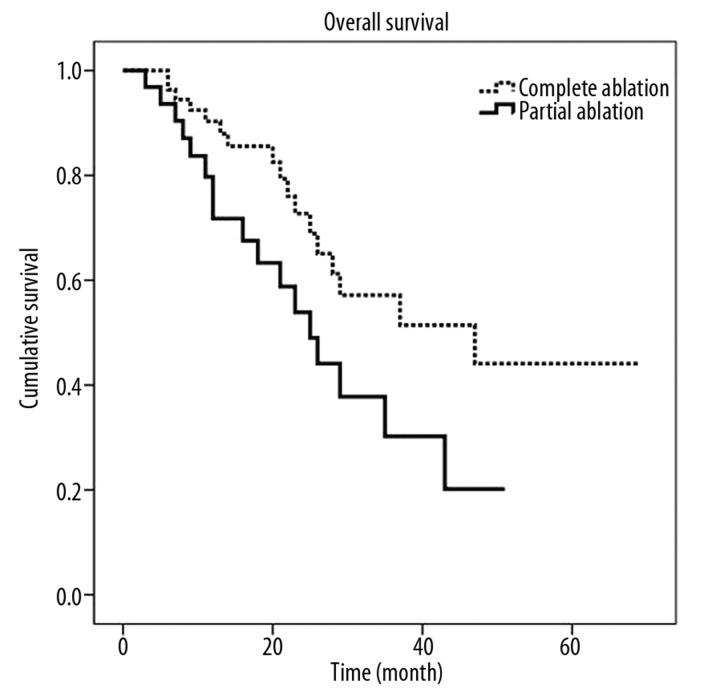
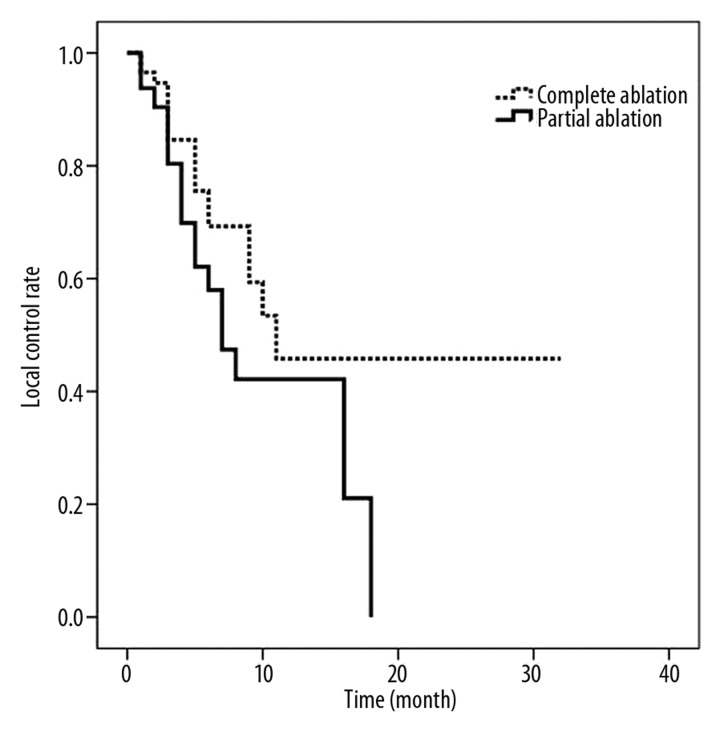
Material/methods: This study included 254 liver tumors in 91 consecutive patients (66 men and 25 women; age 60.9 ± 10.4 years; mean tumor size 25 ± 14 mm [range 5-70 mm]) who underwent thermal ablation (RFA or LITT) between January 2000 and December 2007. Mean follow-up period was 21.1 month (range 1-69 months). Survival rate and local progression-free survival (PFS) were calculated for patients with complete ablation (CA) vs. patients with partial ablation (PA) to assess the impact on long-term survival.
Results: Median survival after CA was 47 months compared to 25 months after PA (P=0.04). The corresponding 5-year survival rates were 44% vs. 20%. Median PFS for CA was 11 months compared to 7 months for PA (P=0.118). The sole statistically significant risk factor for PA was tumor size (>30 mm; P=0.0003). Sustained complete ablation was achieved in 71% of lesions ≤ 30 mm vs. 47% of lesions >30 mm.
Conclusions: We conclude that achievement of complete ablation is a highly important predictor of long-term survival and that tumor size is by far the most important predictor of the likelihood of achieving complete ablation.
Figures
References
-
- Curley SA, Izzo F. Radiofrequency ablation of primary and metastatic hepatic malignancies. Int J Clin Oncol. 2002;7(2):72–81. - PubMed
-
- Dupuy DE, Goldberg SN. Image-guided radiofrequency tumor ablation: challenges and opportunities – part II. J Vasc Interv Radiol. 2001;12(10):1135–48. - PubMed
-
- Gazelle GS, Goldberg SN, Solbiati L, Livraghi T. Tumor ablation with radio-frequency energy. Radiology. 2000;217(3):633–46. - PubMed
-
- Tateishi R, Shiina S, Teratani T, et al. Percutaneous radiofrequency ablation for hepatocellular carcinoma. An analysis of 1000 cases. Cancer. 2005;103(6):1201–9. - PubMed
-
- Vogl TJ, Straub R, Eichler K, et al. Colorectal carcinoma metastases in liver: laser-induced interstitial thermotherapy – local tumor control rate and survival data. Radiology. 2004;230(2):450–58. - PubMed
Publication types
MeSH terms
LinkOut - more resources
Full Text Sources
Medical