


doi: 10.1002/0471141755.ph1414s49.
Mouse models of human bladder cancer as a tool for drug discovery
Affiliations
- PMID: 22294368
- PMCID: PMC3272628
- DOI: 10.1002/0471141755.ph1414s49
Item in Clipboard
Mouse models of human bladder cancer as a tool for drug discovery
Curr Protoc Pharmacol.
2010 Jun.
Abstract
Muscle-invasive bladder cancer is a deadly condition in dire need of effective new treatments. This unit contains a description of mouse models suitable for the evaluation of potential new therapies. Included is a genetically engineered mouse model of bladder cancer generated by the delivery of an adenovirus expressing Cre recombinase into the bladder lumen. Also described is an orthotopic mouse model created by the instillation of human bladder tumor cells into the bladder lumen of immune deficient mice. Protocols are also provided on the use of these models for the preclinical evaluation of new chemical entities, with mTOR inhibitors shown as an example.
Figures
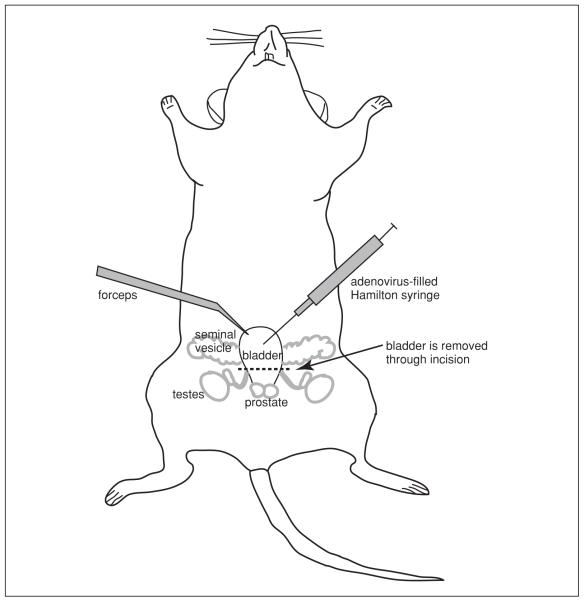
Surgical procedure for instilling cells into the mouse bladder.
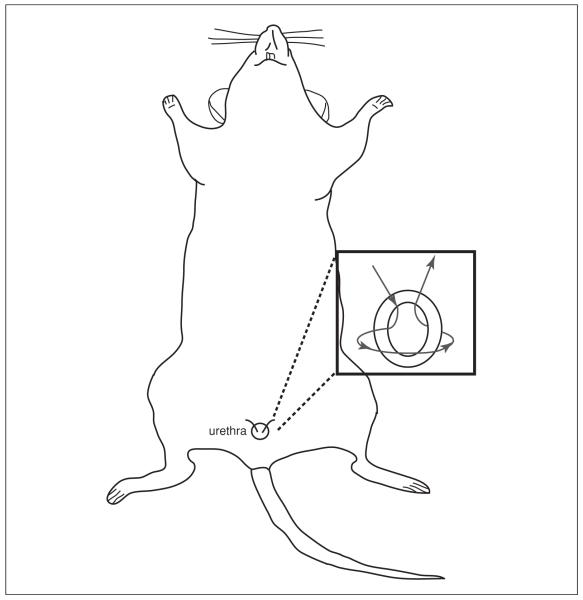
Placement of a superficial silk purse-string suture around the urethral meatus.
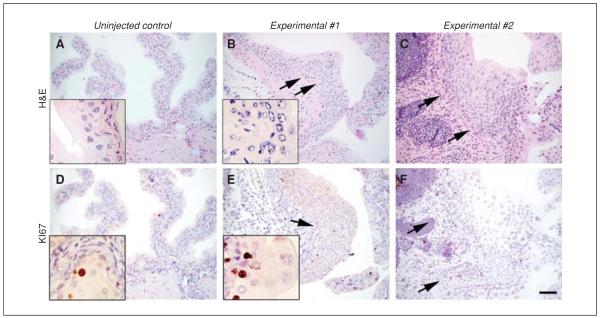
Modeling early-stage bladder cancer in mutant mice. (A to C) Representative H&E-stained sections from bladders of a control mouse (uninjected p53flox/flox; Ptenflox/flox) or two representative experimental mice (Adeno-Cre–injected p53flox/flox; Ptenflox/flox) 6 weeks subsequent to delivery of Adeno-Cre (or mock injection for the control). Shown are representative histologic sections from a total of 10 mice in each of the experimental and control groups. Note that the experimental, but not control, mice have a dysplastic and expanded epithelium (arrows) as well as abnormal stroma. Inset, high power view. (D to F) KI67-immunostained adjacent sections show elevated proliferation in the bladder epithelium of the experimental mice relative to the control mice. Inset, high power view. Scale bar, 100 μm. Reprinted with permission from Seager et al. (2009).
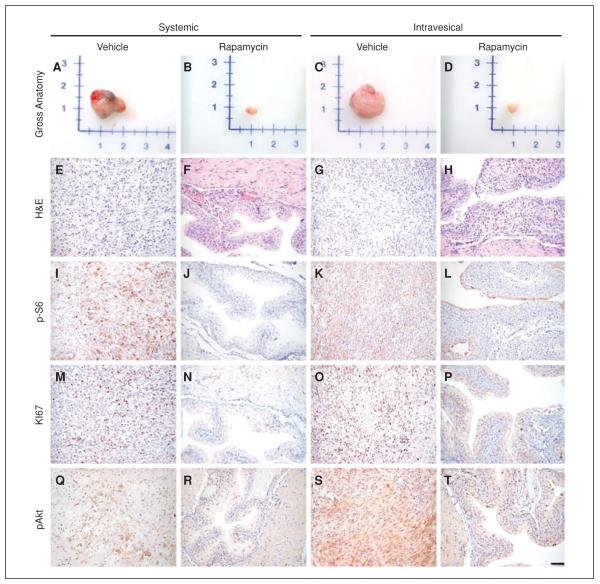
Rapamycin inhibits bladder tumor progression. Representative examples from the vehicle- or rapamycin-treated mutant mice show the following: (A to D) gross anatomy of bladder tissues/tumors; (E to H) H&E-stained sections; or (I to T) immunostained sections using the indicated antibodies. In all groups, gross analyses of bladder tissues and H&E analyses were done on all control and experimental mice in each group; immunohistochemistry was done on a minimum of four animals from each group; representative data are shown. Scale bars, 100 μm. Reprinted with permission from Seager et al. (2009).
References
-
- Ahlering TE, Dubeau L, Jones PA. A new in vivo model to study invasion and metastasis of human bladder carcinoma. Cancer Res. 1987;15:6660–6665. - PubMed
-
- Branda CS, Dymecki SM. Talking about a revolution: The impact of site-specific recombinases on genetic analyses in mice. Dev. Cell. 2004;6:7–28. - PubMed
-
- Chin J, Kadhim S, Garcia B, Kim YS, Karlik S. Magnetic resonance imaging for detecting and treatment monitoring of orthotopic murine bladder tumor implants. J. Urol. 1991;145:1297–1301. - PubMed
-
- Chong L, Ruping Y, Jiancheng B, Guohong Y, Yougang F, Jiansong W, Xiang G, Jie H, Shusheng X. Characterization of a novel transplantable orthotopic murine xenograft model of a human bladder transitional cell tumor (BIU-87) Cancer Biol. Ther. 2006;4:394–398. - PubMed
-
- Cordon-Cardo C. Molecular alterations associated with bladder cancer initiation and progression. Scand. J. Urol. Nephrol. Suppl. 2008;42:154–165. - PubMed
Publication types
MeSH terms
Substances
Grants and funding
LinkOut - more resources
Full Text Sources
Medical
Miscellaneous
