Review
. 2012 Aug;25(4):677-86.
doi: 10.1007/s10534-012-9520-3.

Known and potential roles of transferrin in iron biology

Affiliations
Review

Known and potential roles of transferrin in iron biology

Thomas Benedict Bartnikas. Biometals. 2012 Aug.

Abstract

Transferrin is an abundant serum metal-binding protein best known for its role in iron delivery. The human disease congenital atransferrinemia and animal models of this disease highlight the essential role of transferrin in erythropoiesis and iron metabolism. Patients and mice deficient in transferrin exhibit anemia and a paradoxical iron overload attributed to deficiency in hepcidin, a peptide hormone synthesized largely by the liver that inhibits dietary iron absorption and macrophage iron efflux. Studies of inherited human disease and model organisms indicate that transferrin is an essential regulator of hepcidin expression. In this paper, we review current literature on transferrin deficiency and present our recent findings, including potential overlaps between transferrin, iron and manganese in the regulation of hepcidin expression.


Conflict of interest statement

There are no known conflicts of interest.

Figures
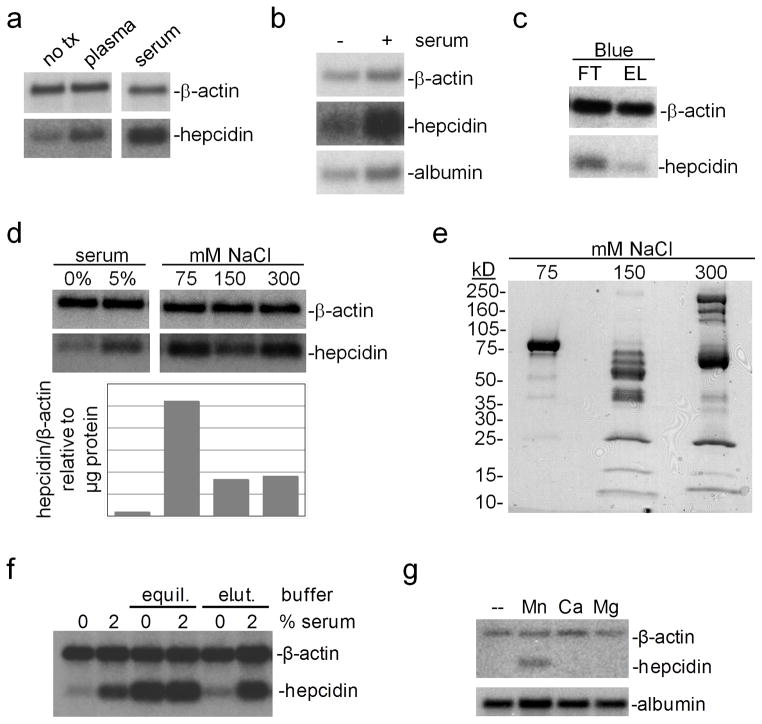
Fig. 1
Fig. 1
Response of hepatocyte hepcidin levels to serum: (a–b) Primary hepatocytes were treated in serum-free media (Optimem) with 0 or 5% human serum or plasma overnight, then harvested and analyzed by Northern blot for hepcidin, albumin and β-actin RNA levels. (c) 1 mL human serum, diluted four-fold with 20 mM Tris pH 8.0, was fractionated with a 5 mL column volume (CV) GE HiTrap Blue column with high affinity for albumin; flowthrough (FT) and eluate (EL) fractions were collected and concentrated and desalted to equal volumes with 5 kD molecular weight cut-off centrifugal filtration devices. Hepatocytes were treated overnight with equal volumes of FT and EL fractions; RNA was isolated and analyzed for β-actin and hepcidin mRNA levels. (d) 1 mL human serum was diluted and chromatographed with GE HiTrap Blue (5 mL CV) and Q anion exchange (1 mL CV) columns. Fractions were eluted from the Q column with 75, 150 and 300 mM NaCl and concentrated and desalted using centrifugal filtration devices. Hepatocytes were treated overnight with 0 or 5% serum or equal volumes of anion exchange fractions. RNA was isolated and analyzed by Northern blot. Band intensity was quantitated by NIH Image software and expressed as a ratio of hepcidin to β-actin mRNA band intensity per μg of fraction protein. (e) Fractions from (d) were subjected to denaturing, reducing SDS PAGE and Coomassie staining. (f) Hepatocytes were treated in serum-free media with 0 or 2% human serum and 0 or 10% concanavalin A equilibration (20 mM Tris pH 7.4/0.5 M NaCl/5 mM MgCl2, MnCl2, CaCl2) or elution buffer (500 mM methyl-α-D-glucopyranoside) overnight, then analyzed for hepcidin and β-actin expression levels by Northern blot. (g) Hepatocytes were incubated in serum-free media with or without 50 μM MnCl2, CaCl2 or MgCl2 overnight, then analyzed as in (f). Results in all panels are representative of three independent experiments
Fig. 2
Fig. 2
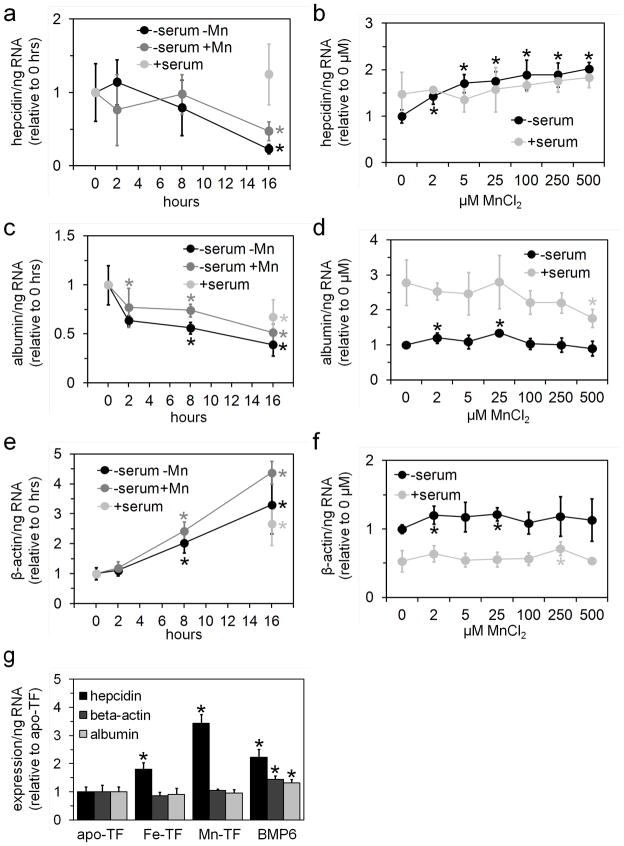
Effect of manganese on hepatocyte hepcidin levels: (a, c, e) Primary hepatocytes were treated in serum-free media (Optimem) without (black circles) or with 100 μM MnCl2 (dark gray circles) or in serum–replete media (containing 10% fetal calf serum) without added MnCl2 (light gray circles) for 0–16 hours then harvested and analyzed by QPCR for hepcidin (a), albumin (c) and β-actin (e) RNA levels. Values are normalized to 0 hour value; asterisks indicate value differs significantly (t-test P<0.05) from 0 hour value. (b, d, f) Primary hepatocytes were treated in serum-free (dark circles) or –eplete media (light gray circles) with 0–500 μM MnCl2 for 16 hours then harvested and analyzed by QPCR for hepcidin (b), albumin (d) and β-actin RNA levels (f). Values are normalized to 0 μM MnCl2 serum-free value; asterisks indicate value differs significantly (t-test P<0.05) from 0 μM MnCl2, same serum treatment. (g) Primary hepatocytes were treated in serum-free media with or without 3 mg/mL apo-TF, 100% saturated Fe-TF or 50% saturated Mn-TF or 50 ng/mL BMP6 overnight, then analyzed for expression levels as in (a–f). Asterisks indicate value differs significantly (t-test P<0.05) from apo-TF value. For all panels, gene RNA levels were expressed relative to total ng RNA used for QPCR; bars indicate standard deviation; each value represents the average of 4–6 biological replicates

References

    1. Aisen P, Aasa R, Redfield AG. The chromium, manganese, and cobalt complexes of transferrin. J Biol Chem. 1969;244:4628–4633. - PubMed
    1. Altstatt LB, Pollack S, Feldman MH, Reba RC, Crosby WH. Liver manganese in hemochromatosis. Proc Soc Exp Biol Med. 1967;124:353–355. - PubMed
    1. Aman J, van der Heijden M, van Lingen A, Girbes ARJ, van Nieuw Amerongen GP, van Hinsbergh VWM, Groeneveld ABJ. Plasma protein levels are markers of pulmonary vascular permeability and degree of lung injury in critically ill patients with or at risk for acute lung injury/acute respiratory distress syndrome. Crit Care Med. 2011;39:89–97. - PubMed
    1. Asada-Senju M, Maeda T, Sakata T, Hayashi A, Suzuki T. Molecular analysis of the transferrin gene in a patient with hereditary hypotransferrinemia. J Hum Genet. 2002;47:355–359. - PubMed
    1. Aslan D, Crain K, Beutler E. A new case of human atransferrinemia with a previously undescribed mutation in the transferrin gene. Acta Haematol. 2007;118:244–247. - PubMed

Publication types

Supplementary concepts