


Evaluation of a constant rate infusion of lidocaine for balanced anesthesia in dogs undergoing surgery
- PMID: 22294791
- PMCID: PMC3135028
Evaluation of a constant rate infusion of lidocaine for balanced anesthesia in dogs undergoing surgery
Abstract
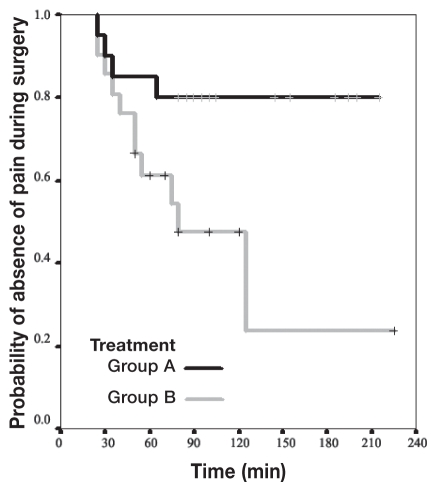
This study assessed the intraoperative analgesic effects of intravenous lidocaine administered by a constant rate infusion (CRI) in surgical canine patients. A prospective, blinded, randomized study was designed with 2 treatment groups: A (lidocaine) and B (placebo), involving 41 dogs. All patients were premedicated with acepromazine and buprenorphine, induced with propofol and midazolam; anesthesia was maintained with isoflurane in oxygen. Group A received 2 mg/kg IV lidocaine immediately after induction, followed within 5 min by a CRI at 50 μg/kg/min. Group B received an equivalent volume of saline instead of lidocaine. Changes in heart rate and blood pressure during maintenance were treated by increasing CRI. Fentanyl was used as a supplemental analgesic when intraoperative nociceptive response was not controlled with the maximum dose of lidocaine infusion. There was a significantly lower use of supplemental intraoperative analgesia in the lidocaine than in the placebo group. Group B dogs had almost twice as high a risk of intraoperative nociceptive response as group A dogs.
Évaluation d’une perfusion à débit constant de lidocaïne pour une anesthésie équilibrée chez les chiens subissant une chirurgie. Cette étude a évalué les effets analgésiques peropératoire de la lidocaïne intraveineuse administrée par perfusion à débit constant (PDC) chez les patients chirurgicaux canins. Une étude prospective à l’aveugle et aléatoire a été conçue avec 2 groupes de traitement : A (lidocaïne) et B (placebo), ciblant 41 chiens. Tous les patients ont reçu une prémédication avec l’acépromazine et la buprénorphine et une induction au propofol et au midazolam; l’anesthésie a été maintenue avec de l’isoflurane dans de l’oxygène. Le groupe A a reçu 2 mg/kg IV de lidocaïne immédiatement après l’induction, suivie après 5 minutes d’un PDR à 50 μg/kg/min. Le groupe B a reçu un volume équivalent de solution saline au lieu de la lidocaïne. Les changements de la fréquence cardiaque et de la tension artérielle durant le maintien ont été traités en augmentant le PDR. Le fentanyl a été utilisé comme analgésique d’appoint lorsque la réaction nociceptive peropératoire n’était pas contrôlée avec la dose maximum de perfusion de lidocaïne. Il y a eu une utilisation significativement réduite d’analgésie peropératoire d’appoint pour le groupe de lidocaïne par rapport au groupe placebo. Les chiens du groupe B présentaient un risque presque deux fois plus élevé de réaction nociceptive peropératoire que les chiens du groupe A.
(Traduit par Isabelle Vallières)
Figures
References
-
- Pypendop BH, Ilkiw JE. The effects of intravenous lidocaine administration on the minimun alveolar concentration of isoflurane in cats. Anesth Analg. 2005;100:97–101. - PubMed
-
- Feary DJ, Mama KR, Wagner AE, et al. Influence of general anesthesia on pharmacokinetics of intravenous lidocaine infusion in horses. Am J Vet Res. 2005;66:574–579. - PubMed
-
- Fozzard HA, Lee PJ, Lipkind GM. Mechanism of local anesthetic drug action on voltage-gated sodium channels. Curr Pharm Des. 2005;11:2671–2686. - PubMed
-
- Wallin G, Cassuto J, Hogstrom S, et al. Effects of lidocaine infusion on the sympathetic response to abdominal surgery. Anesth Analg. 1987;66:1008–1113. - PubMed
-
- De Clive-Lowe SG, Desmond J, North J. Intravenous lidocaine anesthesia. Anaesthesia. 1958;13:138–146. - PubMed
Publication types
MeSH terms
Substances
LinkOut - more resources
Full Text Sources