Clinical Trial
. 2012 Feb 1;35(2):193-202.
doi: 10.5665/sleep.1620.

An adaptive-duration version of the PVT accurately tracks changes in psychomotor vigilance induced by sleep restriction

Affiliations
Clinical Trial

An adaptive-duration version of the PVT accurately tracks changes in psychomotor vigilance induced by sleep restriction

Mathias Basner et al. Sleep. .

Abstract

Study objectives: The Psychomotor Vigilance Test (PVT) is a widely used assay of behavioral alertness sensitive to the effects of sleep loss and circadian misalignment. The standard 10-minute duration of the PVT is often considered impractical for operational or clinical environments. Therefore, we developed and validated an adaptive-duration version of the PVT (PVT-A) that stops sampling once it has gathered enough information to correctly classify PVT performance.

Design: Repeated-measures experiments involving 10-minute PVT assessments every 2 hours across both acute total sleep deprivation (TSD) and 5 days of chronic partial sleep deprivation (PSD).

Setting: Controlled laboratory environment.

Participants: Seventy-four healthy subjects (34 women), aged 22 to 45 years.

Interventions: A TSD experiment involving 33 hours awake (n = 31 subjects), and a PSD experiment involving 5 nights of 4 hours time in bed (n = 43 subjects).

Measurements and results: The PVT-A algorithm was trained with 527 TSD test bouts and validated with 880 PSD test bouts. Based on our primary outcome measure "number of lapses (response times ≥ 500 ms) plus false starts (premature responses or response times < 100 ms)," 10-minute PVT performance was classified into high (≤ 5 lapses and false starts), medium (> 5 and ≤ 16 lapses and false starts), or low (> 16 lapses and false starts). The decision threshold for PVT-A termination was set so that at least 95% of training data-set tests were classified correctly and no test was classified incorrectly across 2 performance categories (i.e., high as low or low as high), resulting in an average test duration of 6.0 minutes (SD 2.4 min). In the validation data set, 95.7% of test bouts were correctly classified, and there were no incorrect classifications across 2 categories. Agreement corrected for chance was excellent (κ = 0.92). Across the 3 performance categories, sensitivity averaged 93.7% (range 87.2%-100%), and specificity averaged 96.8% (range 91.6%-99.9%). Test duration averaged 6.4 minutes (SD 1.7 min), with a minimum of 27 seconds.

Conclusions: We developed and validated a highly accurate, sensitive, and specific adaptive-duration version of the 10-minute PVT. Test duration of the adaptive PVT averaged less than 6.5 minutes, with 60 tests (4.3%) terminating after less than 2 minutes, increasing the practicability of the test in operational and clinical settings. The adaptive-duration strategy may be superior to a simple reduction of PVT duration in which the fixed test duration may be too short to identify subjects with moderate impairment (showing deficits only later during the test) but unnecessarily long for those who are either fully alert or severely impaired.

Keywords: PVT; alertness; attention; lapse; psychomotor vigilance; response speed; response time; sensitivity; sleep deprivation.


Figures
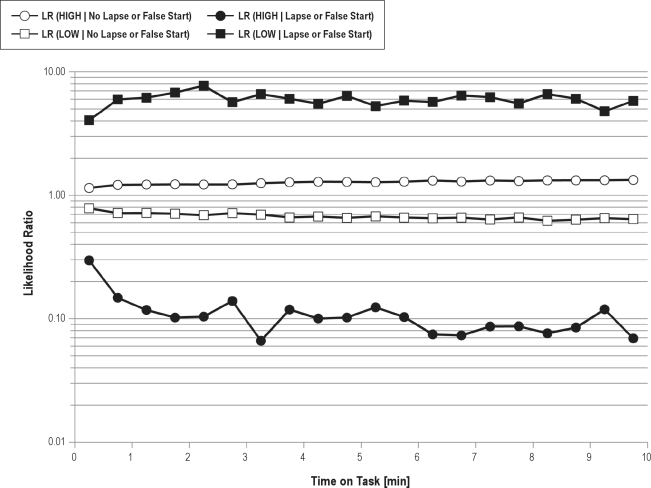
Figure 1
Figure 1
Likelihood ratios (LR) for belonging to the high psychomotor vigilance task (PVT) performance group (HIGH) or to the low PVT performance group (LOW) are given conditional on whether or not a lapse or a false start occurred and depending on time on task. Likelihood ratios are used to update the probability for belonging to a specific PVT performance group from before stimulus presentation (prior probability) to the probability after the response to the stimulus (posterior probability). The probability for belonging to a specific PVT performance group will increase for likelihood ratios > 1, decrease for likelihood ratios < 1, and remain unchanged for likelihood ratios = 1. The figure shows that in case of a lapse or a false start it will be less likely to belong to the HIGH performance group (black circles, LRs < 1) and more likely to belong to the LOW performance group (black squares, LRs > 1). Accordingly, in case of no lapse or a false start it will be more likely to belong to the HIGH performance group (open circles, LRs > 1) and less likely to belong to the LOW performance group (open squares, LRs < 1). Because lapses and false starts are rare events, they carry more information than do stimuli without lapses and false starts (i.e., likelihood ratios associated with lapses and false starts are more extreme and therefore lead to a greater change in posterior probability than do likelihood ratios with no lapses or false starts). Likelihood ratios were relatively stable across the 10-minute test period.
Figure 2
Figure 2
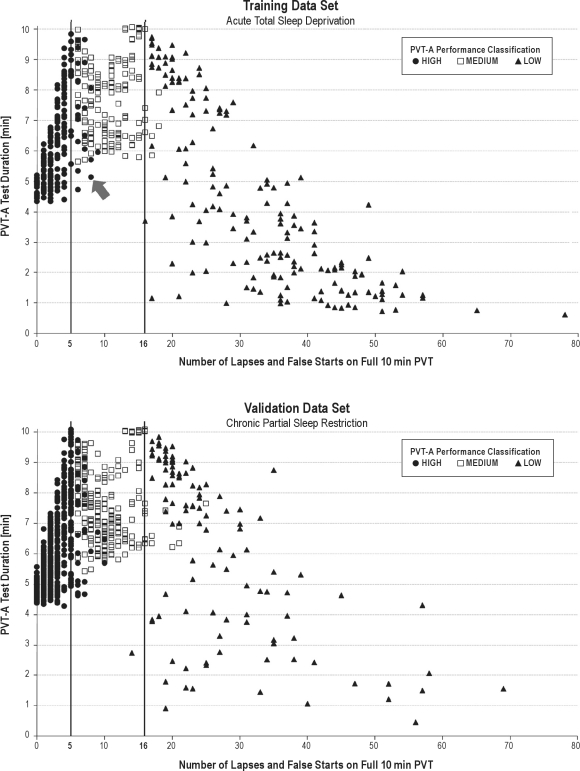
For each test bout and for both the training data set (above, n = 527 test bouts) and the validation data set (below, n = 880 test bouts), the number of lapses and false starts on the full 10-minute psychomotor vigilance task (PVT) (abscissa), the classification of the test bout according to the adaptive-duration PVT (PVT-A, represented by different symbols), and the duration of PVT-A (ordinate) are plotted. The vertical lines represent the category boundaries separating HIGH from MEDIUM (≤ 5 lapses and false starts) and MEDIUM from LOW (≤ 16 lapses and false starts) performance groups based on the full 10-minute PVT. As an example, the arrow points to a test bout with 8 lapses and false starts on the 10-minute PVT that was wrongly classified by PVT-A as a HIGH-performance bout (PVT-A stopped after 5.1 min to reach this decision; 7 of the 8 lapses or false starts occurred after an elapsed time of 5.1 min). PVT-A duration was highest for test bouts with the number of lapses and false starts on the 10-minute PVT near the category boundaries of 5 and 16. Even for test bouts with no lapses or false starts on the 10-minute PVT, PVT-A duration was still longer than 4 minutes, whereas PVT-A duration decreased continuously to values shorter than 1 minute with an increasing number of lapses and false starts on the 10-minute PVT. Misclassications tended to be close to the category boundaries.
Figure 3
Figure 3
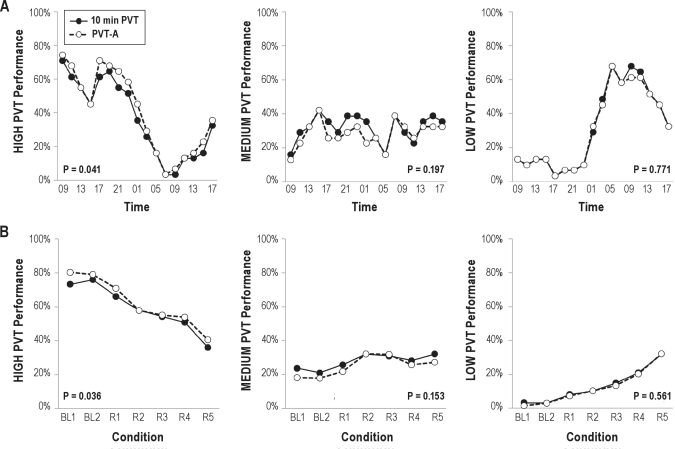
The proportion of performance bouts classified as HIGH, MEDIUM, or LOW is shown for the training data set (A, across 33 h of acute total sleep deprivation) and for the validation data set (B, chronic partial sleep deprivation with 2 baseline nights BL1 and BL2 and 5 nights of sleep restricted to 4 h time in bed—R1 to R5). Classifications based on the full 10-minute psychomotor vigilance task (PVT) are shown as black circles, whereas classifications based on the adaptive-duration version of the PVT (PVT-A) are shown as open circles. In general, agreement between the 2 versions of the test was high. PVT-A significantly overestimated the percentage of HIGH-performance bouts in both the training and the validation data set (mean difference 3.8%, range 0%-9.7%). The percentage of performance bouts classified as MEDIUM or LOW did not differ significantly between PVT-A and the full 10-minute PVT. P values are based on nonlinear mixed-effects models testing for differences between the 10-minute PVT and PVT-A controlling for experimental condition.

References

    1. Banks S, Dinges DF. Behavioral and physiological consequences of sleep restriction. J Clin Sleep Med. 2007;3:519–28. - PMC - PubMed
    1. Basner M, Rubinstein J, Fomberstein KM, et al. Effects of night work, sleep loss and time on task on simulated threat detection performance. Sleep. 2008;31:1251–9. - PMC - PubMed
    1. Barger LK, Cade BE, Ayas NT, et al. Extended work shifts and the risk of motor vehicle crashes among interns. N Engl J Med. 2005;352:125–34. - PubMed
    1. Dinges DF. An overview of sleepiness and accidents. J Sleep Res. 1995;4:4–14. - PubMed
    1. Finkel KJ, Searleman AC, Tymkew H, et al. Prevalence of undiagnosed obstructive sleep apnea among adult surgical patients in an academic medical center. Sleep Med. 2009;10:753–8. - PubMed

Publication types