


Age at onset versus family history and clinical outcomes in 1,665 international bipolar-I disorder patients
- PMID: 22295008
- PMCID: PMC3266753
- DOI: 10.1016/j.wpsyc.2012.01.006
Age at onset versus family history and clinical outcomes in 1,665 international bipolar-I disorder patients
Abstract
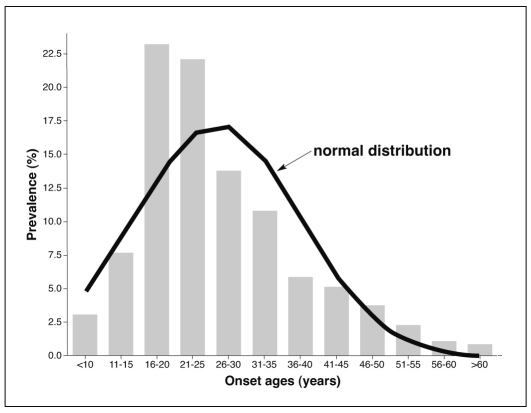
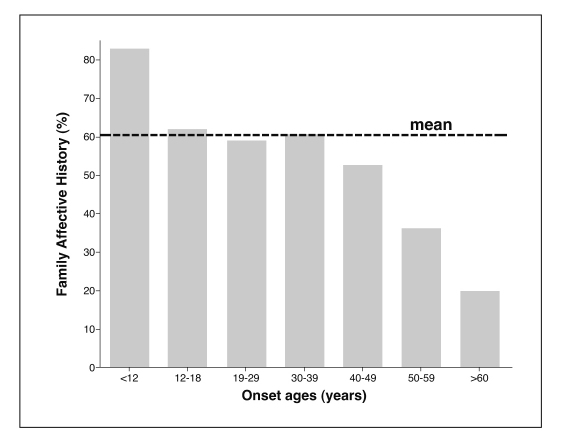
Early onset in bipolar disorder (BPD) has been associated with greater familial risk and unfavorable clinical outcomes. We pooled data from seven international centers to analyze the relationships of family history and symptomatic as well as functional measures of adult morbidity to onset age, or onset in childhood (age <12), adolescence (12-18), or adulthood (19-55 years). In 1,665 adult, DSM-IV BPD-I patients, onset was 5% in childhood, 28% in adolescence, and 53% at peak ages 15-25. Adolescent and adult onset did not differ by symptomatic morbidity (episodes/year, percentage of months ill, co-morbidity, hospitalization, suicide attempts) or family history. Indications of favorable adult functional outcomes (employment, living independently, marriage and children, and a composite measure including education) ranked, by onset: adult > adolescent > child. Onset in childhood versus adolescence had more episodes/year and more psychiatric co-morbidity. Family history was most prevalent with childhood onset, similar over onset ages 12-40 years, and fell sharply thereafter. Multivariate modeling sustained the impression that family history and poor functional, but not symptomatic, outcomes were associated with younger, especially childhood onset. Early onset was more related to poor functional outcomes than greater symptomatic morbidity, with least favorable outcomes and greater family history with childhood onset.
Keywords: Bipolar disorder; adult functional status; age at onset; morbidity; outcome.
Figures
References
-
- Baldessarini RJ, Bolzani L, Cruz N. Onset-age of bipolar disorders at six international sites. J Affect Dis. 2010;121:143–146. - PubMed
-
- Larsson S, Lorentzen S, Mork E. Age at onset of bipolar disorder in a Norwegian catchment area sample. J Affect Disord. 2010;124:174–177. - PubMed
-
- Tondo L, Lepri B, Cruz N. Age at onset in 3014 Sardinian bipolar and major depressive disorder patients. Acta Psychiatr Scand. 2010;121:446–452. - PubMed
-
- Perlis RH, Miyahara S, Marangell LB. Long-term implications of early onset in bipolar disorder: data from the first 1000 participants in the Systematic Treatment Enhancement Program for Bipolar Disorder (STEP-BP) Psychiatry. 2004;55:875–881. - PubMed
-
- Goodwin RK, Jamison KR, editors. Manic-depressive illness, 2nd ed. New York: Oxford University Press; 2007.
LinkOut - more resources
Full Text Sources
