


Metabolic syndrome and triple-negative breast cancer: a new paradigm
- PMID: 22295251
- PMCID: PMC3262602
- DOI: 10.1155/2012/809291
Metabolic syndrome and triple-negative breast cancer: a new paradigm
Abstract
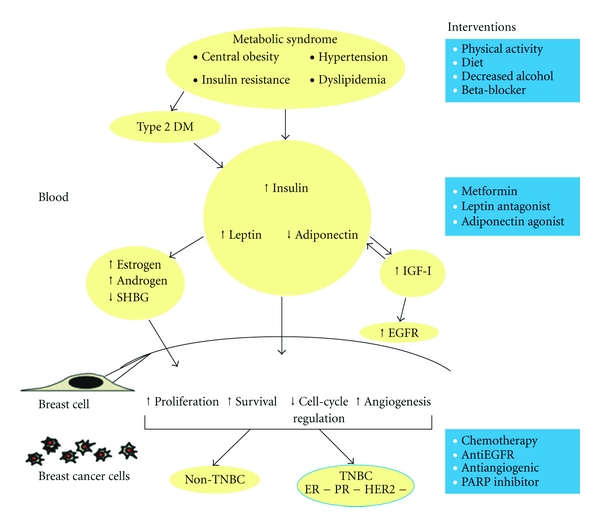
Triple-negative breast cancers (TNBCs) are aggressive tumors with poor prognosis compared to other breast cancer subtypes. The evidence linking TNBC with the metabolic syndrome, which consists of central obesity, insulin resistance, impaired glucose tolerance, dyslipidemia, and hypertension, has emerged from clinical studies and experiments using cell lines and mouse models. Epidemiological studies have associated abdominal obesity with increased incidence of TNBC. Additionally, insulin resistance, dyslipidemia, and hypertension are associated with increased incidence of breast cancer across all subtypes. The insulin-leptin-adiponectin axis has been implicated mechanistically in breast cancer tumorigenesis. Specifically, increased leptin and decreased adiponectin levels disrupt homeostatic signaling pathways involved in cell proliferation, survival, cell-cycle regulation, and angiogenesis. Insulin, insulin-like growth factor I (IGF-I), and epidermal growth factor receptor (EGFR) may mediate interactions between these two hormones. Further research will facilitate the development of targeted therapeutics and programs to modify lifestyle factors to modulate the insulin-leptin-adiponectin axis for TNBC.
Figures
References
-
- Sasa M, Bando Y, Takahashi M, Hirose T, Nagao T. Screening for basal marker expression is necessary for decision of therapeutic strategy for triple-negative breast cancer. Journal of Surgical Oncology. 2008;97(1):30–34. - PubMed
-
- Viale G, Rotmensz N, Maisonneuve P, et al. Invasive ductal carcinoma of the breast with the “triple- negative” phenotype: prognostic implications of EGFR immunoreactivity. Breast Cancer Research and Treatment. 2009;116(2):317–328. - PubMed
-
- Cheang MCU, Voduc D, Bajdik C, et al. Basal-like breast cancer defined by five biomarkers has superior prognostic value than triple-negative phenotype. Clinical Cancer Research. 2008;14(5):1368–1376. - PubMed
-
- Bauer KR, Brown M, Cress RD, Parise CA, Caggiano V. Descriptive analysis of estrogen receptor (ER)-negative, progesterone receptor (PR)-negative, and HER2-negative invasive breast cancer, the so-called triple-negative phenotype: a population-based study from the California Cancer Registry. Cancer. 2007;109(9):1721–1728. - PubMed
-
- Morris GJ, Naidu S, Topham AK, et al. Differences in breast carcinoma characteristics in newly diagnosed African-American and Caucasian patients: a single-institution compilation compared with the national cancer institute’s surveillance, epidemiology, and end results database. Cancer. 2007;110(4):876–884. - PubMed
LinkOut - more resources
Full Text Sources
Research Materials
Miscellaneous
