Simultaneous population pharmacokinetic modelling of ketamine and three major metabolites in patients with treatment-resistant bipolar depression
- PMID: 22295895
- PMCID: PMC3630750
- DOI: 10.1111/j.1365-2125.2012.04198.x
Simultaneous population pharmacokinetic modelling of ketamine and three major metabolites in patients with treatment-resistant bipolar depression
Abstract
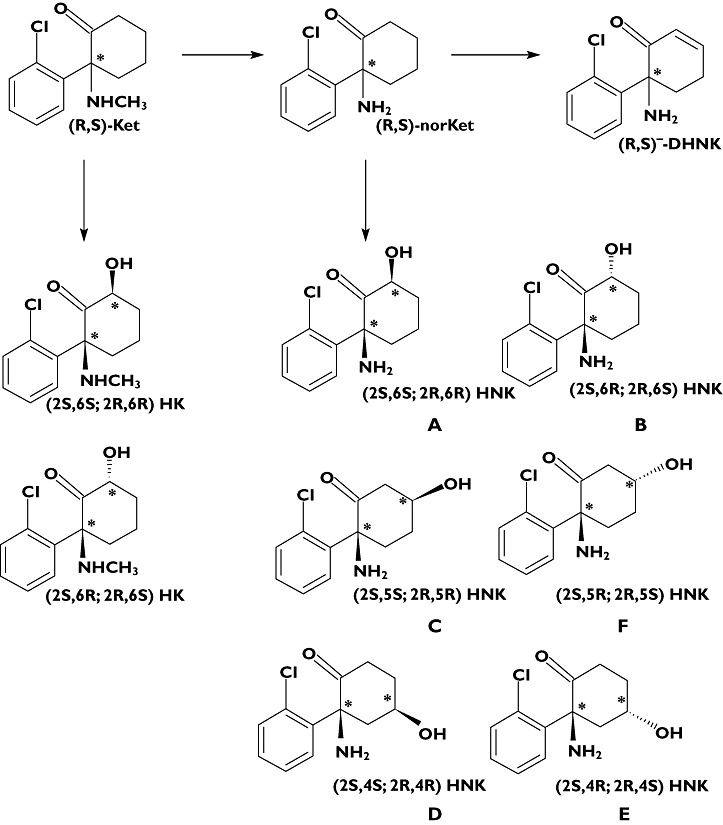
Aim: To construct a population pharmacokinetic (popPK) model for ketamine (Ket), norketamine (norKet), dehydronorketamine (DHNK), hydroxynorketamine (2S,6S;2R,6R)-HNK) and hydroxyketamine (HK) in patients with treatment-resistant bipolar depression.
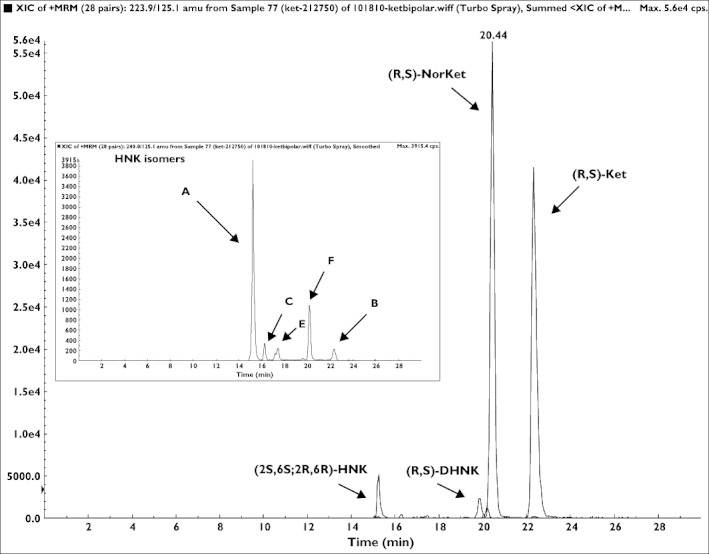
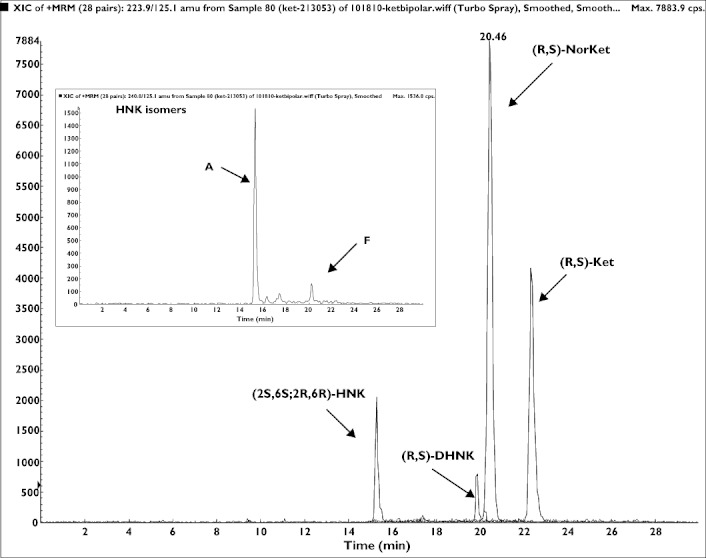
Method: Plasma samples were collected at 40, 80, 110, 230 min on day 1, 2 and 3 in nine patients following a 40 min infusion of (R,S)-Ket (0.5 mg kg⁻¹) and analyzed for Ket, norKet and DHNK enantiomers and (2S,6S;2R,6R)-HNK, (2S,6S;2R,6R)-HK and (2S,6R;2R,6S)-HK. A compartmental popPK model was constructed that included all quantified analytes, and unknown parameters were estimated with an iterative two-stage algorithm in ADAPT5.
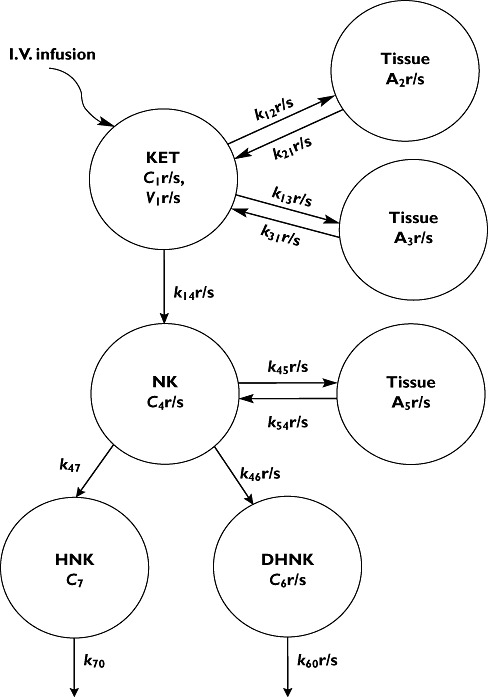
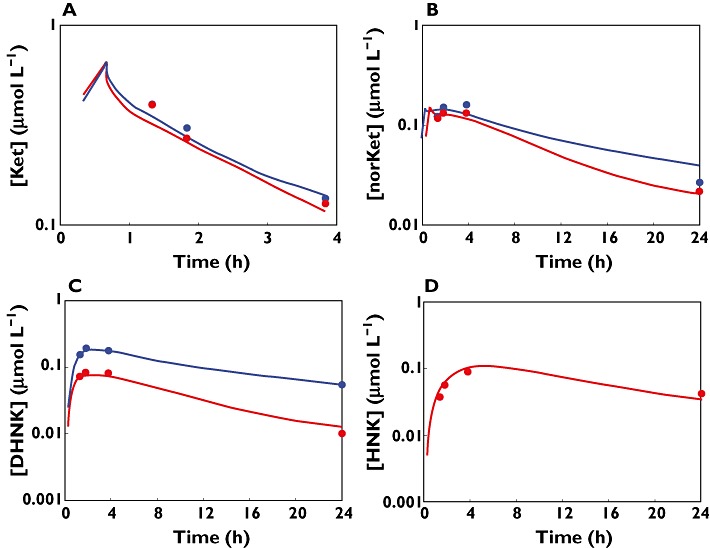
Results: Ket, norKet, DHNK and (2S,6S;2R,6R)-HNK were present during the first 230 min post infusion and significant concentrations (>5 ng ml⁻¹) were observed on day 1. Plasma concentrations of (2S,6S;2R,6R)-HK and (2S,6R;2R,6S)-HK were below the limit of quantification. The average (S) : (R) plasma concentrations for Ket and DHNK were <1.0 while no significant enantioselectivity was observed for norKet. There were large inter-patient variations in terminal half-lives and relative metabolite concentrations; at 230 min (R,S)-DHNK was the major metabolite in four out of nine patients, (R,S)-norKet in three out of nine patients and (2S,6S;2R,6R)-HNK in two out of nine patients. The final PK model included three compartments for (R,S)-Ket, two compartments for (R,S)-norKet and single compartments for DHNK and HNK. All PK profiles were well described, and parameters for (R,S)-Ket and (R,S)-norKet were in agreement with prior estimates.
Conclusion: This represents the first PK analysis of (2S,6S;2R,6R)-HNK and (R,S)-DHNK. The results demonstrate that while norKet is the initial metabolite, it is not the main metabolite suggesting that future Ket studies should include the analysis of the major metabolites.
Published 2012. This article is a U.S. Government work and is in the public domain in the USA.
Figures
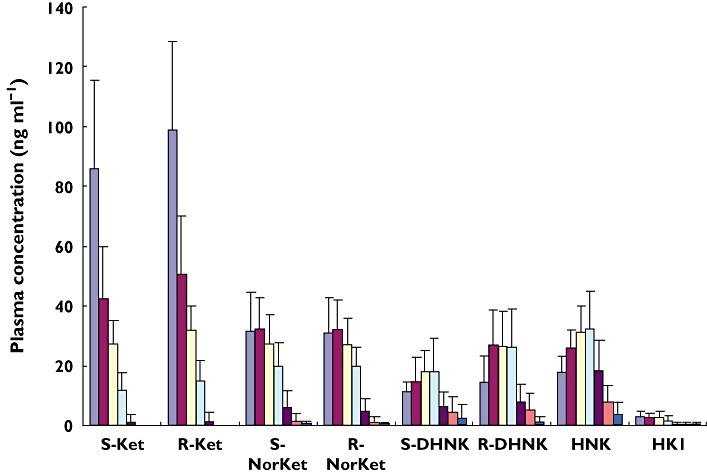
 ); 80 min (
 ); 110 min (
 ); 230 min (
 ); Day 1 (
 ); Day 2 (
 ); Day 3 (
 )
)
References
-
- Kohrs R, Durieux ME. Ketamine: teaching an old drug new tricks. Anesth Analg. 1998;87:1186–93. - PubMed
-
- Domino EF. Taming the ketamine tiger. Anesthesiology. 2010;113:678–86. - PubMed
-
- Schwarztman RJ, Alexander GM, Grothusen JR. The use of ketamine in complex regional pain syndrome: possible mechanisms. Expert Rev Neurother. 2011;11:719–34. - PubMed
-
- Sabia M, Hirsh RA, Torjman MC, Wainer IW, Cooper N, Domsky R, Goldberg ME. Advances in translational neuropathic pain research: example of enantioselective pharmacokinetic-pharmacodynamic modeling of ketamine-induced pain relief in complex regional pain syndrome. Curr Pain Headache Rep. 2011;15:207–14. - PMC - PubMed
-
- Loftus RW, Yeager MP, Clark JA, Brown JR, Abdu WA, Sengupta DK, Beach ML. Intraoperative ketamine reduces perioperative opiate consumption in opiate-dependent patients with chronic back pain undergoing back surgery. Anesthesiology. 2010;113:639–46. - PubMed
Publication types
MeSH terms
Substances
Grants and funding
LinkOut - more resources
Full Text Sources
Other Literature Sources
Medical