


Betel quid use in relation to infectious disease outcomes in Cambodia
- PMID: 22296863
- PMCID: PMC3307941
- DOI: 10.1016/j.ijid.2011.12.006
Betel quid use in relation to infectious disease outcomes in Cambodia
Abstract
Objectives: The habitual chewing of betel quid (areca nut, betel leaf, tobacco) is estimated to occur among 600 million persons in Asia and the Asia-Pacific Region. Emerging data from rural Asia indicate that the betel quid is part of traditional medicine practices that promote its use for a wide range of ailments, including infectious disease. In the present study, we examined the association between betel quid, traditional medicine, and infectious disease outcomes.
Methods: For the purpose of a nationwide, interviewer-administered, cross-sectional survey of tobacco use (including betel quid), we conducted a stratified three-stage cluster sampling of 13 988 adults aged 18 years and older from all provinces of Cambodia.
Results: We found an association between the intensity of betel quid use and HIV/AIDS (odds ratio (OR) 2.06, 95% CI 1.09-3.89), dengue fever (OR 2.40, 95% CI 1.55-2.72), tuberculosis (OR 1.50, 95% CI 0.96-2.36), and typhoid (OR 1.48, 95% CI 0.95-2.30). These associations were even stronger in women - the primary users of betel quid in Cambodia. Multivariable analyses that controlled for age, gender, income, education, urban versus rural dwelling, receiving care from traditional medicine practitioners, and cigarette smoking did not alter the betel quid-infectious disease association.
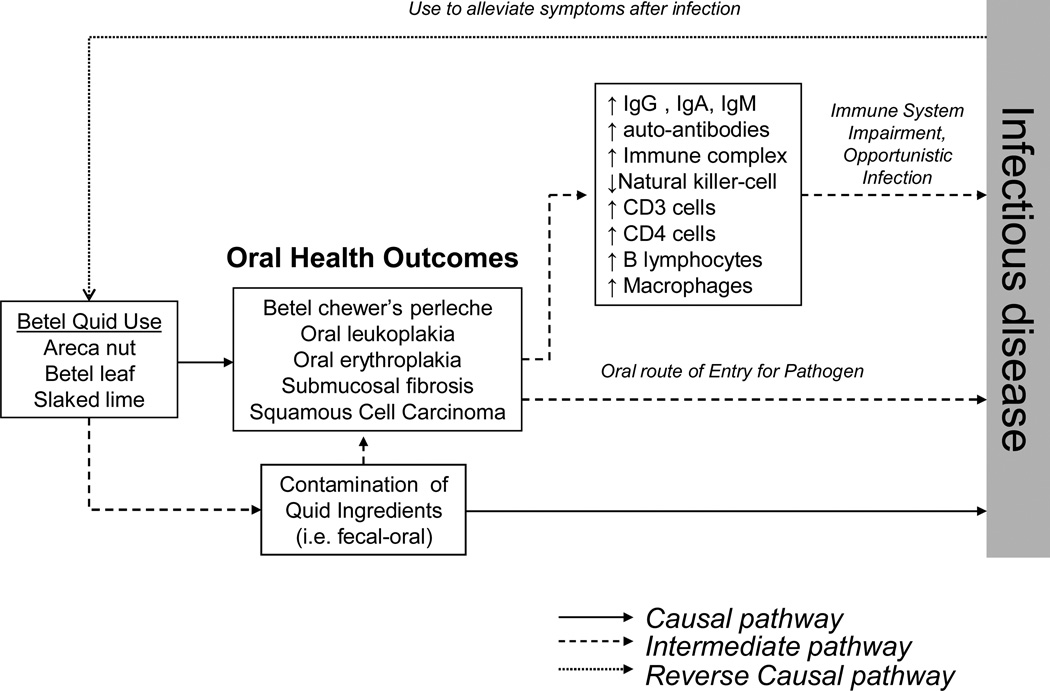
Conclusions: Our findings raise the possibility of a role of betel quid use in the transmission of infectious disease through pathways such as immunosuppression, oral route of entry for a pathogen (i.e., through injury to the oral mucosa), and contamination (i.e., fecal-oral) of the betel quid ingredients.
Copyright © 2012 International Society for Infectious Diseases. Published by Elsevier Ltd. All rights reserved.
Conflict of interest statement
Figures
References
-
- Trivedy CR, Craig G, Warnakulasuriya S. The oral health consequences of chewing areca nut. Addict Biol. 2002;7:115–125. - PubMed
-
- Gupta PC, Warnakulasuriya S. Global epidemiology of areca nut usage. Addict Biol. 2002;7:77–83. - PubMed
-
- Gupta PC, Ray CS, Sinha DN, Singh PK. Smokeless tobacco: a major public health problem in the SEA region: a review. Indian J Public Health. 2011;55:199–209. - PubMed
-
- Gupta PC, Ray CS. Epidemiology of betel quid usage. Ann Acad Med Singapore. 2004;33:31–36. - PubMed
