


AT2 receptor non-peptide agonist C21 promotes natriuresis in obese Zucker rats
- PMID: 22297475
- PMCID: PMC3912844
- DOI: 10.1038/hr.2012.13
AT2 receptor non-peptide agonist C21 promotes natriuresis in obese Zucker rats
Abstract
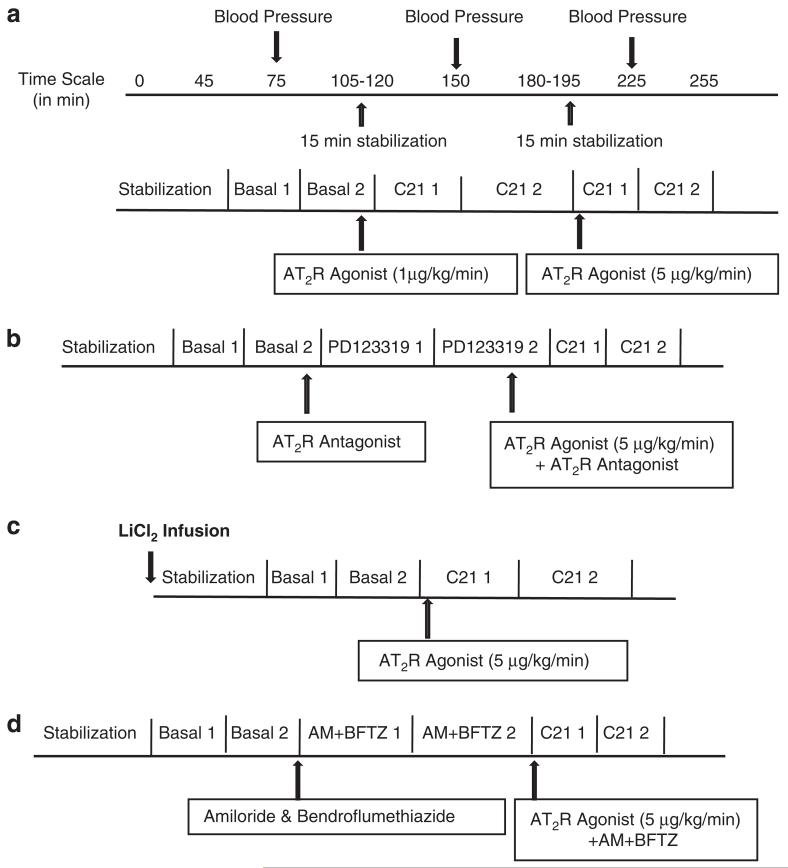
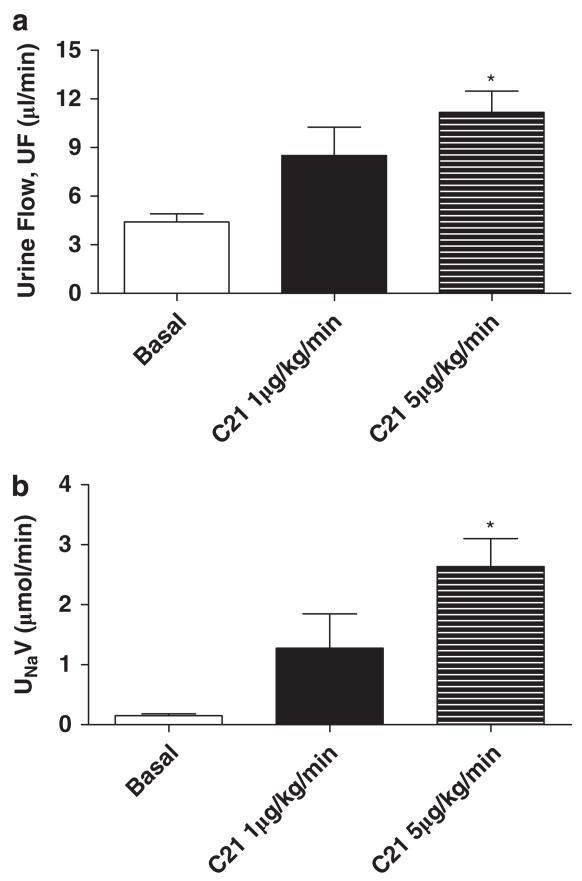
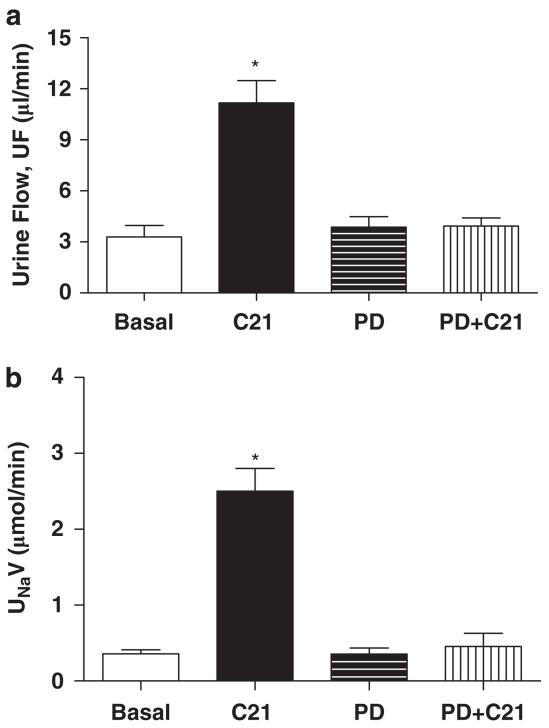
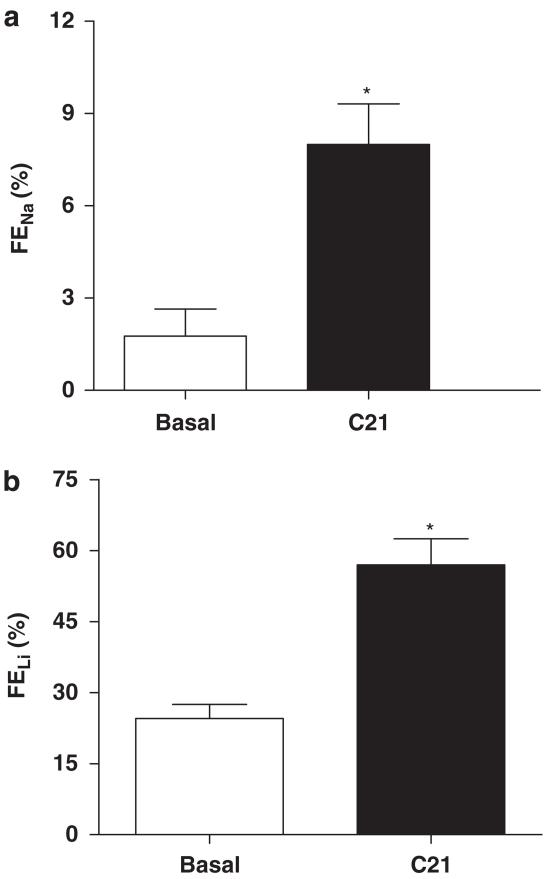
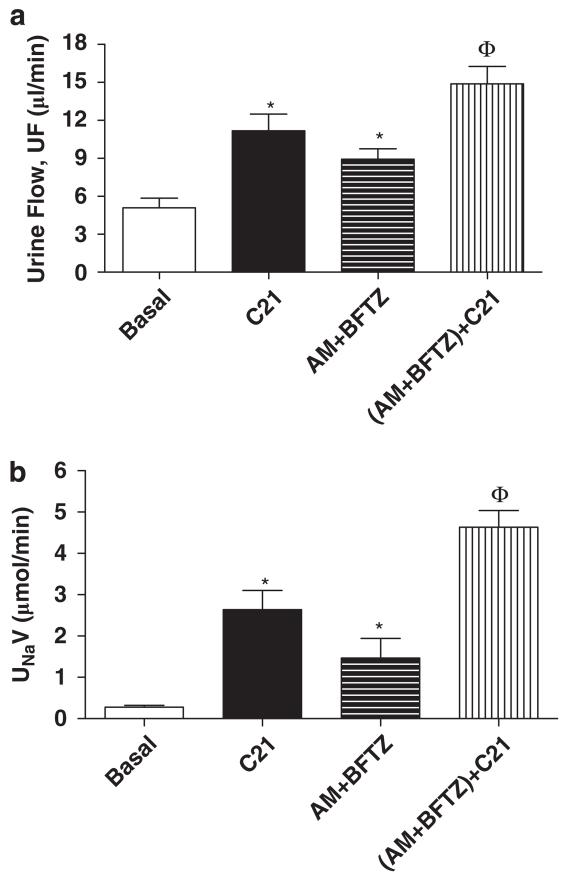
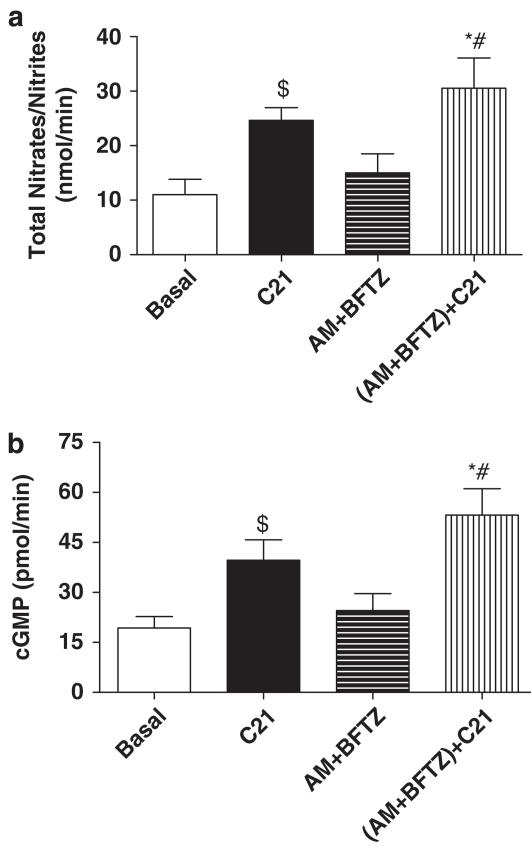
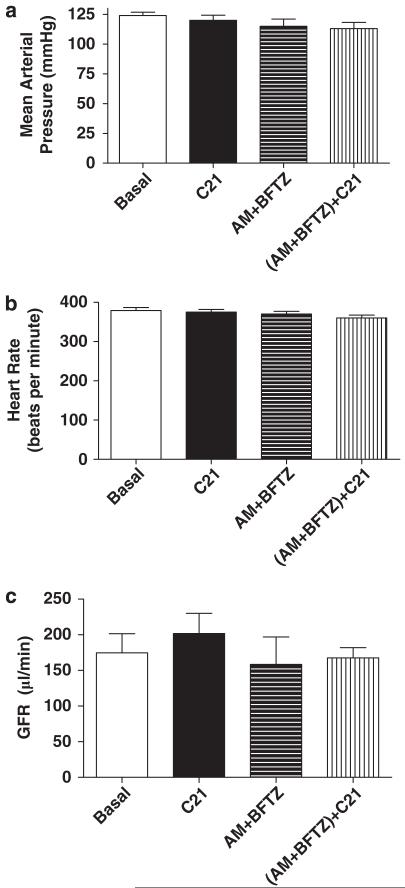
Previously, we demonstrated that angiotensin II type 2 (AT(2)) receptors have a role in natriuresis in obese Zucker rats (OZR). In the present study, we investigated the role of a novel, non-peptide agonist, C21, in natriuresis via AT(2) receptor activation in OZR. Infusion of C21 (1 and 5 μg kg(-1) min(-1)) into rats under anesthesia caused a dose-dependent increase in urine flow (UF) and urinary Na volume (U(Na)V). These effects of C21 were blocked by pre-infusion of the AT(2) receptor antagonist, PD123319, (50 μg kg(-1) min(-1)), suggesting involvement of the AT(2) receptor. Infusion of C21 (5 μg kg(-1) min(-1)) significantly increased the fractional excretion of sodium without changing the glomerular filtration rate or blood pressure, suggesting a tubular effect. Similarly, C21 infusion increased the fractional excretion of lithium, suggesting a proximal tubular effect. Furthermore, we tested the effect of C21 on natriuresis after blocking two main, distal-nephron Na transporters, the epithelial Na channels (ENaC), with amiloride (AM, 3 mg kg(-1) body wt), and the NaCl cotransporters (NCC), with bendroflumethiazide (BFTZ, 7 mg kg(-1) body wt). Infusion of AM + BFTZ caused significant increases in both diuresis and natriuresis, which were further increased by infusion of C21 (5 μg kg(-1) min(-1)). Natriuresis in response to C21 was associated with increases in urinary NO and cGMP levels. The data indicate that the AT(2) receptor agonist, C21, promotes natriuresis via AT(2) receptor activation and that this effect is potentially based in the proximal tubules and linked to the nitric oxide/cyclic guanosine monophosphate pathway. The natriuretic response to C21 may have therapeutic significance by improving kidney function in obesity.
Figures
Comment in
-
The angiotensin type 2 receptor weighs in on obesity: a promising therapeutic target?Hypertens Res. 2012 Jun;35(6):582-4. doi: 10.1038/hr.2012.22. Epub 2012 Feb 16. Hypertens Res. 2012. PMID: 22336769 No abstract available.
References
-
- Carey RM, Wang ZQ, Siragy HM. Role of the angiotensin type 2 receptor in the regulation of blood pressure and renal function. Hypertension. 2000;35:155–163. - PubMed
-
- Rompe F, Artuc M, Hallberg A, Alterman M, Stroder K, Thone-Reineke C, Reichenbach A, Schacherl J, Dahlof B, Bader M, Alenina N, Schwaninger M, Zuberbier T, Funke-Kaiser H, Schmidt C, Schunck WH, Unger T, Steckelings UM. Direct angiotensin II type 2 receptor stimulation acts anti-inflammatory through epoxyeicosatrienoic acid and inhibition of nuclear factor kappaB. Hypertension. 2010;55:924–931. - PubMed
-
- de Gasparo M, Catt KJ, Inagami T, Wright JW, Unger T. International union of pharmacology. XXIII. The angiotensin II receptors. Pharmacol Rev. 2000;52:415–472. - PubMed
-
- Ozono R, Wang ZQ, Moore AF, Inagami T, Siragy HM, Carey RM. Expression of the subtype 2 angiotensin (AT2) receptor protein in rat kidney. Hypertension. 1997;30:1238–1246. - PubMed
Publication types
MeSH terms
Substances
Grants and funding
LinkOut - more resources
Full Text Sources
Medical
Miscellaneous