


Prognostic value of liver fibrosis biomarkers: a meta-analysis
- PMID: 22298979
- PMCID: PMC3264893
Prognostic value of liver fibrosis biomarkers: a meta-analysis
Abstract
Aims and methods: Several serum biomarkers such as FibroTest, aspartate transaminase-platelet ratio index (APRI), FIB-4, and liver stiffness measurement by FibroScan have been validated as alternatives to biopsy for the diagnosis of fibrosis in patients with chronic liver disease. This paper aims to assess the 5-year prognostic values of these biomarkers. A meta-analysis combined all published prognostic studies. Baseline biopsy and APRI data were used as references.
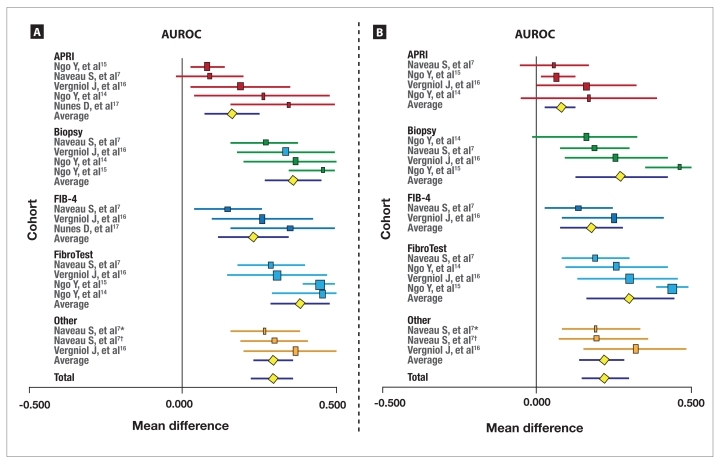
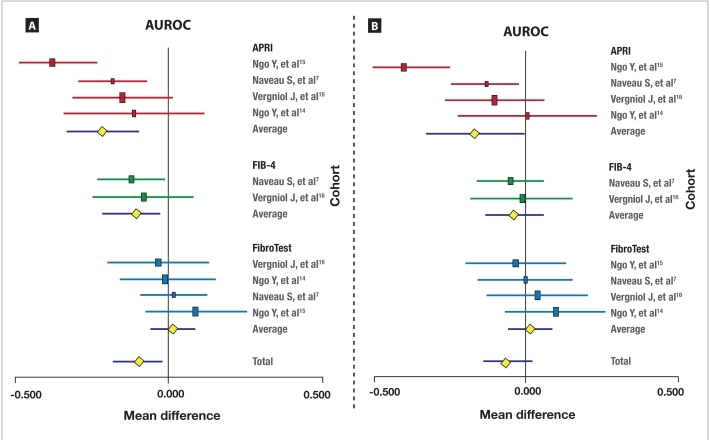
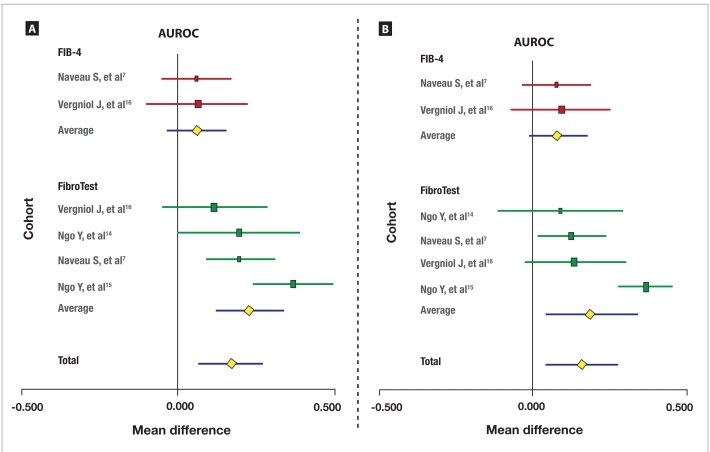
Results: Only 3 biomarkers had several prognostic validations: FibroTest (4 studies; 2,396 patients), APRI (5 studies; 2,422 patients), and FIB-4 (3 studies; 1,184 patients). For the prediction of survival without liver-related death, the areas under the receiver operating characteristic curves (AUROCs) were 0.86 for biopsy (95% confidence interval [CI], 0.77-0.95), 0.88 for FibroTest (95% CI, 0.79-0.98), 0.73 for FIB-4 (95% CI, 0.62-0.85), and 0.66 for APRI (95% CI, 0.57-0.75). APRI had a significantly lower prognostic value versus biopsy, with a mean difference between AUROCs of -0.21 (95% CI, -0.33 to -0.10; P<.001); FIB-4 had a significantly lower prognostic value versus biopsy, with a mean difference between AUROCs of -0.21 (95% CI, -0.20 to -0.02; P=.02). Only FibroTest did not show a significant difference in prognostic value versus biopsy, with a mean difference in AUROCs of +0.02 (95% CI, -0.05 to +0.09; P=.85).
Conclusion: FibroTest is a validated biomarker for the prognosis of patients with chronic liver disease.
Keywords: FIB-4; FibroScan; FibroTest; Fibrosis biomarkers; HepaScore; aspartate transaminase-platelet ratio index; biopsy; elastography; meta-analysis; prognostic value.
Figures
References
-
- Poynard T, Mathurin P, Lai CL, et al. A comparison of fibrosis progression in chronic liver diseases. J Hepatol. 2003;38:257–265. - PubMed
-
- Castera L, Pinzani M. Non-invasive assessment of liver fibrosis: are we ready? Lancet. 2010;375:1419–1420. - PubMed
-
- Fontaine H, Petitprez K, Roudot-Thoraval F, Trinchet JC. Guidelines for the diagnosis of uncomplicated cirrhosis. Gastroenterol Clin Biol. 2007;31:504–509. - PubMed
-
- Bossuyt PM, Reitsma JB, Bruns DE, et al. Towards complete and accurate reporting of studies of diagnostic accuracy: the STARD initiative. The Standards for Reporting of Diagnostic Accuracy Group. Croat Med J. 2003;44:635–638. - PubMed
LinkOut - more resources
Full Text Sources
Other Literature Sources