


Nitric oxide in adaptation to altitude
- PMID: 22300645
- PMCID: PMC3295887
- DOI: 10.1016/j.freeradbiomed.2011.12.028
Nitric oxide in adaptation to altitude
Abstract
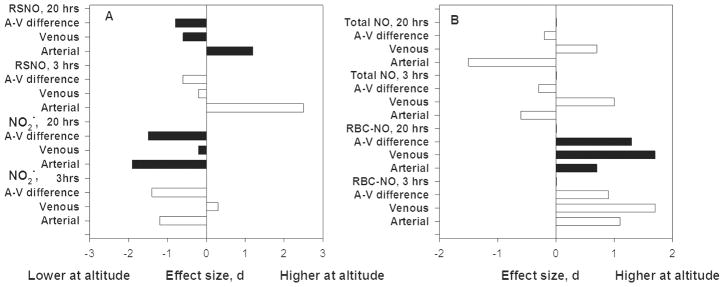
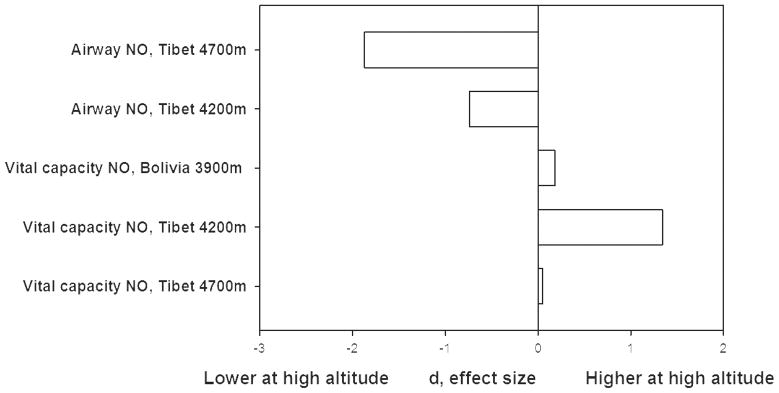
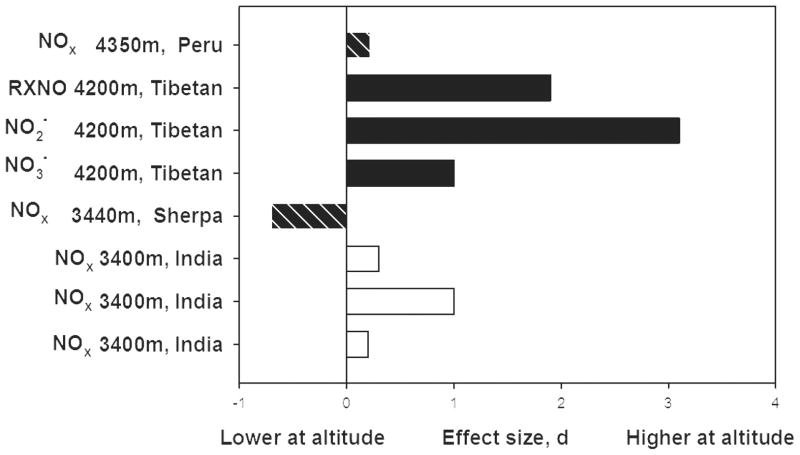
This review summarizes published information on the levels of nitric oxide gas (NO) in the lungs and NO-derived liquid-phase molecules in the acclimatization of visitors newly arrived at altitudes of 2500 m or more and adaptation of populations whose ancestors arrived thousands of years ago. Studies of acutely exposed visitors to high altitude focus on the first 24-48 h with just a few extending to days or weeks. Among healthy visitors, NO levels in the lung, plasma, and/or red blood cells fell within 2h, but then returned toward baseline or slightly higher by 48 h and increased above baseline by 5 days. Among visitors ill with high-altitude pulmonary edema at the time of the study or in the past, NO levels were lower than those of their healthy counterparts. As for highland populations, Tibetans had NO levels in the lung, plasma, and red blood cells that were at least double and in some cases orders of magnitude greater than other populations regardless of altitude. Red blood cell-associated nitrogen oxides were more than 200 times higher. Other highland populations had generally higher levels although not to the degree shown by Tibetans. Overall, responses of those acclimatized and those presumed to be adapted are in the same direction, although the Tibetans have much larger responses. Missing are long-term data on lowlanders at altitude showing how similar they become to the Tibetan phenotype. Also missing are data on Tibetans at low altitude to see the extent to which their phenotype is a response to the immediate environment or expressed constitutively. The mechanisms causing the visitors' and the Tibetans' high levels of NO and NO-derived molecules at altitude remain unknown. Limited data suggest processes including hypoxic upregulation of NO synthase gene expression, hemoglobin-NO reactions, and genetic variation. Gains in understanding will require integrating appropriate methods and measurement techniques with indicators of adaptive function under hypoxic stress.
Copyright © 2012 Elsevier Inc. All rights reserved.
Figures
References
-
- Persson MG. Endogenous nitric oxide as a probable modulator of pulmonary circulation and hypoxic pressor response in vivo. Acta Physiol Scand. 1990;140:449–457. - PubMed
-
- Gustafsson LE, Leone AM, Persson MG, Wiklund NP, Moncada S. Endogenous Nitric Oxide Is Present In The Exaled Air Of Rabbits, Guinea Pigs And Humans. Biochem Biophys Res Commun. 1991;181:852–857. - PubMed
-
- Scherrer U, Vollenweider L, Delabays A, Savcic M, Eichenberger U, Kleger GR, Fikrle A, Ballmer PE, Nicod P, Bärtsch P. Inhaled nitric oxide for high-altitude pulmonary edema. N Engl J Med. 1996;334:624–629. - PubMed
-
- Erusalimsky JD, Moncada S. Nitric oxide and mitochondrial signaling: from physiology to pathophysiology. Arterioscler Thromb Vac Biol. 2007;27:2524. - PubMed
References for Figures
-
- Beall CM, Laskowski D, Strohl KP, Soria R, Villena M, Vargas E, Alarcon AM, Gonzales C, Erzurum SD. Pulmonary nitric oxide in mountain dwellers. Nature. 2001;414:411–412. - PubMed
-
- Anand IS, et al. Effects of Inhaled Nitric Oxide and Oxygen in High-Altitude Pulmonary Edema. Circulation. 1998;98:2441–2445. - PubMed
-
- Sartori C, Allemann Y, Trueb L, Delabays A, Nicod P, Scherrer U. Augmented vasoreactivity in adult life associated with perinatal vascular insult. The Lancet. 1999;353:2205–2207. - PubMed
-
- Jayet PY, Rimoldi SF, Stuber T, Salmon CS, Hutter D, Rexhaj E, Thalmann S, Schwab M, Turini P, Sartori-Cucchia C, Nicod P, Villena M, Allemann Y, Scherrer U, Sartori C. Pulmonary and systemic vascular dysfunction in young offspring of mothers with preeclampsia. Circulation. 2010;122:488–494. - PubMed
-
- Scherrer U, Vollenweider L, Delabays A, Savcic M, Eichenberger U, Kleger GR, Fikrle A, Ballmer PE, Nicod P, Bärtsch P. Inhaled nitric oxide for high-altitude pulmonary edema. N Engl J Med. 1996;334:624–629. - PubMed
Publication types
MeSH terms
Substances
Supplementary concepts
Grants and funding
LinkOut - more resources
Full Text Sources
Other Literature Sources
Medical
Research Materials
Miscellaneous
