Human risk of infection with Borrelia burgdorferi, the Lyme disease agent, in eastern United States
- PMID: 22302869
- PMCID: PMC3269287
- DOI: 10.4269/ajtmh.2012.11-0395
Human risk of infection with Borrelia burgdorferi, the Lyme disease agent, in eastern United States
Abstract
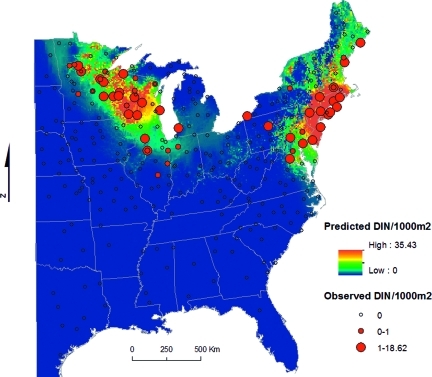
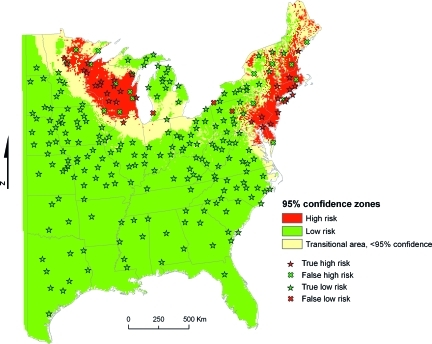
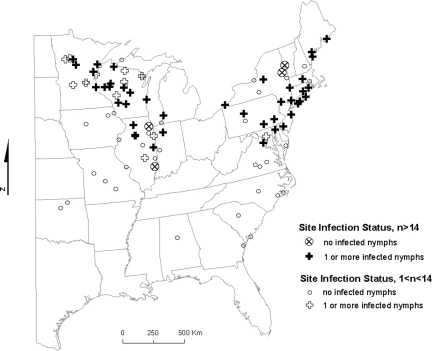
The geographic pattern of human risk for infection with Borrelia burgdorferi sensu stricto, the tick-borne pathogen that causes Lyme disease, was mapped for the eastern United States. The map is based on standardized field sampling in 304 sites of the density of Ixodes scapularis host-seeking nymphs infected with B. burgdorferi, which is closely associated with human infection risk. Risk factors for the presence and density of infected nymphs were used to model a continuous 8 km×8 km resolution predictive surface of human risk, including confidence intervals for each pixel. Discontinuous Lyme disease risk foci were identified in the Northeast and upper Midwest, with a transitional zone including sites with uninfected I. scapularis populations. Given frequent under- and over-diagnoses of Lyme disease, this map could act as a tool to guide surveillance, control, and prevention efforts and act as a baseline for studies tracking the spread of infection.
Figures
Comment in
-
Yale Lyme disease risk maps are not accurate for the South in 2012.Am J Trop Med Hyg. 2012 Jun;86(6):1085. doi: 10.4269/ajtmh.2012.12-0149a. Am J Trop Med Hyg. 2012. PMID: 22665623 Free PMC article. No abstract available.
References
-
- Steere AC, Hardin JA, Malawista SE. Lyme arthritis: the enlarging clinical spectrum. Clin Res. 1977;25:368A. - PubMed
-
- Steere AC. Lyme disease. N Engl J Med. 1989;321:586–596. - PubMed
-
- Steere AC, Hardin JA, Malawista SE. Erythema chronicum migrans and Lyme arthritis: cryoimmunoglobulins and clinical activity of skin and joints. Science. 1977;196:1121–1122. - PubMed
-
- Bacon RM, Kugeler KJ, Mead PS. Surveillance for Lyme disease—United States, 1992–2006. MMWR Surveill Summ. 2008;57:1–9. - PubMed
-
- Shadick NA, Phillips CB, Logigian EL, Steere AC, Kaplan RF, Berardi VP, Duray PH, Larson MG, Wright EA, Ginsburg KS, Katz JN, Liang MH. The long-term clinical outcomes of Lyme disease. A population-based retrospective cohort study. Ann Intern Med. 1994;121:560–567. - PubMed
Publication types
MeSH terms
Grants and funding
LinkOut - more resources
Full Text Sources
Medical