. 2002:1:e0044.
doi: 10.1199/tab.0044. Epub 2002 Mar 27.

The Arabidopsis circadian system

The Arabidopsis circadian system

C Robertson McClung et al. Arabidopsis Book. 2002.

Abstract

Rhythms with periods of approximately 24 hr are widespread in nature. Those that persist in constant conditions are termed circadian rhythms and reflect the activity of an endogenous biological clock. Plants, including Arabidopsis, are richly rhythmic. Expression analysis, most recently on a genomic scale, indicates that the Arabidopsis circadian clock regulates a number of key metabolic pathways and stress responses. A number of sensitive and high-throughput assays have been developed to monitor the Arabidopsis clock. These assays have facilitated the identification of components of plant circadian systems through genetic and molecular biological studies. Although much remains to be learned, the framework of the Arabidopsis circadian system is coming into focus.DedicationThis review is dedicated to the memory of DeLill Nasser, a wonderful mentor and an unwavering advocate of both Arabidopsis and circadian rhythms research.


Figures
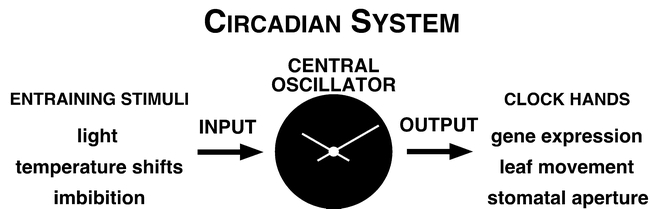
Figure 1.
Figure 1.
Conceptual scheme illustrating simple linear information flow from input (entrainment) pathways through the central oscillator to output pathways. Modified from Eskin (Eskin, (1979))
Figure 2.
Figure 2.
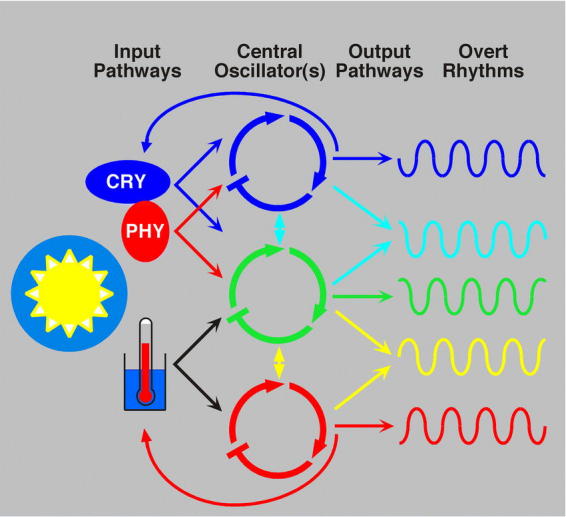
A more realistic model of a simple circadian system consisting of a set of input (entrainment) pathways, multiple central oscillators, and sets of output pathways. Entraining stimuli include light, mediated through phytochromes (PHY) and cryptochromes (CRY), temperature, and imbibition (not shown). Complexity in input pathways arises from multiple phytochromes and cryptochromes as well as interaction among them and their downstream signaling pathways. Each central oscillator is illustrated as a loop including positive and negative components that yields a self-sustaining oscillation with a period of approximately 24 hr. Coupling between oscillators is suggested by double-headed arrows. Multiple output pathways are drawn as each regulating an overt rhythm with a distinct phase. Some outputs may be driven by individual oscillators whereas others may receive input from more than one oscillator. Additionally, different oscillators may drive separate rhythms with distinct periods.
Figure 3.
Figure 3.
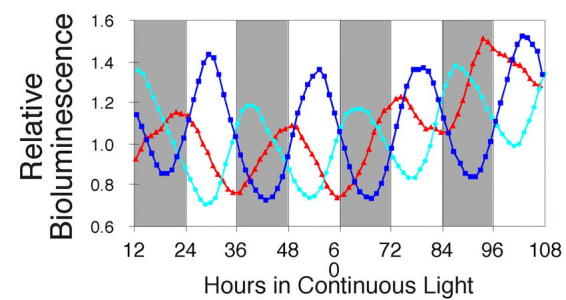
Rhythmic gene transcription, monitored as LUC activity in seedlings carrying promoter::LUC transgenes to illustrate phase-specific transcription. Seedlings (Col ecotype) carrying either CAT2::LUC (red triangles), LHCB::LUC transgene (blue squares) or a CAT3::LUC transgene (cyan circles) were entrained to a light-dark (12:12) cycle and released into continuous light at T=0. The peak in CAT2::LUC activity occurs at subjective dawn, in CAB2::LUC activity at mid-day, and in CAT3::LUC activity at subjective dusk. Gray boxes indicate subjective night.
Figure 4.
Figure 4.
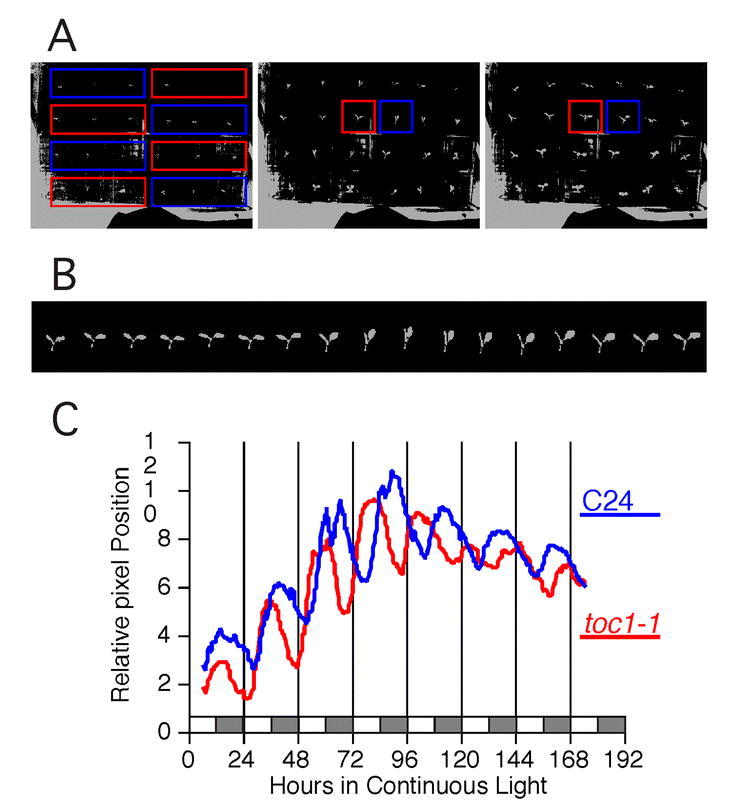
toc1-1 shows a short period in leaf (cotyledon) movement. (A) Three images (initial, middle and last) of a video clip that can be reached by double-clicking on the image. Twelve toc1-1 (red) and twelve isogenic wild type C24 ecotype (blue) seedlings were imaged for seven circadian cycles. (B) Images of a single C24 seedling [outlined by the blue box in the middle and right panels of (A)] captured at 90 min intervals across a single circadian cycle. (C) Quantification of cotyledon position from the images shown in (A) for toc1-1 (red) and C24 (blue). The data represent the average for the two cotyledons of the seedlings indicated by the boxes in the middle and right panels of (A). The shortened period of toc1-1 is evident. Seedlings were entrained to a light-dark (12:12) cycle and released into continuous light at T=0. Gray boxes indicate subjective night as defined by the entraining cycle.
Figure 5.
Figure 5.
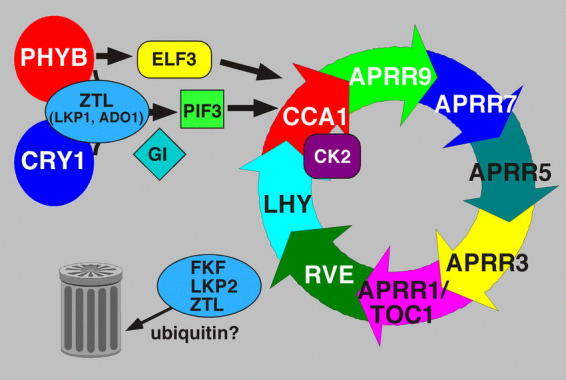
A speculative model of an Arabidopsis circadian clock. Light input via phytochromes and cryptochromes (for simplicity, only PHYB and CRY1 are shown, although others are certainly involved) is mediated through ZTL, ELF3 and GI, or through PIF3. ZTL/ADO1 is known to bind to PHYB and CRY1. PIF3 binds to CCA1 and LHY promoters and possibly to other targets in the clock. The pathway downstream of GI is not known. Although the input pathways are drawn as discrete linear pathways, there may be interaction among them. For simplicity, a single central oscillator is illustrated with a number of putative oscillator components indicated. Components on the circular arrows oscillate in mRNA or protein abundance. One should not infer causal relationships among putative components from the relative order of their placement on the circle as experimental proof is lacking. FKF/LKP2/ZTL are clustered, although there is no evidence that they form molecular complexes. Moreover, LKP2 mRNA oscillates and overexpression results in arrhythmicity, making LKP2 a strong candidate as an oscillator component. CCA1 and LHY are phosphorylated by CK2, which may make them substrates for the F-box proteins (ZTL, FKF and LKP2) and target them for ubiquitination and degradation by the proteasome (trash can). Output pathways may emanate from any of the putative oscillator components. CCA1, LHY, RVEs and TOC1/APRR1 are DNA-binding proteins, and CCA1 is know to bind to LHCB promoters. Other outputs from the oscillator feed back to input components, such as PHYA, PHYB and CRY1, which are regulated by the clock at transcriptional and mRNA abundance levels
Figure 6.
Figure 6.
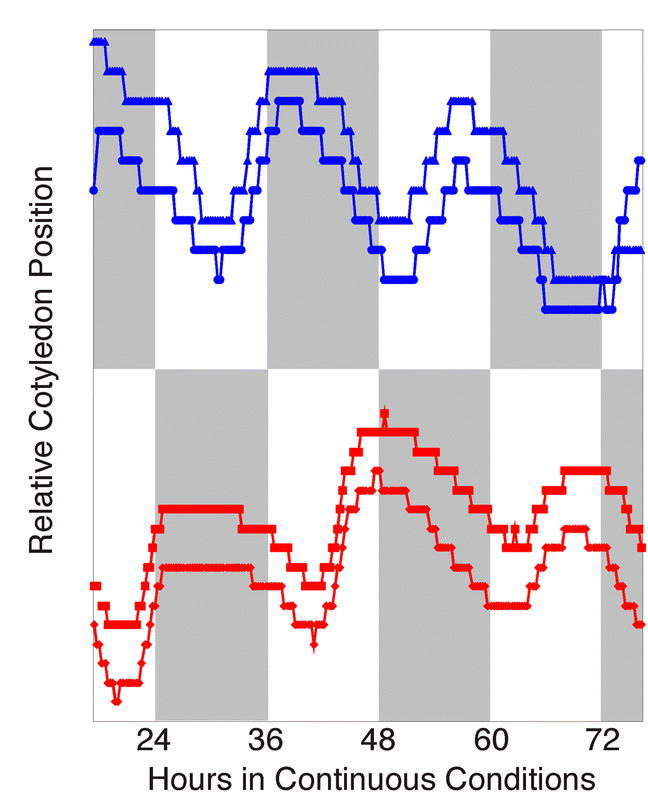
Entrainment of the circadian rhythm in leaf (cotyledon) movement by temperature cycles. Upper panel shows individual traces (blue) of the relative cotyledon positions for the two cotyledons of a representative seedling entrained under continuous light to a temperature cycle of 12 hr at 22°C and 12 hr at 18°C and then released into continuous conditions of constant light at 22°C at T=0. The lower panel shows traces (red) for the two cotyledons of a seedling entrained to the antiphase (180° out-of-phase) temperature cycle of 12 hr at 18°C and 12 hr at 22°C. Gray bars indicate subjective night as defined by the cold period of the entraining cycle.
Figure 7.
Figure 7.
A simple model of a circadian oscillator to illustrate interlocked positive and negative feedback loops. For detailed models of Neurospora, Drosophila and murine clocks, see (Heintzen et al., 2001; Reppert and Weaver, (2001); Williams and Sehgal, (2001)).

References

    1. Adams J., Kelso R., Cooley L. The kelch repeat superfamily of proteins: propellers of cell function. Trends Cell Biol. 2000;101(1):17–24. - PubMed
    1. Ahmad M., Jarillo J. A., Smirnova O., Cashmore A. R. The CRY1 blue light photoreceptor of Arabidopsis interacts with phytochrome A in vitro. Mol. Cell. 1998;11(1):939–948. - PubMed
    1. Alabadí D., Oyama T., Yanovsky M. J., Harmon F. G., Más P., Kay S. A. Reciprocal regulation between TOC1 and LHY/CCA1 within the Arabidopsis circadian clock. Science. 2001;2931(1):880–883. - PubMed
    1. Aschoff J. Exogenous and endogenous components in circadian rhythms. Cold Spring Harbor Symposia on Quantitative Biology. 1960;1(1):11–28. XXV. - PubMed
    1. Barnes S. A., McGrath R. B., Chua N-H. Light signal transduction in plants. Trends Cell Biol. 1997;71(1):21–26. - PubMed

LinkOut - more resources