


doi: 10.1199/tab.0107.
Epub 2007 Feb 21.
Arabidopsis-insect interactions
Affiliations
- PMID: 22303231
- PMCID: PMC3243410
- DOI: 10.1199/tab.0107
Item in Clipboard
Arabidopsis-insect interactions
Arabidopsis Book.
2007.
No abstract available
Figures
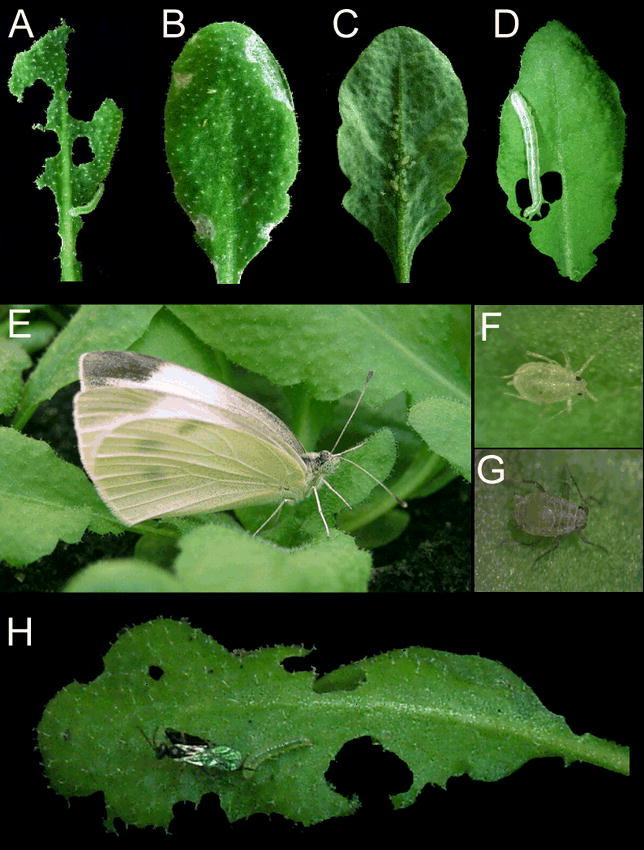
(A) Leaf damage by early instar P. rapae caterpillars; (B) Leaf damage by Franliniella occidentalis thrips larvae; (C) Myzus persicae aphids accumulating near the mid-vein; (D) Leaf damage by late instar Trichoplusia ni caterpillar; (E) P. rapae female butterfly preparing to oviposit; (F) Close-up of M. persicae on Arabidopsis; (G) Close-up of Lipaphis erysimi aphid on Arabidopsis; (H) Cotesia rubecula female parasitoid after ovipositing on its host P. rapae. (A)-(C) adapted with permission from De Vos et al., (2005); (D)-(G) by Jetske De Boer & Remco Van Poecke; (H) by Tjeerd Snoeren.
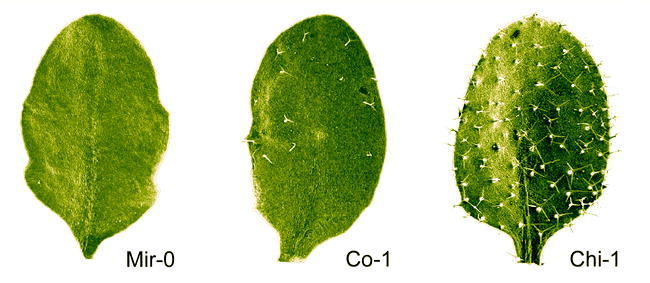
Arabidopsis leaf trichomes. Three Arabidopsis accession showing difference in leaf trichome densitiy. Figure adapted with permission from Symonds et al. (2005). Color on the original black and white picture was added using Adobe Photoshop 8.0.
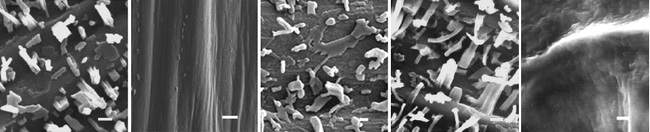
Arabidopsis waxes. Scanning electron microscope images of waxes from (from left to right): flowering stems from accession Ler, mutants cer6 and cer15 (both in Ler background), accession Ws and abaxial leaf from Ws. Figure adapted with permission from Jenks et al. (2002).
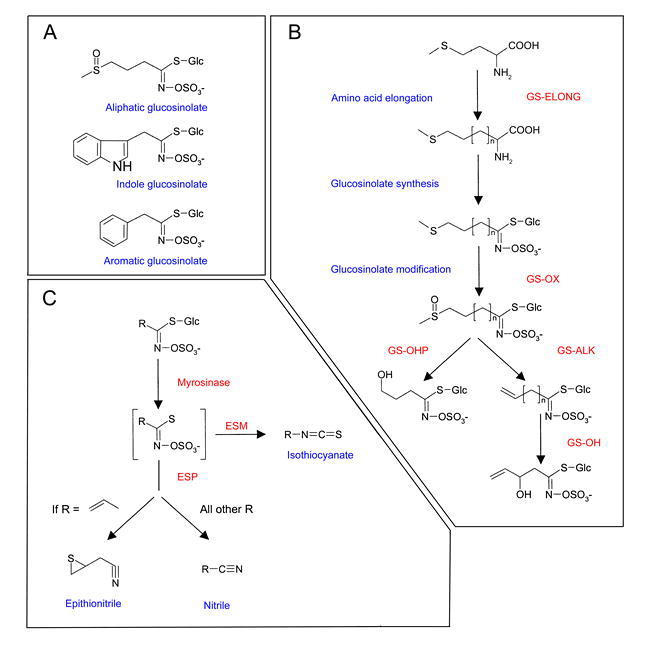
Glucosinolates. (A) Examples of the three classes of glucosinolates: aliphatic; indole; and aromatic glucosinolates, here represented by 3-methylsulfinylpropyl glucosinolate; indol-3-ylmethyl glucosinolate; and benzyl glucosinolate. (B) Simplified biosynthesis of glucosinolates in three steps, illustrated here with the biosynthesis of methionine-derived glucosinolates, the largest and most diverse group of glucosinolates in Arabidopsis. The three steps are indicated in blue: amino acid elongation (optional); glucosinolate synthesis; and glucosinolate modification (optional). The optional steps are not required for every glucosinolate. Five major loci controlling much of the variation in glucosinolate composition are indicated in red. GS-ELONG is involved in side-chain elongation (n indicates number of elongation cycles); GS-OX converts methylthioalkyl glucosinolates to methylsulfinylalkylglucosinolates; GS-OHP and GS-ALK represent two different alleles from the GS-AOP locus, GS-OHP only acts on 3 carbon side-chain glucosinolates (n=1) and produces hydroxypropyl glucosinolates and GS-AOP produces alkenyl glucosinolates; GS-OH hydroxylates alkenyl glucosinolates and only acts on 4 carbon side-chain glucosinolates. (C) Degradation of glucosinolates leading either to isothiocyanate or nitrile production depending on activity of ethiospecifier protein (ESP) and/or ethiospecifier modifier1 (ESM1). Enzyme activities are indicated in red. Figure adapted with permission from Kliebenstein, et al. (2004).
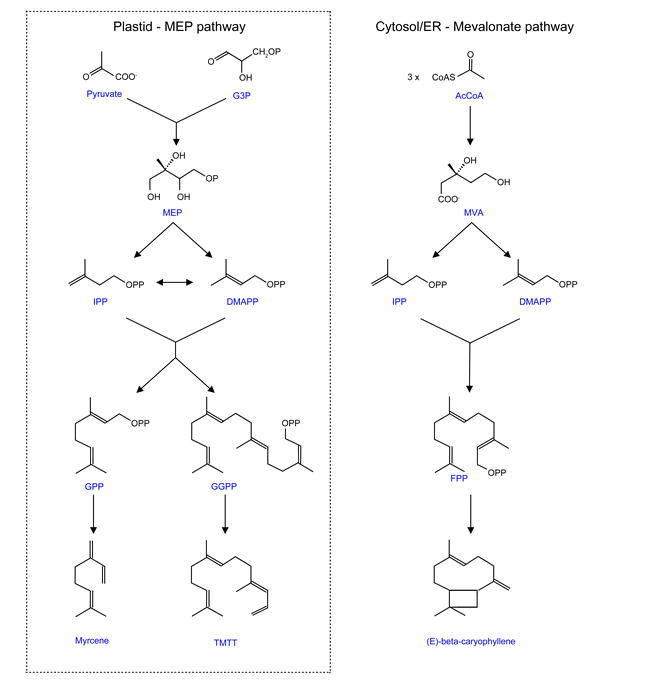
Terpenoid biosynthesis. Biosynthesis of mono- and di-terpenes via the plastidal MEP pathway and of sesquiterpenes via the cytosolic mevalonate pathway for three compounds commonly found in Arabidopsis. Compound names in blue. For abbreviations see §2.4.1; additionally G3P, glyceraldehyde 3-phosphate; AcCoA, acetyl coenzyme A; GPP, ger-anyl diphosphate; GGPP, geranylgeranyl diphosphate; FPP farnesyl diphosphate; TMTT, (3E,7E)-4,8,12-trimethyl-1,3,7,11-tridecatetraene.
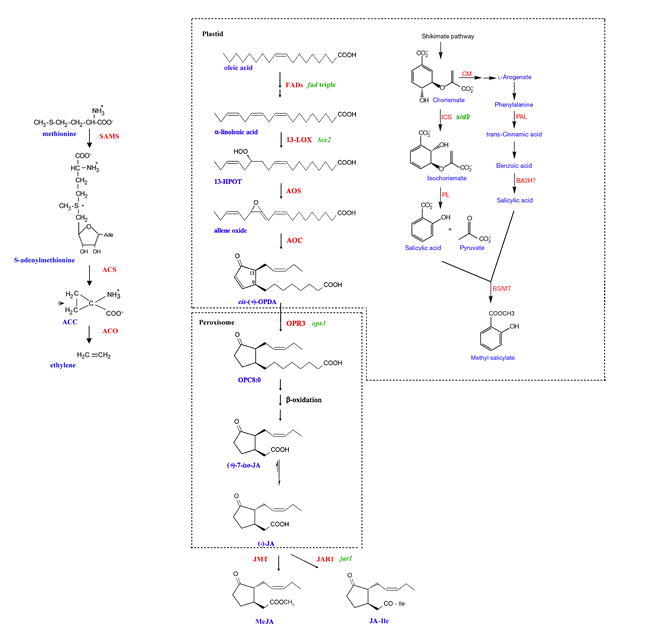
Biosynthesis of ET, JA and SA. From left to right: biosynthesis of ET, jasmonates and SA. Enzymes are indicated in red, mutants in green and compound names in blue. For explanation of abbreviations see §3.2.2.1 (ET), §3.2.1 (jasmonates) and §3.2.3.1 (SA); additionally FADs, fatty acid desaturases; 13-HPOT, 13(S)-hydroperoxy linolenic acid; OPC8:0, 3-oxo-2(2_(Z)-pentenyl)-cyclopentane-1-octanoic acid; BA2H, benzoic acid-2 hydroxylase. Figure adapted with permission from Schaller and Kieber (2002); Schaller et al. (2005); and Wildermuth et al. (2001).
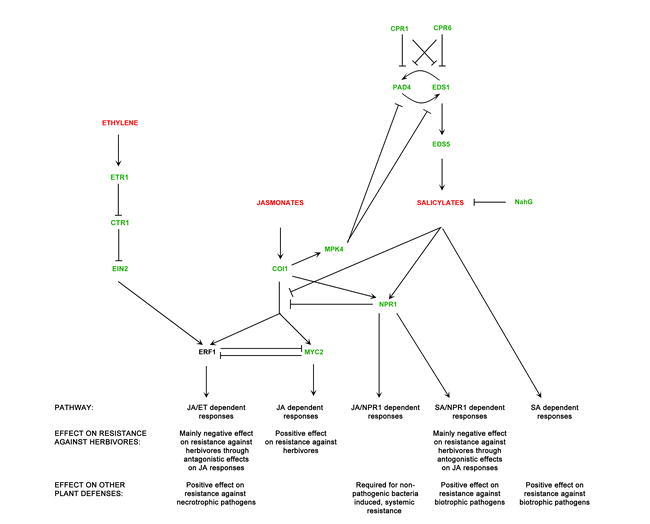
Signaling networks. A simplified scheme of ET, JA and SA signaling and their interactions. Hormones are depicted in red, proteins for which mutants were discussed in section 3.2 are depicted in green. Figure partially adapted from de Vos (2006).
References
-
- Agrawal A. A., Karban R. Why induced defenses may be favored over constitutive strategies in plants. 1999;5(1):45–61. In R Tollrian, CD Harvell, eds, The ecology and evolution of inducible defenses. Princeton University Press, Princeton, pp.
-
- Alborn T., Turlings T. C. J., Jones T. H., Stenhagen G., Loughrin J. H., Tumlinson J. H. An elicitor of plant volatiles from beet armyworm oral secretion. Science. 1997;2765(1):945–949.
-
- Alméras E., Stolz S., Vollenweider S., Reymond P., Mene-Saffrane L., Farmer E. E. Reactive electrophile species activate defense gene expression in Arabidopsis. Plant Journal. 2003;345(1):202–216. - PubMed
-
- Alonso J. M., Hirayama T., Roman G., Nourizadeh S., Ecker J. R. EIN2, a bifunctional transducer of ethylene and stress responses in Arabidopsis. Science. 1999;2845(1):2148–2152. - PubMed
LinkOut - more resources
Full Text Sources