. 2008:6:e0113.
doi: 10.1199/tab.0113. Epub 2008 Jul 24.

Storage reserve accumulation in Arabidopsis: metabolic and developmental control of seed filling

Affiliations

Storage reserve accumulation in Arabidopsis: metabolic and developmental control of seed filling

Sébastien Baud et al. Arabidopsis Book. 2008.

Abstract

In the life cycle of higher plants, seed development is a key process connecting two distinct sporophytic generations. Seed development can be divided into embryo morphogenesis and seed maturation. An essential metabolic function of maturing seeds is the deposition of storage compounds that are mobilised to fuel post-germinative seedling growth. Given the importance of seeds for food and animal feed and considering the tremendous interest in using seed storage products as sustainable industrial feedstocks to replace diminishing fossil reserves, understanding the metabolic and developmental control of seed filling constitutes a major focus of plant research. Arabidopsis thaliana is an oilseed species closely related to the agronomically important Brassica oilseed crops. The main storage compounds accumulated in seeds of A. thaliana consist of oil stored as triacylglycerols (TAGs) and seed storage proteins (SSPs). Extensive tools developed for the molecular dissection of A. thaliana development and metabolism together with analytical and cytological procedures adapted for very small seeds have led to a good description of the biochemical pathways producing storage compounds. In recent years, studies using these tools have shed new light on the intricate regulatory network controlling the seed maturation process. This network involves sugar and hormone signalling together with a set of developmentally regulated transcription factors. Although much remains to be elucidated, the framework of the regulatory system controlling seed filling is coming into focus.

Keywords: Arabidopsis; seed maturation; seed storage proteins (SSPs); triacylglycerols (TAGs).


Figures
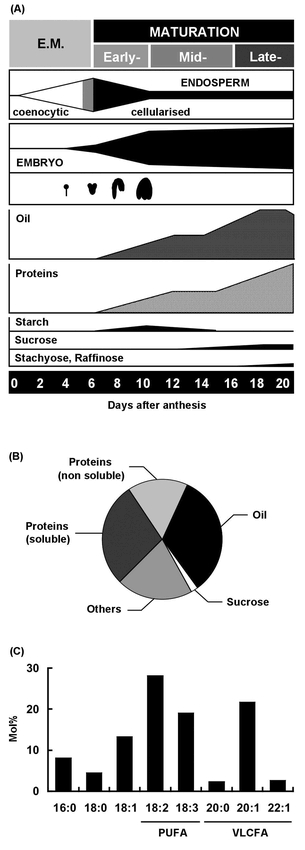
Figure 1.
Figure 1.
Seeds of Arabidopsis thaliana (A) Schematic overview of seed development in A. thaliana adapted from Baud et al. (2002). The relative volume of endosperm and embryo within the seed are presented throughout the seed developmental process. Embryos are represented at the globular, torpedo, early-bent cotyledon, and upturned-U stages. A time course of carbohydrate and major storage compound (e.g. triacylglycerols and seed storage proteins) content is shown in parallel. E.M., embryo morphogenesis. (B) Composition of mature A. thaliana seeds (Wassilewskija accession). (C) Fatty acid composition of mature A. thaliana seeds (Wassilewskija accession). PUFA, polyunsatu-rated fatty acids; VLCFA, very long chain fatty acids.
Figure 2.
Figure 2.
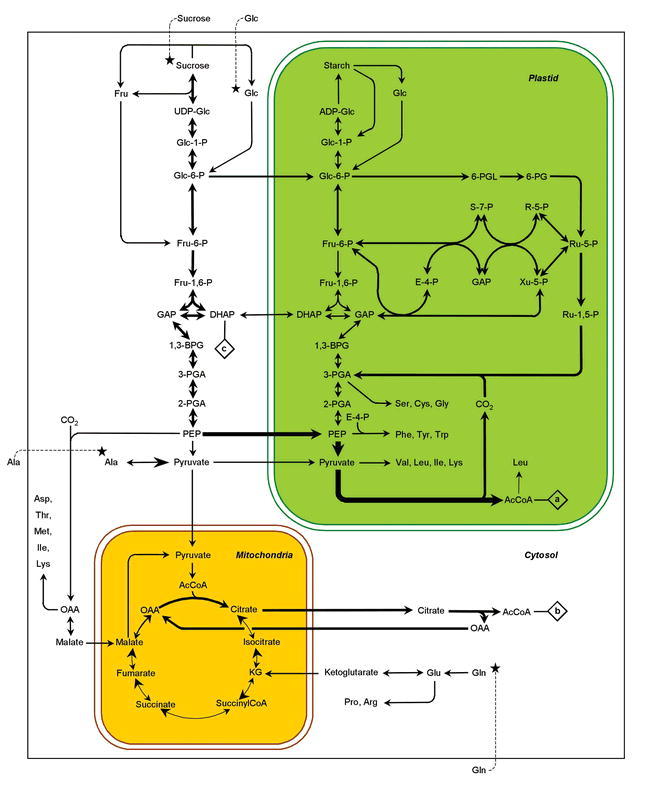
Simplified scheme of central metabolism in maturing embryos of Arabidopsis thaliana. This scheme is adapted from White et al. (2000), Schwender et al. (2004), and Schwender et al. (2006). The arrow thicknesses are proportional to net fluxes of carbon, based on biochemical data and transcriptional profiling of maturing seeds. Black stars indicate metabolites that are directly imported from the apoplastic space. Letters in a diamond indicate metabolic links with pathways presented on figures 3 and 4. ADP-Glc, adenosine diphosphoglucose; AcCoA, acetyl-coenzyme A; 1,3-BPG, 1,3-bisphosphoglycerate; DHAP, dihydroxyacetone-3-phosphate; E-4-P, erythrose-4-phosphate; Fru, fructose; Fru-1,6-P, fructose-1,6-bisphosphate; Fru-6-P, fructose-6-phosphate; GAP, glyceraldehyde-3-phosphate; Glc, glucose; Glc-1-P, glucose-1-phosphate; Glc-6-P, glucose-6-phosphate; KG, alpha-ketoglutarate; OAA, oxaloacetate; 6-PG, 6-phosphogluconate; 6-PGL, 6-phosphogluconolactone; PEP, phospho-enolpyruvate; 2-PGA, 2-phosphoglycerate; 3-PGA, 3-phosphoglycerate; R-5-P, ribose-5-phosphate; Ru-1,5-P, ribulose-1,5-bisphosphate; Ru-5-P, ribulose-5-phosphate; S-7-P, sedoheptulose-7-phosphate; UDP-Glc, uridine diphosphoglucose; Xu-5-P, xylulose-5-phosphate.
Figure 3.
Figure 3.
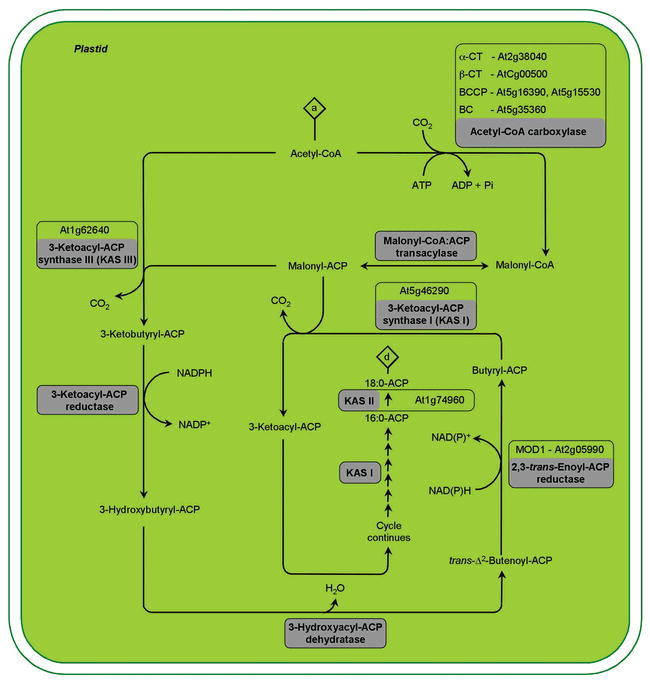
Fatty acid synthesis in the plastids of maturing embryos of Arabidopsis thaliana. This scheme is adapted from Miquel and Browse (1995) and Somerville et al. (2000). Fatty acids are grown by sequential acylation of two-carbon units. The first condensation reaction is catalysed by ketoacyl-ACP synthase III (KASIII). During the following cycles, the condensation reaction is catalysed by KASI. Finally, the conversion of 16:0 to 18:0 is catalysed by KASII. ACP, acyl-carrier protein; CoA, coenzyme A. Letters in a diamond indicate metabolic links with pathways presented on figures 2 and 4
Figure 4.
Figure 4.
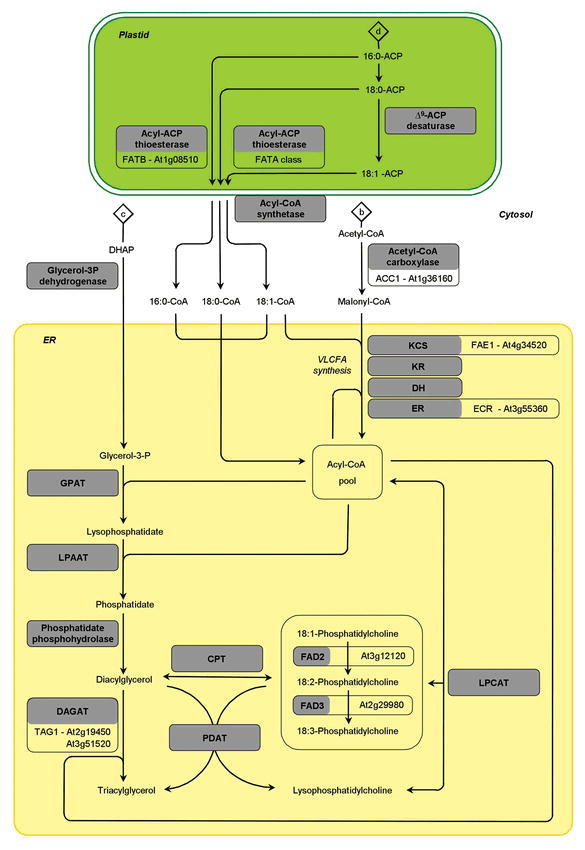
Simplified scheme of the reactions involved in triacylglycerol biosynthesis in seeds of Arabidopsis thaliana. Fatty acids are synthesised in the plastids, and 16:0 and 18:1 are massively exported toward the cytosolic compartment as CoA esters. Glycerol backbones are derived from cytosolic dihydroxyacetone phosphate (DHAP) through the action of glycerol-3-phosphate dehydrogenase. The enzymes of the Kennedy pathway catalyse triacylglycerol assembly in the endoplasmic reticulum. The contribution of the acyl-CoA independent phospholipid:diacylglycerol acyltransferase (PDAT) is presented. ER, endoplasmic reticulum; FAD2, oleoyl desaturase; FAD3, linoleoyl desaturase. Letters in a diamond indicate metabolic links with pathways presented on figures 2 and 3
Figure 5.
Figure 5.
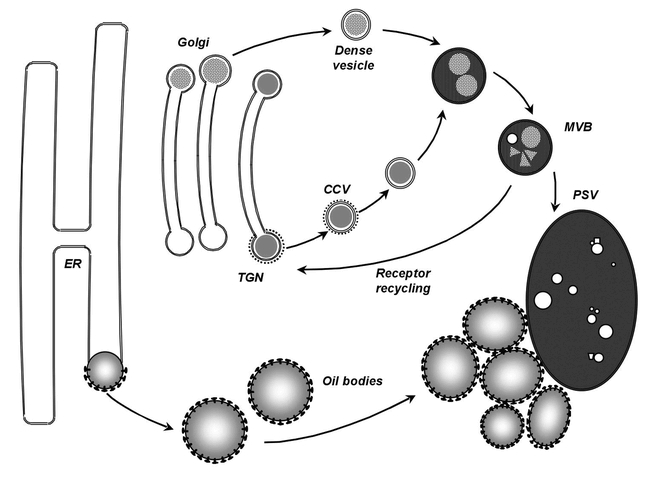
Sorting and trafficking of reserve compounds in maturing seeds of Arabidopsis thaliana. This scheme is adapted from Otegui et al. (2006). CCV, clathrin coated vesicles; ER, endoplasmic reticulum; MVB, multivesicular bodies; TGN, trans Golgi network; PSV, protein storage vacuole.
Figure 6.
Figure 6.
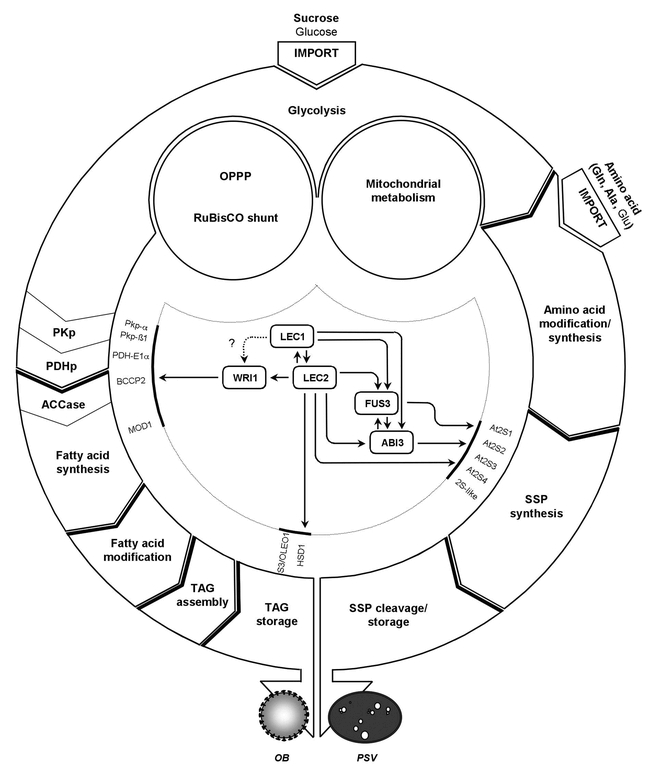
Model for the control of storage compound synthesis and accumulation in maturing seeds of Arabidopsis thaliana. Precursors for fatty acid synthesis are derived from sucrose through the glycolysis, the OPPP and the RuBisCO shunt. Fatty acids synthesised in the plastids are then exported toward the cytosol in the form of acyl-CoAs, acylated on a glycerol backbone to form triacylglycerides, which are ultimately stored in oil bodies. Amino acids required for the synthesis of seed storage proteins are either directly imported from the maternal tissues or synthesised/modified in the embryo. Solid arrows represent positive transcriptional regulations. Target genes encoding actors of the metabolic network are placed in the inner ring of the scheme. ACCase, heteromeric acetyl-CoA carboxylase; FA, fatty acids; OPPP, oxidative pentose phosphate pathway; PDHp, plastidial pyruvate dehydrogenase complex; PKp, plastidial pyruvate kinase; SSP, seed storage proteins; TAG, triacylglycerides.

References

    1. Abbadi A., Domergue F., Bauer J., Napier J. A., Welti R., Zahringer U., Cirpus P., Heinz E. Biosynthesis of very-long-chain polyunsaturated fatty acids in transgenic oilseeds: constraints on their accumulation. Plant Cell. 2004;166(1):2734–2748. - PMC - PubMed
    1. Abell B. M., Holbrook L. A., Abenes M., Murphy D. J., Hills M. J., Moloney M. M. Role of the proline knot motif in oleosin endoplasmic reticulum topology and oil body targeting. Plant Cell. 1997;96(1):1481–1493. - PMC - PubMed
    1. Alban C., Job D., Douce R. Biotin metabolism in plants. Annu. Rev. Plant Physiol. Plant Mol. Biol. 2000;516(1):17–47. - PubMed
    1. Alonso-Blanco C., Blankestijnde Vries H., Hanhart C. J., Koornneef M. Natural allelic variation at seed size loci in relation to other life history traits of Arabidopsis thaliana. Proc. Natl. Acad. Sci. USA. 1999;966(1):4710–4717. - PMC - PubMed
    1. Altenbach S. B., Kuo C. C., Staraci L. C., Pearson K. W., Wainwright C., Georgescu A. Accumulation of Brazil nut albumin in seeds of transgenic canola results in enhanced levels of seed protein methionine. Plant Mol. Biol. 1992;186(1):235–245. - PubMed

LinkOut - more resources