. 2010:8:e0130.
doi: 10.1199/tab.0130. Epub 2010 Mar 23.

Photorespiration

Photorespiration

Christoph Peterhansel et al. Arabidopsis Book. 2010.

Abstract

Photorespiration is initiated by the oxygenase activity of ribulose-1,5-bisphosphate-carboxylase/oxygenase (RUBISCO), the same enzyme that is also responsible for CO(2) fixation in almost all photosynthetic organisms. Phosphoglycolate formed by oxygen fixation is recycled to the Calvin cycle intermediate phosphoglycerate in the photorespiratory pathway. This reaction cascade consumes energy and reducing equivalents and part of the afore fixed carbon is again released as CO(2). Because of this, photorespiration was often viewed as a wasteful process. Here, we review the current knowledge on the components of the photorespiratory pathway that has been mainly achieved through genetic and biochemical studies in Arabidopsis. Based on this knowledge, the energy costs of photorespiration are calculated, but the numerous positive aspects that challenge the traditional view of photorespiration as a wasteful pathway are also discussed. An outline of possible alternative pathways beside the major pathway is provided. We summarize recent results about photorespiration in photosynthetic organisms expressing a carbon concentrating mechanism and the implications of these results for understanding Arabidopsis photorespiration. Finally, metabolic engineering approaches aiming to improve plant productivity by reducing photorespiratory losses are evaluated.


Figures
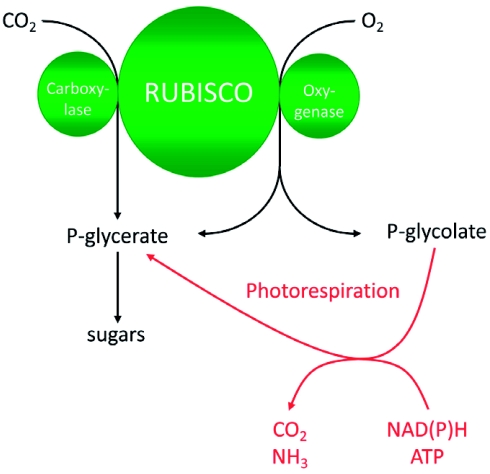
Figure 1:
Figure 1:
Schematic overview of photosynthesis and photorespiration. Ribulose-1,5-bisphosphate carboxylase/oxygenase (RUBISCO) catalyzes both CO2 and O2 fixation. The product of CO2 fixation is phosphoglycerate (P-glycerate) that enters the Calvin cycle. During oxygenation, equimolar amounts of P-glycerate and phosphoglycolate (P-glycolate) are formed. P-glycolate is recycled to P-glycerate in the photorespiratory pathway. In this reaction cascade, reducing equivalents (NAD(P)H) and energy equivalents are consumed. Ammonia (NH3) and CO2 are released and have to be refixed. Under current atmospheric gas concentrations and moderate environmental conditions, approximately each fourth reaction catalyzed by RUBISCO is an oxygenase reaction.
Figure 2:
Figure 2:
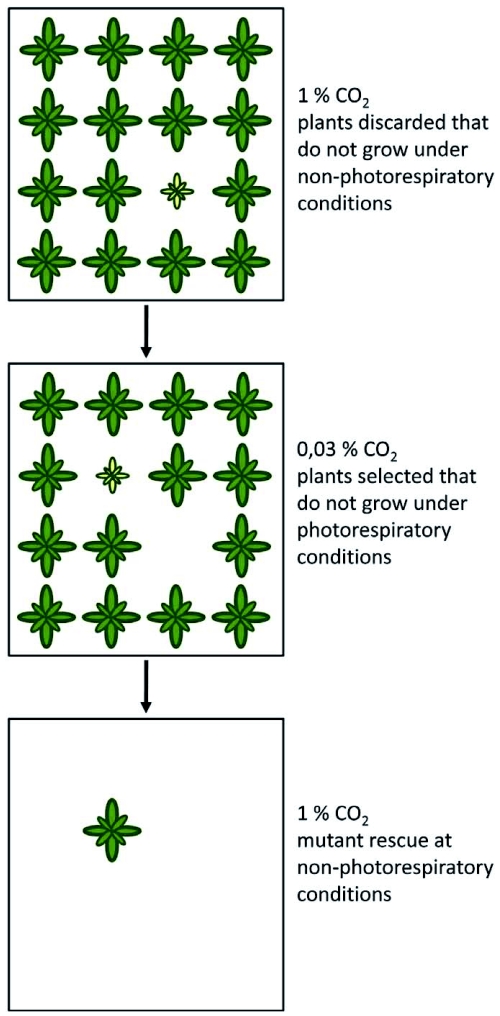
Screening for photorespiratory mutants of Arabidopsis. A segregating M2 population is grown at a high CO2 concentration that suppresses photorespiration. Stunted or chlorotic plants at this stage probably carry defects in genes unrelated to photorespiration and are discarded. Healthy plants that become chlorotic after the population was shifted to atmospheric CO2 concentrations are candidates for photorespiratory mutants. These mutants are rescued by shifting plants back to a high CO2 concentration.
Figure 3.
Figure 3.
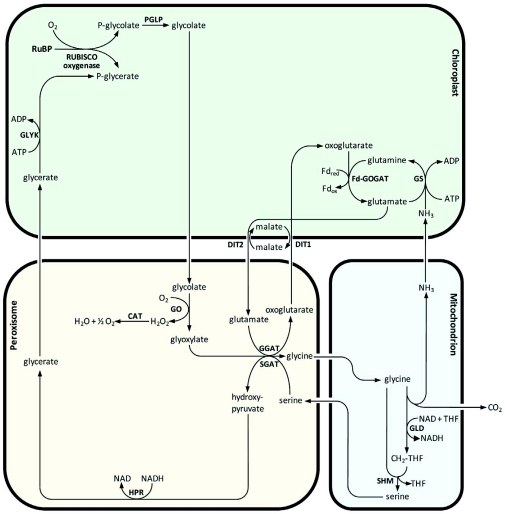
The major photorespiratory pathway in Arabidopsis. Overview of the major photorespiratory pathway in Arabidopsis. For details and chemical structures, see text. RuBP, ribulose-1,5-bisphosphate; RUBISCO, RuBP carboxylase/oxygenase; PGLP, phosphoglycolate phosphatase; GO, glycolate oxidase; CAT, catalase; GGAT, glyoxylate:glutamate aminotransferase; SGAT, serine:glyoxylate aminotransferase; DIT1, dicarboxylate transporter 1; DIT2, dicarboxylate transporter 2; GLD, glycine decarboxylase; SHM, serine hydroxymethyltransferase; HPR, hydroxypyruvate reductase; GLYK, glycerate kinase; GS, glutamine synthetase; Fd-GOGAT, glutamine:oxoglutarate aminotransferase; THF, tetrahydrofolate; CH2-THF, 5, 10-methylene-THF. The stoichiometry of the reactions is not included.
Figure 4:
Figure 4:
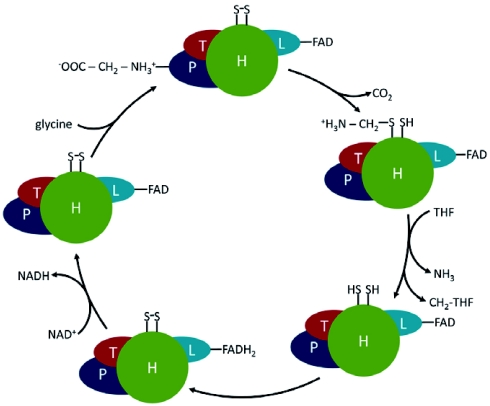
The glycine decarboxylase complex in Arabidopsis. Glycine cleavage by the glycine decarboxylase (GLD) complex. GLD consists of P-, H-, T- and L-protein. THF = tetrahydrofolate; CH2-THF = 5,10-methylene THF. Glycine binds to the pyridoxalphosphate co-factor (not shown) of P-protein, is decarboxylated and transferred to H-protein. T-protein releases NH3 and transfers the methylene group to THF. L-protein catalyzes the re-oxidation of H-protein. The subunit stoichiometry is not shown and the size of the symbols does not imply the size of the proteins. For further details, see main text.
Figure 5:
Figure 5:
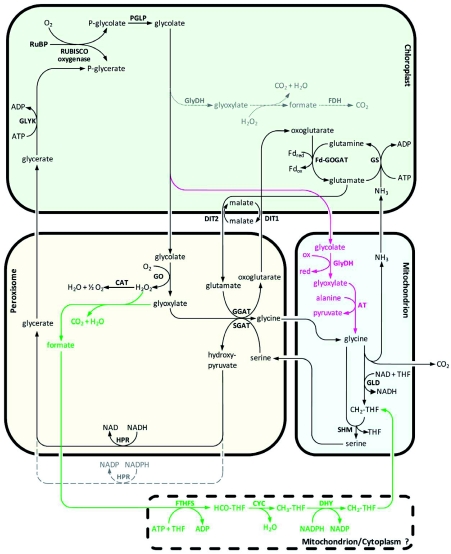
Possible alternative photorespiratory pathways in Arabidopsis. Overview of the major photorespiratory pathway (black) and four possible alternative photorespiratory pathways (dotted grey, green, red, and dashed grey) in Arabidopsis that are described in the main text. RuBP, ribulose-1,5-bisphosphate; RUBISCO, RuBP carboxylase/oxygenase; PGLP, phosphoglycolate phosphatase; GO, glycolate oxidase; CAT, catalase; GGAT, glyoxylate:glutamate aminotransferase; SGAT, serine:glyoxylate aminotransferase; DIT1, dicarboxylate transporter 1; DIT2, dicarboxylate transporter 2; GLD, glycine decarboxylase; SHM, serine hydroxymethyltransferase; HPR, hydroxypyruvate reductase; GLYK, glycerate kinase; GS, glutamine synthetase; Fd-GOGAT, glutamine:oxoglutarate aminotransferase; GlyDH, glycolate dehydrogenase; AT, aminotransferase; FDH, formate dehydrogenase; FTHFS, 10-formyl-THF-synthetase;CYC, 5,10-methenyl-THF-cyclohydrolase;DHY, 5,10-methenyl-THF-dehydrogenase;THF, tetrahydrofolate; HCO-THF, formyl-THF; CH3-THF, methenyl-THF; CH2-THF, methylene-THF. The stoichiometry of the reactions is not included.
Figure 6.
Figure 6.
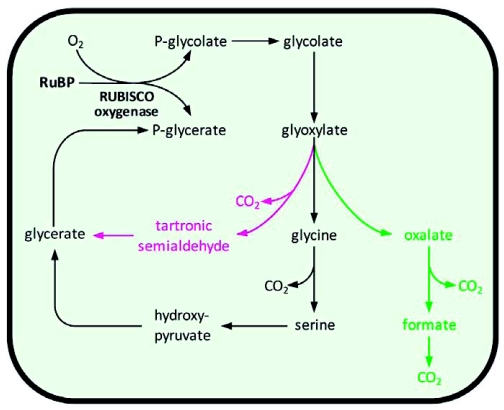
The three pathways for glyoxylate conversion in Synechocystis. Overview of the metabolism of photorespiratory glyoxylate in Synechocystis. The pathways are homologous to the major pathway in Arabidopsis (black), the bacterial glycerate pathway (red), or involve the complete oxidation of glyoxylate to CO2 (green), respectively. RuBP, ribulose-1,5-bisphosphate; RUBISCO, RuBP carboxylase/oxygenase. The stoichiometry of the reactions is not included.
Figure 7.
Figure 7.
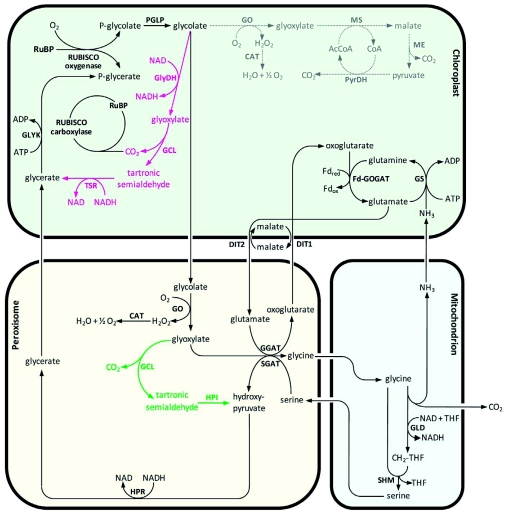
Transgenic pathways for the reduction of photorespiratory losses in Arabidopsis. Overview of the major photorespiratory pathway (black) and different transgenic approaches for the reduction of photorespiratory losses (red, dotted grey, and green). The red pathway shows the glycerate pathway from E. coli integrated into the chloroplast, the dotted grey pathway shows the alternative complete oxidation of glycolate inside the chloroplast, and the green pathway shows a shortcircuit inside the peroxisome. RuBP, ribulose-1,5-bisphosphate; RUBISCO, RuBP carboxylase/oxygenase; PGLP, phosphoglycolate phosphatase; GO, glycolate oxidase; CAT, catalase; GGAT, glyoxylate:glutamate aminotransferase; SGAT, serine:glyoxylate aminotransferase; DIT1, dicarboxylate transporter 1; DIT2, dicarboxylate transporter 2; GLD, glycine decarboxylase; SHM, serine hydroxymethyltransferase; HPR, hydroxypyruvate reductase; GLYK, glycerate kinase; GS, glutamine synthetase; Fd-GOGAT, glutamine:oxoglutarate aminotransferase; GlyDH, glycolate dehydrogenase; GCL, glyoxylate carboligase; TSR, tartronic semialdehyde reductase; MS, malate synthase; ME, malic enzyme; PyrDH, pyruvate dehydrogenase; AcCoA, acetylated Coenzyme A; CoA, Coenzyme A; HYI, hydroxypyruvate isomerase; THF, tetrahydrofolate; CH2-THF, methylene-THF. The stoichiometry of the reactions is not included.
Figure 8.
Figure 8.
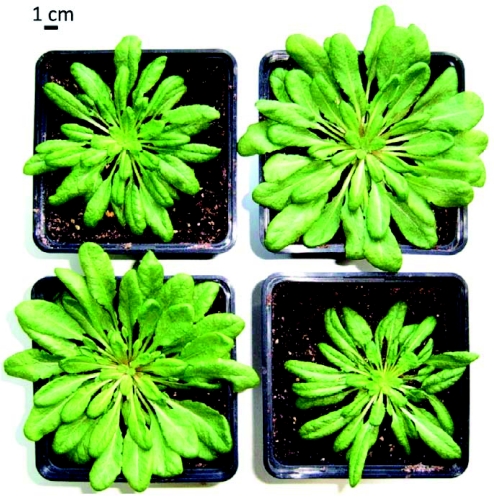
Photorespiratory bypass increases biomass production in Arabidopsis. Arabidopsis plants were grown at 100 µE light and a 8h light/16 h dark light regime for 12 weeks. After 8 weeks, plants were repotted from 8 cm pots to 15 cm pots. The upper right and lower left plants express the photorespiratory bypass (red pathway in Figure 7), the upper left and lower right plants are wildtype controls.

References

    1. Ainsworth E.A., Rogers A. The response of photosynthesis and stomatal conductance to rising CO2: mechanisms and environmental interactions. Plant Cell Environ. 2007;308(1):258–270. - PubMed
    1. Allan W.L., Clark S.M., Hoover G.J., Shelp B.J. Role of plant glyoxylate reductases during stress: a hypothesis. Biochem. J. 2009;4238(1):15–22. - PMC - PubMed
    1. Anderson L.E. Chloroplast and cytoplasmic enzymes II. Pea leaf triose phosphate isomerases. Biochim. Biophys. Acta. 1971;2358(1):237–244. - PubMed
    1. Andersson I. Catalysis and regulation in Rubisco. J. Exp. Bot. 2008;598(1):1555–1568. - PubMed
    1. Apel K., Hirt H. Reactive oxygen species: metabolism, oxidative stress, and signal transduction. Annu. Rev. Plant Biol. 2004;558(1):373–399. - PubMed

LinkOut - more resources