


Recurrent urinary tract infection and urinary Escherichia coli in women ingesting cranberry juice daily: a randomized controlled trial
- PMID: 22305026
- PMCID: PMC3497550
- DOI: 10.1016/j.mayocp.2011.10.006
Recurrent urinary tract infection and urinary Escherichia coli in women ingesting cranberry juice daily: a randomized controlled trial
Abstract
Objective: To compare the time to urinary tract infection (UTI) and the rates of asymptomatic bacteriuria and urinary P-fimbriated Escherichia coli during a 6-month period in women ingesting cranberry vs placebo juice daily.
Patients and methods: Premenopausal women with a history of recent UTI were enrolled from November 16, 2005, through December 31, 2008, at 2 centers and randomized to 1 of 3 arms: 4 oz of cranberry juice daily, 8 oz of cranberry juice daily, or placebo juice. Time to UTI (symptoms plus pyuria) was the main outcome. Asymptomatic bacteriuria, adherence, and adverse effects were assessed at monthly visits.
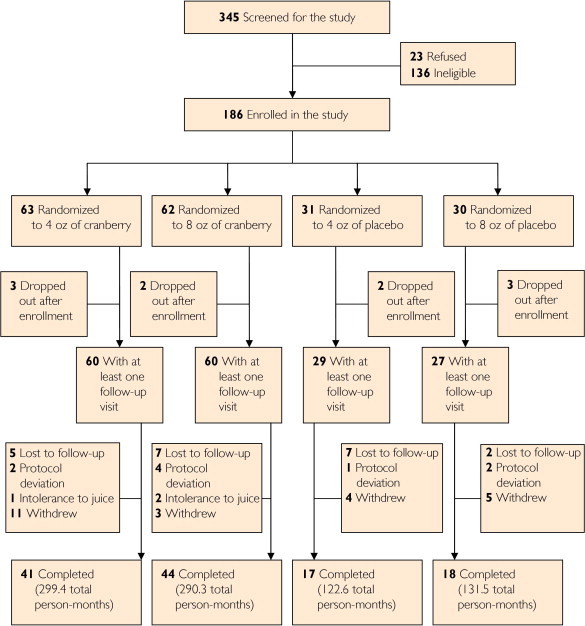
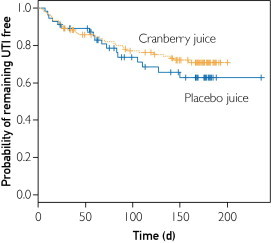
Results: A total of 176 participants were randomized (120 to cranberry juice and 56 to placebo) and followed up for a median of 168 days. The cumulative rate of UTI was 0.29 in the cranberry juice group and 0.37 in the placebo group (P=.82). The adjusted hazard ratio for UTI in the cranberry juice group vs the placebo group was 0.68 (95% confidence interval, 0.33-1.39; P=.29). The proportion of women with P-fimbriated urinary E coli isolates during the intervention phase was 10 of 23 (43.5%) in the cranberry juice group and 8 of 10 (80.0%) in the placebo group (P=.07). The mean dose adherence was 91.8% and 90.3% in the cranberry juice group vs the placebo group. Minor adverse effects were reported by 24.2% of those in the cranberry juice group and 12.5% in the placebo group (P=.07).
Conclusion: Cranberry juice did not significantly reduce UTI risk compared with placebo. The potential protective effect we observed is consistent with previous studies and warrants confirmation in larger, well-powered studies of women with recurrent UTI. The concurrent reduction in urinary P-fimbriated E coli strains supports the biological plausibility of cranberry activity.
Trial registration: clinicaltrials.gov Identifier: NCT00128128.
Copyright © 2012 Mayo Foundation for Medical Education and Research. Published by Elsevier Inc. All rights reserved.
Figures
References
-
- Dielubanza E.J., Schaeffer A.J. Urinary tract infections in women. Med Clin North Am. 2011;95(1):27–41. - PubMed
-
- Griebling T.L. Urologic diseases in America project: trends in resource use for urinary tract infections in women. J Urol. 2005;173(4):1281–1287. - PubMed
-
- Gupta K., Hooton T.M., Naber K.G. International clinical practice guidelines for the treatment of acute uncomplicated cystitis and pyelonephritis in women: a 2010 update by the Infectious Diseases Society of America and the European Society for Microbiology and Infectious Diseases. Clin Infect Dis. 2011;52(5):e103–e120. - PubMed
-
- Raz R., Chazan B., Dan M. Cranberry juice and urinary tract infection. Clin Infect Dis. 2004;38(10):1413–1419. - PubMed
Publication types
MeSH terms
Substances
Associated data
Grants and funding
LinkOut - more resources
Full Text Sources
Other Literature Sources
Medical
