. 2012 May;142(5):1218-1228.e1.
doi: 10.1053/j.gastro.2012.01.032. Epub 2012 Jan 31.

Hepatic cannabinoid receptor-1 mediates diet-induced insulin resistance via inhibition of insulin signaling and clearance in mice

Affiliations

Hepatic cannabinoid receptor-1 mediates diet-induced insulin resistance via inhibition of insulin signaling and clearance in mice

Jie Liu et al. Gastroenterology. 2012 May.

Abstract

Background & aims: Obesity-related insulin resistance contributes to cardiovascular disease. Cannabinoid receptor-1 (CB(1)) blockade improves insulin sensitivity in obese animals and people, suggesting endocannabinoid involvement. We explored the role of hepatic CB(1) in insulin resistance and inhibition of insulin signaling pathways.

Methods: Wild-type mice and mice with disruption of CB(1) (CB(1)(-/-) mice) or with hepatocyte-specific deletion or transgenic overexpression of CB(1) were maintained on regular chow or a high-fat diet (HFD) to induce obesity and insulin resistance. Hyperinsulinemic-euglycemic clamp analysis was used to analyze the role of the liver and hepatic CB(1) in HFD-induced insulin resistance. The cellular mechanisms of insulin resistance were analyzed in mouse and human isolated hepatocytes using small interfering or short hairpin RNAs and lentiviral knockdown of gene expression.

Results: The HFD induced hepatic insulin resistance in wild-type mice, but not in CB(1)(-/-) mice or mice with hepatocyte-specific deletion of CB(1). CB(1)(-/-) mice that overexpressed CB(1) specifically in hepatocytes became hyperinsulinemic as a result of reduced insulin clearance due to down-regulation of the insulin-degrading enzyme. However, they had increased hepatic glucose production due to increased glycogenolysis, indicating hepatic insulin resistance; this was further increased by the HFD. In mice with hepatocytes that express CB(1), the HFD or CB(1) activation induced the endoplasmic reticulum stress response via activation of the Bip-PERK-eIF2α protein translation pathway. In hepatocytes isolated from human or mouse liver, CB(1) activation caused endoplasmic reticulum stress-dependent suppression of insulin-induced phosphorylation of akt-2 via phosphorylation of IRS1 at serine-307 and by inducing the expression of the serine and threonine phosphatase Phlpp1. Expression of CB(1) was up-regulated in samples from patients with nonalcoholic fatty liver disease.

Conclusions: Endocannabinoids contribute to diet-induced insulin resistance in mice via hepatic CB(1)-mediated inhibition of insulin signaling and clearance.


Conflict of interest statement

Conflicts of interest

The authors disclose no conflicts.

Figures
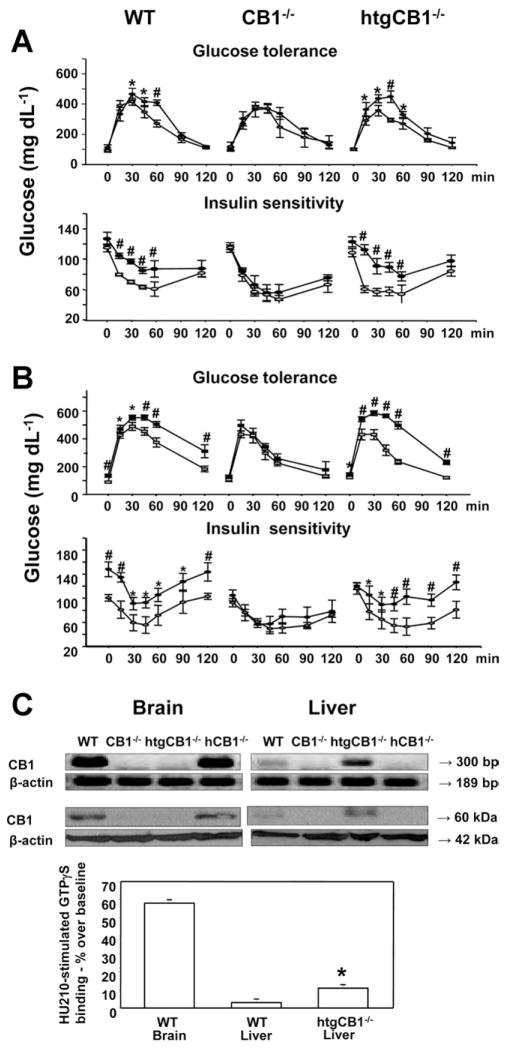
Figure 1
Figure 1
(A) Anandamide induces whole body glucose intolerance and insulin resistance via activation of hepatic CB1. Male wild-type, CB1−/−, and htgCB1−/− mice were subjected to an intraperitoneal glucose tolerance test (GTT) and a week later an insulin sensitivity test (IST). Overnight fasted mice received an intraperitoneal injection of vehicle (open symbols) or 10 mg/kg anandamide (filled symbols). Ten minutes later, the animals received 2 g/kg glucose intraperitoneally, followed by blood glucose measurements at the indicated time points. One week later, each mouse received an intraperitoneal injection of vehicle or 10 mg/kg anandamide. Ten minutes later, 0.75 U/kg insulin was injected and blood glucose monitoring was continued for an additional 2 hours. Note that anandamide caused acute glucose intolerance and insulin resistance in wt and htgCB1−/−, but not in CB1−/−, mice. N = 6 – 8 animals/group. *P < .05 or #P < .005 from corresponding value in vehicle-pretreated mice. (B) GTT and IST were conducted as previously described in wild-type (wt), CB1−/−, and htgCB1−/− mice on STD (open symbols) or HFD (solid symbols) for 14 –16 weeks. N = 6 – 8 animals/group, significance indicated as in A. (C) CB1 receptor expression profile in wt, CB1−/−, htgCB1−/−, and hCB1−/− mice. (Top) CB1 mRNA expression in brain and liver using reverse-transcription PCR. (Middle) Western blotting of CB1 protein using a CB1 receptor N-terminal antibody (Cayman) or a β-actin antibody for loading control. (Bottom) GTPγS binding stimulated by the cannabinoid agonist HU-210 (100 nmol/L) in membranes from wild-type mouse brain and liver and htgCB1−/− liver. Similar results were obtained in 3 independent experiments. Note that CB1 overexpression in ht-gCB1−/− hepatocytes is associated with increased CB1-stimulated GTPγS binding.
Figure 2
Figure 2
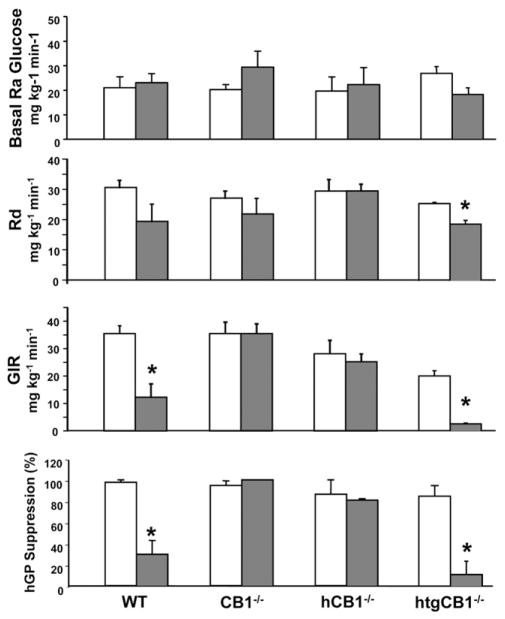
HFD induces hepatic insulin resistance via activation of hepatic CB1. Hyperinsulinemic euglycemic clamps were performed in wild-type, CB1−/−, hCB1−/−, and htgCB1−/− mice 5 hours after withdrawal of food, as described in Materials and Methods. The mice had been maintained on HFD (filled columns) or STD (open columns) for 14 –16 weeks before the clamps. Note that HFD results in suppression of glucose infusion rate (GIR) and hepatic glucose production (hGP), indicating decreased insulin-mediated suppression of hepatic glucose production in mice with (wild-type [WT] and htgCB1−/−) but not those without hepatic CB1 (CB1−/− or hCB1−/−). Rd, whole body glucose uptake. Means ± SE from 3– 6 animals/group are shown. *P < .05 relative to corresponding STD values.
Figure 3
Figure 3
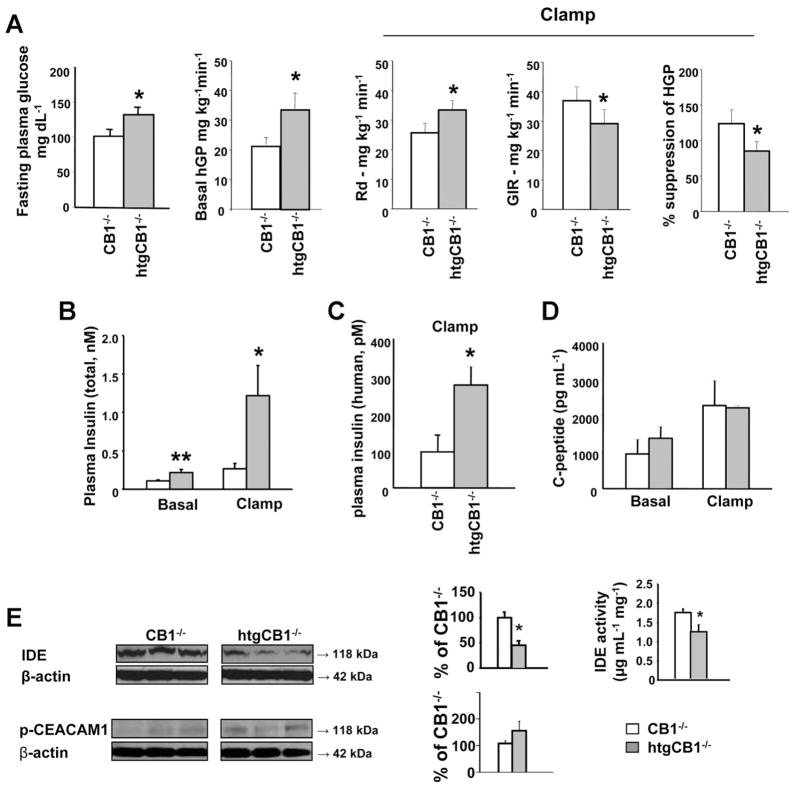
Selective overexpression of CB1 in the liver is associated with hepatic insulin resistance and reduced insulin clearance. (A) HtgCB1−/− mice on STD (filled columns) are hyperglycemic and show hepatic insulin resistance, compensated by increased whole body glucose uptake, relative to CB1−/− littermates (open columns). (B) Plasma insulin before (basal) and 120 minutes after initiation of euglycemic/hyperinsulinemic clamp. *P < .05, **P < .01 relative to corresponding value in CB1−/− mice, n = 7 (CB1−/−) or 8 (htgCB1−/−). (C) Plasma levels of human insulin, measured in the same “clamp” samples, *P < .05. (D) Plasma levels of C-peptide in same basal and clamp samples. (E) IDE and p-CEACAM1 levels and IDE activity in livers from CB1−/− and htgCB1−/− mice.
Figure 4
Figure 4
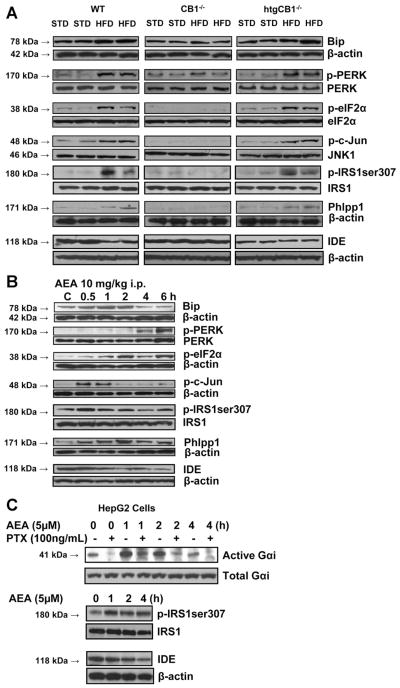
Both HFD and acute treatment with anandamide inhibit hepatic insulin signaling via CB1 receptor-induced ER stress response, through serine-307 phosphorylation of IRS1 and activation of Phlpp1. (A) HFD increases Bip levels; induces PERK, eIF2α, c-Jun, and IRS1 (serine) phosphorylation; increases Phlpp1; and decreases IDE protein in the liver of wild-type and htgCB1−/−, but not CB1−/−, mice (Western blots). (B) Acute treatment of wild-type mice on STD with anandamide (10 mg/kg intraperitoneally) induces hepatic Bip expression, PERK, eIF2α, c-Jun, and IRS1 (serine) phosphorylation and increases Phlpp1 and decreases IDE expression. (C) In HepG2 cells, anandamide causes pertussis toxin (PTX)-sensitive activation of Giα, serine-307 phosphorylation of IRS1, and inhibition of IDE expression in a time-dependent manner.
Figure 5
Figure 5
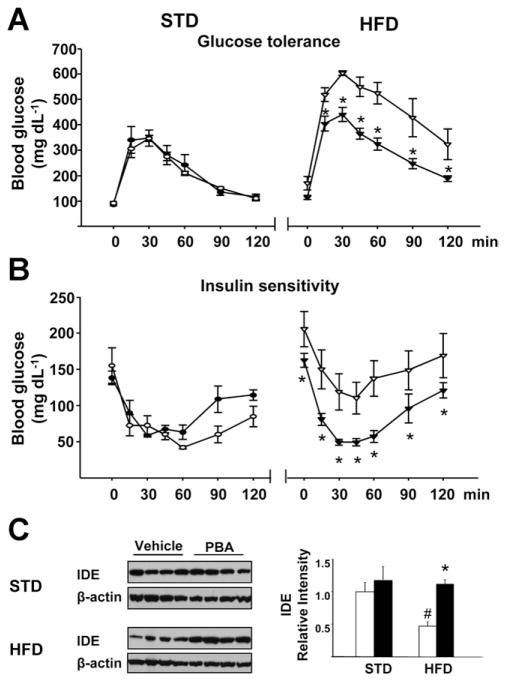
In vivo treatment of mice with the chemical chaperone PBA (1 g · kg−1 · day−1 for 20 days, solid symbols) reverses (A) obesity-induced glucose intolerance, (B) insulin resistance, and (C) down-regulation of IDE in the liver. *P < .05 from corresponding value in vehicle-treated mice; #P < .05 relative to corresponding STD values.
Figure 6
Figure 6
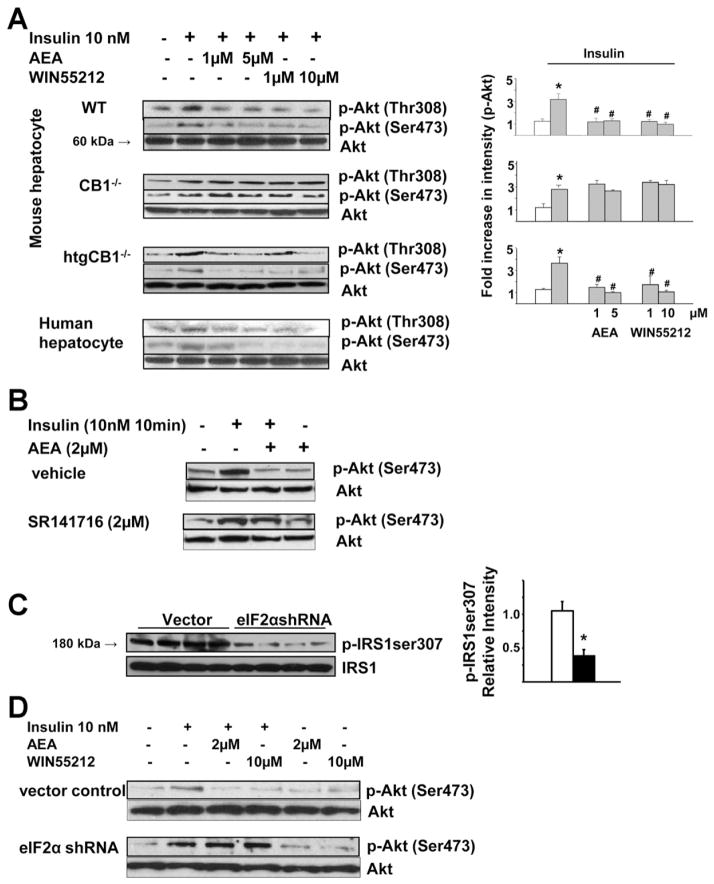
CB1-mediated inhibition of akt-2 phosphorylation is ER stress dependent. (A) Insulin-induced phosphorylation of akt-2 is inhibited by anandamide or WIN55,212-2 in isolated hepatocytes obtained from wild-type or htgCB1−/− mice or from human livers, but not in hepatocytes from CB1−/− mice (quantified by densitometry, *P < .05 relative to control cells (first lanes, open columns); #P < .05 relative to cells treated with insulin only. (B) Anandamide inhibition of insulin-induced akt-2 phosphorylation is abolished by the CB1 antagonist rimonabant. (C) shRNA knockdown of eIF2α prevents serine-307 phosphorylation of IRS1 in HepG2 cells. (D) shRNA knockdown of eIF2α prevents CB1 agonist-induced inhibition of akt-2 phosphorylation. Each blot in AD has been replicated 3 times with similar results.
Figure 7
Figure 7
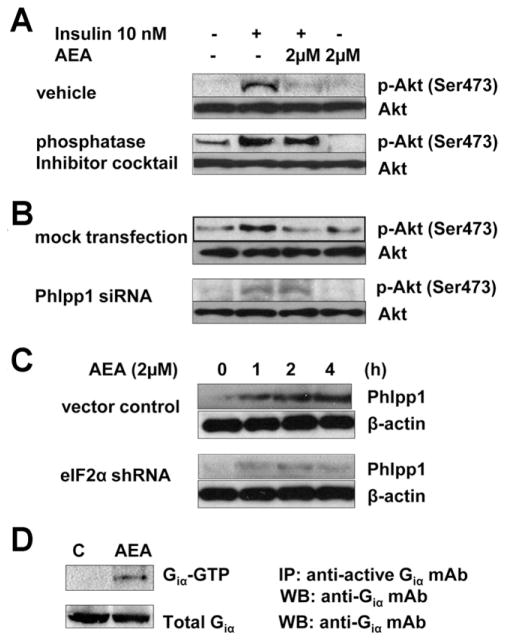
Anandamide inhibits insulin-induced akt-2 phosphorylation in mouse hepatocytes via ER stress-dependent activation of Phlpp1. Anandamide inhibition of insulin-induced akt-2 phosphorylation is abrogated by (A) a phosphatase inhibitory cocktail or by (B) siRNA knockdown of Phlpp1 expression. (C) Anandamide induction of Phlpp1 is inhibited by shRNA-mediated knockdown of eIF2α. (D) Anandamide activates Giα in hepatocytes. Each blot in AD has been replicated 3 times with similar results.

Comment in

References

    1. Biddinger SB, Hernandez-Ono A, Rask-Madsen C, et al. Hepatic insulin resistance is sufficient to produce dyslipidemia and susceptibility to atherosclerosis. Cell Metab. 2008;7:125–134. - PMC - PubMed
    1. Matsumoto M, Han S, Kitamura T, et al. Dual role of transcription factor FoxO1 in controlling hepatic insulin sensitivity and lipid metabolism. J Clin Invest. 2006;116:2464–2472. - PMC - PubMed
    1. Ramnanan CJ, Edgerton DS, Rivera N, et al. Molecular characterization of insulin-mediated suppression of hepatic glucose production in vivo. Diabetes. 2010;59:1302–1311. - PMC - PubMed
    1. Petersen KF, Laurent D, Rothman DL, et al. Mechanism by which glucose and insulin inhibit net hepatic glycogenolysis in humans. J Clin Invest. 1998;101:1203–1209. - PMC - PubMed
    1. Brown MS, Goldstein JL. The SREBP pathway: regulation of cholesterol metabolism by proteolysis of a membrane-bound transcription factor. Cell. 1997;89:331–340. - PubMed

Publication types

MeSH terms