. 2012 Mar 21;31(6):1556-67.
doi: 10.1038/emboj.2012.12. Epub 2012 Feb 3.

Coordination of multiple enzyme activities by a single PCNA in archaeal Okazaki fragment maturation

Affiliations

Coordination of multiple enzyme activities by a single PCNA in archaeal Okazaki fragment maturation

Thomas R Beattie et al. EMBO J. .

Abstract

Chromosomal DNA replication requires one daughter strand-the lagging strand-to be synthesised as a series of discontinuous, RNA-primed Okazaki fragments, which must subsequently be matured into a single covalent DNA strand. Here, we describe the reconstitution of Okazaki fragment maturation in vitro using proteins derived from the archaeon Sulfolobus solfataricus. Six proteins are necessary and sufficient for coupled DNA synthesis, RNA primer removal and DNA ligation. PolB1, Fen1 and Lig1 provide the required catalytic activities, with coordination of their activities dependent upon the DNA sliding clamp, proliferating cell nuclear antigen (PCNA). S. solfataricus PCNA is a heterotrimer, with each subunit having a distinct specificity for binding PolB1, Fen1 or Lig1. Our data demonstrate that the most efficient coupling of activities occurs when a single PCNA ring organises PolB1, Fen1 and Lig1 into a complex.


Conflict of interest statement

The authors declare that they have no conflict of interest.

Figures
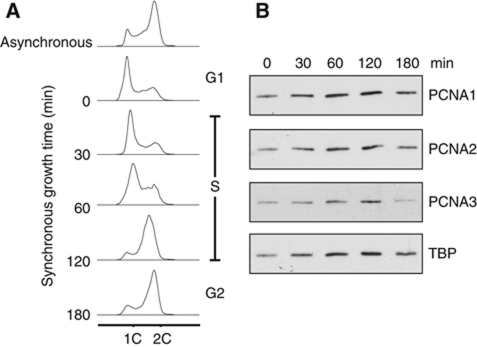
Figure 1
Figure 1
S. solfataricus heterotrimeric PCNA is expressed throughout S-phase. (A) Cell-cycle synchronisation of S. solfataricus cells. An asynchronous culture was applied to the ‘Baby machine’ apparatus, G1-phase cells were collected at time 0 and subsequently grown synchronously at 75°C. The DNA content of cells was analysed at the indicated time points by FACS; ‘1C’ and ‘2C’ indicate fluorescent signal corresponding to 1 or 2 copies of genomic DNA, respectively. (B) Analysis of PCNA expression throughout the cell cycle by western blotting. Samples were analysed at the indicated time points during synchronous growth. TBP was analysed as a loading control.
Figure 2
Figure 2
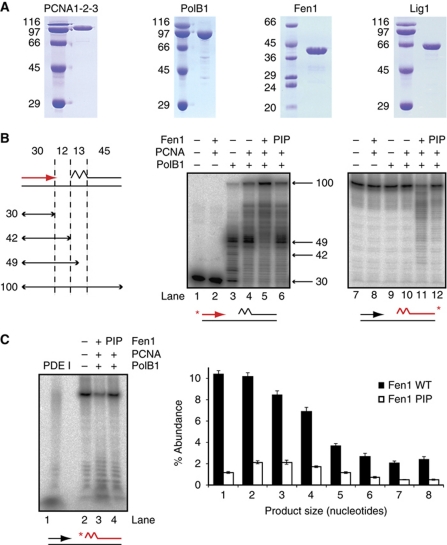
PCNA-dependent coupling of PolB1 and Fen1 activities in vitro. (A) Analysis of purified recombinant proteins by SDS–PAGE visualised by Coomassie staining. Molecular weight markers are labelled on the left, sizes are in kDa. (B) Activity of purified PolB1, Fen1 and PCNA on an in vitro lagging strand substrate. A schematic of the substrate is illustrated on the left, with section sizes indicated in nucleotides (for sequences of oligonucleotides see Supplementary Table S1). The jagged region of the substrate denotes a ribonucleotide primer. Reactions contained 0.1 pmol PolB1, 0.1 pmol Fen1 and 20 pmol PCNA. Reaction products were separated by denaturing PAGE. The sizes and migration of notable DNA synthesis products are indicated. ‘PIP’ denotes the substitution of a Fen1 mutated in the PIP motif that is defective in PCNA binding (see Supplementary Figure S2). Substrates are also indicated below gels, with the radiolabelled strand indicated in red. Note that the upstream strand was labelled on its 5′ end and the downstream strand on its 3′ end, indicated with asterisks. (C) Analysis of CPs generated by WT and a PIP mutant version (PIP) of Fen1. Reactions were performed as in (B). Substrate is indicated below gel, labelling of the downstream strand is indicated in red, asterisk indicates 5′ end labelling. PDE I indicates substrate digestion to completion by snake phosphodiesterase I to indicate the migration of monoribonucleotides. Quantification of product abundance as a percentage of total DNA after subtraction of background degradation (lane 2) is illustrated on the right. Values are mean±s.e.m. (n=3).
Figure 3
Figure 3
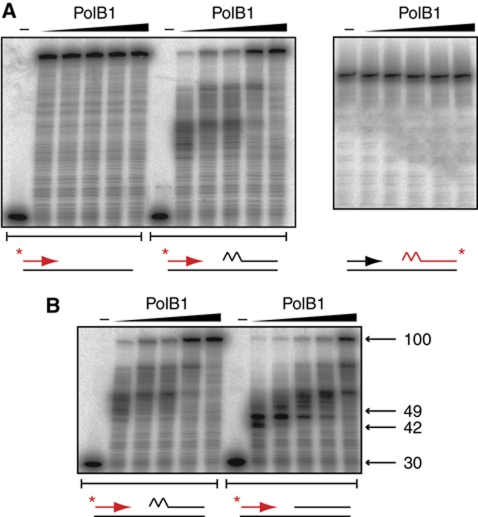
Characterisation of PolB1 strand displacement activity. (A) Comparison of PolB1 activity on substrates possessing or lacking a downstream Okazaki fragment. Reactions contained 0, 15, 30, 60, 120, 240 fmol PolB1, assays were performed as described in Materials and methods with the exception that reactions contained 50 mM KCl and MnCl2 was omitted. Reaction products were separated by denaturing PAGE. Substrates are indicated below gels, the radiolabelled strand is coloured red and the position of the label is indicated with an asterisk. The jagged region of the substrate denotes a 13-ribonucleotide primer. (B) Comparison of strand displacement by PolB1 on substrates containing Okazaki fragments possessing or lacking RNA primers. Experiments were performed as in (A). The sizes and migration of notable DNA synthesis products are indicated on the right.
Figure 4
Figure 4
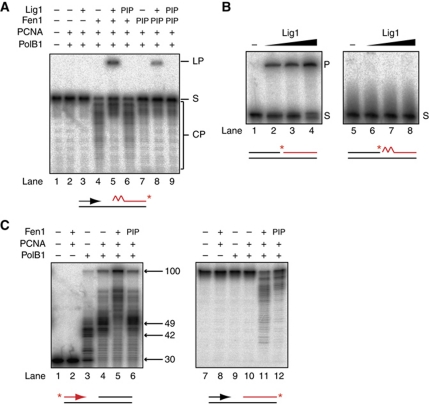
Completion of Okazaki fragment maturation in vitro by PolB1, Fen1 and Lig1. (A) Activity of PolB1, Fen1, Lig1 and PCNA on an in vitro lagging strand substrate. Reactions contained 0.1 pmol PolB1, 0.1 pmol Fen1, 1 pmol Lig1 and 20 pmol PCNA. Reaction products were separated by denaturing PAGE. The migration of substrate (S), CPs and the ligation product (LP) are indicated. Substrate is indicated below gel, with radiolabelled strand indicated in red and label position with a red asterisk. The jagged region of the substrate denotes a 13-ribonucleotide primer. ‘PIP’ denotes the substitution of a Fen1 and/or Lig1, which are mutated in the PIP motif and are defective in PCNA binding (see also Supplementary Figure S2). (B) Substrate specificity of Lig1. Reactions contained 0, 0.625, 1.25, 2.5 pmol Lig1. Reaction products were separated by denaturing PAGE. Substrates (S) are indicated below gel, 5′ end labelling of the downstream strand is indicated in red and label position with a red asterisk. The ligated product is labelled (P). (C) Activity of purified PolB1, Fen1 and PCNA on an in vitro lagging strand substrate lacking a downstream RNA primer. Reactions contained 0.1 pmol PolB1, 0.1 pmol Fen1 and 20 pmol PCNA. Reaction products were separated by denaturing PAGE. The sizes and migration of notable DNA synthesis products are indicated on the right. ‘PIP’ denotes the substitution of a Fen1 mutant defective in PCNA binding. Substrates are indicated below gels, with radiolabelled strand indicated in red and label position with a red asterisk.
Figure 5
Figure 5
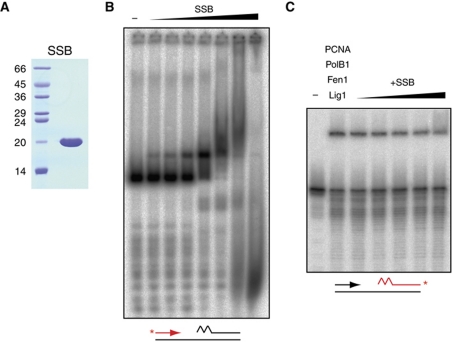
Effect of SSB on Okazaki fragment maturation in vitro. (A) Analysis of purified SSB by SDS–PAGE visualised by Coomassie staining. Molecular weight markers are labelled on the left, sizes are in kDa (B) SSB binding to a lagging strand substrate. Substrate, indicated below the gel, was incubated with 0, 0.14, 5.6, 22.3, 89.1, 356, 1425, 5700 fmol of SSB and protein–DNA complexes separated by native gel electrophoresis. Radiolabelling of the upstream strand is indicated in red and label position with a red asterisk. (C) Effect of SSB on Okazaki fragment maturation. Reactions contained 0.1 pmol PolB1, 0.1 pmol Fen1, 1 pmol Lig1, 20 pmol PCNA, and 0, 0.14, 5.6, 22.3, 89.1, 356 fmol of SSB. Reaction products were separated by denaturing PAGE. Substrate is indicated below gel, 3′ end labelling (asterisk) of the downstream strand is indicated in red.
Figure 6
Figure 6
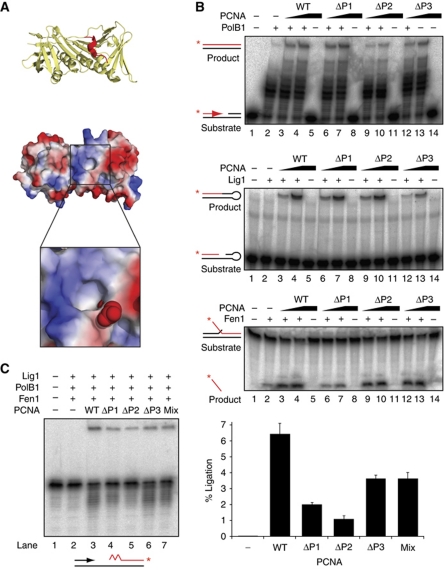
Separating binding of PolB1, Fen1 and Lig1 across multiple PCNA rings impairs coupled activity. (A) Structural basis of PCNA mutagenesis. Upper panel shows cartoon representation of PCNA1 (yellow) in complex with the PIP peptide motif of Fen1 (red). Lower panel shows electrostatic surface view of the same PCNA1 molecule highlighting the boxed hydrophobic binding pocket. The Fen1 PIP motif is omitted for clarity. The magnified section models a mutation of Alanine 246 to glutamate, rendered in space-filling mode. Images were generated in PyMOL (http://www.pymol.org) from PDB file 2IZO. (B) Effect of PCNA mutants on stimulating the activities of PolB1, Fen1 and Lig1 on optimal model substrates in vitro. Substrates and products for each reaction are indicated on the left, with radiolabelled strands indicated in red and label position by a red asterisk. ‘WT’ PCNA is a covalent fusion of PCNA1, PCNA2 and PCNA3. ‘ΔP1’ possess an A246E mutation in the PCNA1 subunit of the fusion. ‘ΔP2’ possesses an A242E mutation in the PCNA2 subunit of the fusion. ‘ΔP3’ possesses an A241E mutation in the PCNA3 subunit of the fusion. In all, 30 fmol PolB1/65 fmol Fen1/10 pmol Lig1 were incubated with 0, 0.77 and 7.7 pmol of each PCNA protein and reaction products were separated by denaturing PAGE (C) Effect of PCNA mutants on Okazaki fragment maturation. Reactions contained 0.1 pmol PolB1, 0.1 pmol Fen1, 1 pmol Lig1 and 20 pmol PCNA. Reaction products were separated by denaturing PAGE. The substrate is indicated below the gel, with radiolabelled strand indicated in red and label position with a red asterisk. Quantification of the upper ligated band—a measure of completed Okazaki fragment maturation—is shown on the right. Values are mean±s.e.m. (n=3).
Figure 7
Figure 7
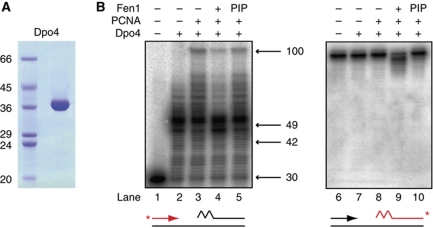
Preventing DNA polymerase and Fen1 from simultaneously binding the same PCNA ring impairs coupled activity. (A) Analysis of purified Dpo4 by SDS–PAGE visualised by Coomassie staining. Molecular weight markers are labelled on the left, sizes are in kDa (B) Activity of purified Dpo4, Fen1 and PCNA on an in vitro lagging strand substrate. Reactions contained 50 fmol Dpo4, 0.1 pmol Fen1 and 20 pmol PCNA. Reaction products were separated by denaturing PAGE. The sizes and migration of notable DNA synthesis products are indicated. Substrates are indicated below gels, with radiolabelled strand indicated in red and label position with a red asterisk. The jagged region of the substrate denotes a 13-ribonucleotide primer. ‘PIP’ denotes the substitution of a Fen1 mutated in the PIP motif that is defective in PCNA binding (see also Supplementary Figure S2).
Figure 8
Figure 8
Schematic illustration of Okazaki fragment maturation in S. solfataricus. DNA is illustrated by black lines, RNA primer is illustrated by the jagged region. (A) PolB1 (blue), Fen1 (yellow) and Lig (red) bind to their specific PCNA1, PCNA2 or PCNA3 binding sites on heterotrimeric PCNA (blue, yellow and red, respectively). PolB1 engages the template to perform DNA synthesis while Fen1 and Lig1 are carried by PCNA. (B) Upon encountering a downstream Okazaki fragment, PolB1 initiates strand displacement synthesis, displacing downstream RNA into a flap structure. (C) Fen1 engages the generated flap and cleaves it, producing a nick. Multiple rounds of PCNA-coordinated PolB1 and Fen1 coupled activity enables complete removal of RNA primers. (D) Lig1 interrogates nick structures emerging from Fen1, and, following RNA removal, encircles the DNA nick and catalyses Okazaki fragment ligation. (E) Efficient coupling of PolB1, Fen1 and Lig1 activities mediated by PCNA ensures covalent integrity for nascent lagging strands. Adapted from Beattie and Bell (2011b).

References

    1. Ayyagari R, Gomes XV, Gordenin DA, Burgers PM (2003) Okazaki fragment maturation in yeast. I. Distribution of functions between FEN1 AND DNA2. J Biol Chem 278: 1618–1625 - PubMed
    1. Beattie TR, Bell SD (2011a) The role of the DNA sliding clamp in Okazaki fragment maturation in archaea and eukaryotes. Biochem Soc Trans 39: 70–76 - PubMed
    1. Beattie TR, Bell SD (2011b) Molecular machines in archaeal DNA replication. Curr Opin Chem Biol 15: 614–619 - PubMed
    1. Boudsocq F, Iwai S, Hanaoka F, Woodgate R (2001) Sulfolobus solfataricus P2 DNA polymerase IV (Dpo4): an archaeal DinB-like DNA polymerase with lesion-bypass properties akin to eukaryotic poleta. Nucleic Acids Res 29: 4607–4616 - PMC - PubMed
    1. Bubeck D, Reijns MAM, Graham SC, Astell KR, Jones EY, Jackson AP (2011) PCNA directs type 2 RNase H activity on DNA replication and repair substrates. Nucleic Acids Res 39: 3652–3666 - PMC - PubMed

Publication types

MeSH terms