


Quantification of human fecal bifidobacterium species by use of quantitative real-time PCR analysis targeting the groEL gene
- PMID: 22307308
- PMCID: PMC3318781
- DOI: 10.1128/AEM.07749-11
Quantification of human fecal bifidobacterium species by use of quantitative real-time PCR analysis targeting the groEL gene
Abstract
Quantitative real-time PCR assays targeting the groEL gene for the specific enumeration of 12 human fecal Bifidobacterium species were developed. The housekeeping gene groEL (HSP60 in eukaryotes) was used as a discriminative marker for the differentiation of Bifidobacterium adolescentis, B. angulatum, B. animalis, B. bifidum, B. breve, B. catenulatum, B. dentium, B. gallicum, B. longum, B. pseudocatenulatum, B. pseudolongum, and B. thermophilum. The bifidobacterial chromosome contains a single copy of the groEL gene, allowing the determination of the cell number by quantification of the groEL copy number. Real-time PCR assays were validated by comparing fecal samples spiked with known numbers of a given Bifidobacterium species. Independent of the Bifidobacterium species tested, the proportion of groEL copies recovered from fecal samples spiked with 5 to 9 log(10) cells/g feces was approximately 50%. The quantification limit was 5 to 6 log(10) groEL copies/g feces. The interassay variability was less than 10%, and variability between different DNA extractions was less than 23%. The method developed was applied to fecal samples from healthy adults and full-term breast-fed infants. Bifidobacterial diversity in both adults and infants was low, with mostly ≤3 Bifidobacterium species and B. longum frequently detected. The predominant species in infant and adult fecal samples were B. breve and B. adolescentis, respectively. It was possible to distinguish B. catenulatum and B. pseudocatenulatum. We conclude that the groEL gene is a suitable molecular marker for the specific and accurate quantification of human fecal Bifidobacterium species by real-time PCR.
Figures
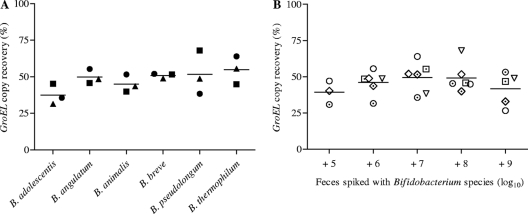
 ), B. breve (♢), B. pseudolongum (▽), and B. thermophilum (○). The values are means. Significance was estimated by one-way ANOVA with Bonferroni's posttests. Differences of means were not significant. GroEL copy recovery was 48% ± 6% (A) and 45% ± 6% (B) (means ± SD).
References
-
- Altschul SF, Gish W, Miller W, Myers EW, Lipman DJ. 1990. Basic local alignment search tool. J. Mol. Biol. 215:403–410 - PubMed
-
- Bartosch S, Woodmansey EJ, Paterson JC, McMurdo ME, Macfarlane GT. 2005. Microbiological effects of consuming a synbiotic containing Bifidobacterium bifidum, Bifidobacterium lactis, and oligofructose in elderly persons, determined by real-time polymerase chain reaction and counting of viable bacteria. Clin. Infect. Dis. 40:28–37 - PubMed
-
- Berthoud H, Chavagnat F, Haueter M, Casey MG. 2005. Comparison of partial gene sequences encoding a phosphoketolase for the identification of bifidobacteria. Lebensm. Wiss. Technol. 38:101–105
Publication types
MeSH terms
Substances
LinkOut - more resources
Full Text Sources
Other Literature Sources
Medical
Molecular Biology Databases
Research Materials
Miscellaneous
