


Lipid and lipoprotein biomarkers and the risk of ischemic stroke in postmenopausal women
- PMID: 22308251
- PMCID: PMC3547588
- DOI: 10.1161/STROKEAHA.111.641324
Lipid and lipoprotein biomarkers and the risk of ischemic stroke in postmenopausal women
Abstract
Background: Few studies simultaneously investigated lipids and lipoprotein biomarkers as predictors of ischemic stroke. The value of these biomarkers as independent predictors of ischemic stroke remains controversial.
Methods: We conducted a prospective nested case-control study among postmenopausal women from the Women's Health Initiative Observational Study to assess the relationship between fasting lipids (total cholesterol, low-density lipoprotein cholesterol [LDL-C], high-density lipoprotein cholesterol [HDL-C], and triglycerides), lipoproteins (LDL, HDL, and very low-density lipoprotein [VLDL] particle number and size, intermediate-density lipoprotein [IDL] particle number, and lipoprotein (a)), and risk of ischemic stroke. Among women free of stroke at baseline, 774 ischemic stroke patients were matched according to age and race to control subjects, using a 1:1 ratio.
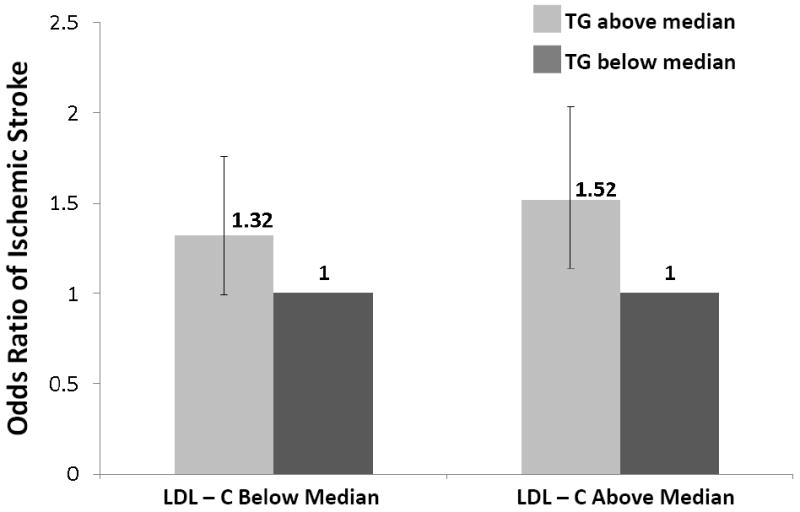
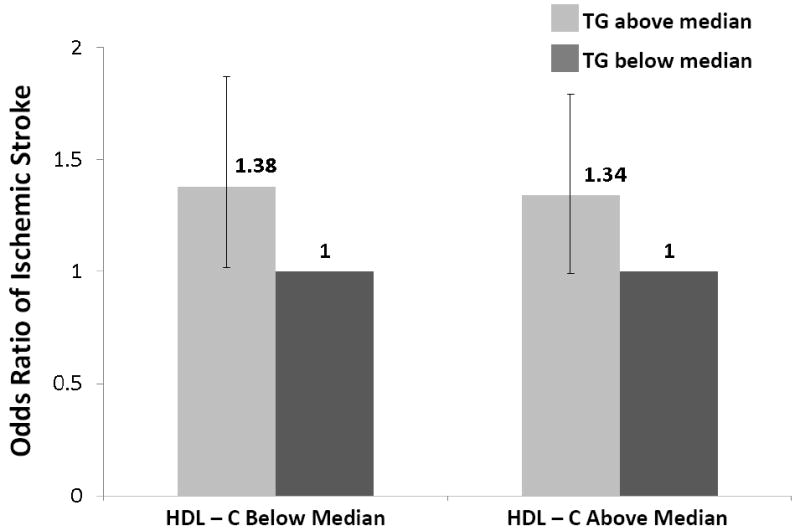
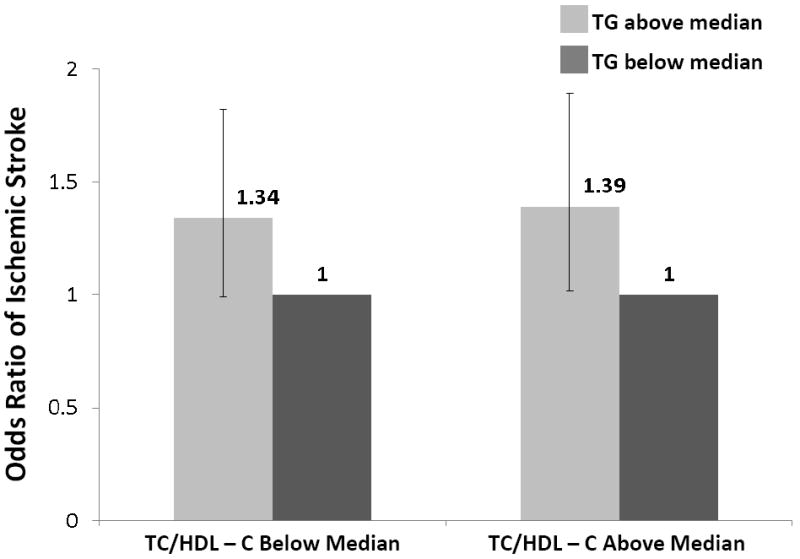
Results: In bivariate analysis, baseline triglycerides (P<0.001), IDL particles (P<0.01), LDL particles (P<0.01), VLDL triglyceride (P<0.001), VLDL particles (P<0.01), VLDL size (P<0.001), LDL size (P=0.03), and total/HDL cholesterol ratio (P<0.01) were significantly higher among women with incident ischemic stroke, whereas levels of HDL-C (P<0.01) and HDL size (P<0.01) were lower. No significant baseline difference for total cholesterol (P=0.15), LDL-C (P=0.47), and lipoprotein (a) (P=0.11) was observed. In multivariable analysis, triglycerides (odds ratio for the highest versus lowest quartile, 1.56; 95% confidence interval, 1.13-2.17; P for trend=0.02), VLDL size (odds ratio, 1.59; 95% confidence interval, 1.10-2.28; P for trend=0.03), and IDL particle number (odds ratio, 1.46; 95% confidence interval, 1.04-2.04; P for trend=0.02) were significantly associated with ischemic stroke.
Conclusions: Among a panel of lipid and lipoprotein biomarkers, baseline triglycerides, VLDL size, and IDL particle number were significantly associated with incident ischemic stroke in postmenopausal women.
Conflict of interest statement
Dr Howard is a consultant for Merck and Egg Nutrition Council, and has received research support (donation of drugs) from Pfizer, Merck, and Schering-Plough, and lectures for Schering-Plough. Dr Otvos is an employee and stockholder of Liposcience, Inc. Dr Eaton has received research support from Pfizer, Parexel, AstraZeneca, Auxilium, and Forest Pharmaceuticals; is on the Speakers Bureau for Pfizer and Merck-Shering Plough; and is a consultant for Pfizer, Merck-Shering Plough, Merck, and Johnson&Johnson. Drs Berger, McGinn, Kuller, Manson, Curb, Kaplan, Lynch, Rosenbaum, and Wassertheil-Smoller report no conflicts.
Figures
References
-
- Roberts WC. Factors linking cholesterol to atherosclerotic plaques. Am J Cardiol. 1988;62:495–499. - PubMed
-
- Ross R, Glomset JA. The pathogenesis of atherosclerosis (first of two parts) N Engl J Med. 1976;295:369–377. - PubMed
-
- Schwenke DC, Carew TE. Initiation of atherosclerotic lesions in cholesterol-fed rabbits. I. Focal increases in arterial LDL concentration precede development of fatty streak lesions. Arteriosclerosis. 1989;9:895–907. - PubMed
-
- Bush TL, Fried LP, Barrett-Connor E. Cholesterol, lipoproteins, and coronary heart disease in women. Clin Chem. 1988;34:B60–70. - PubMed
-
- Coresh J, Kwiterovich PO., Jr Small, dense low-density lipoprotein particles and coronary heart disease risk: A clear association with uncertain implications. JAMA. 1996;276:914–915. - PubMed
Publication types
MeSH terms
Substances
Grants and funding
LinkOut - more resources
Full Text Sources
Medical
