


Dominant folding pathways of a WW domain
- PMID: 22308345
- PMCID: PMC3289289
- DOI: 10.1073/pnas.1111796109
Dominant folding pathways of a WW domain
Abstract
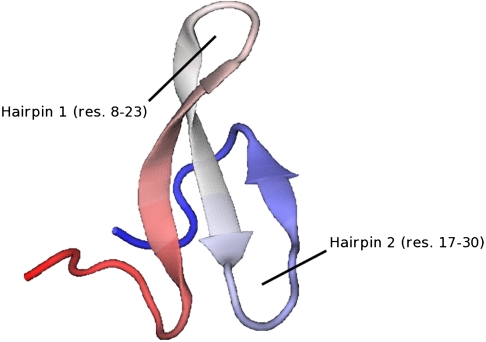
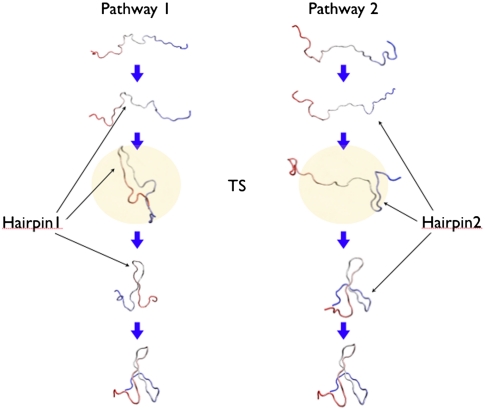
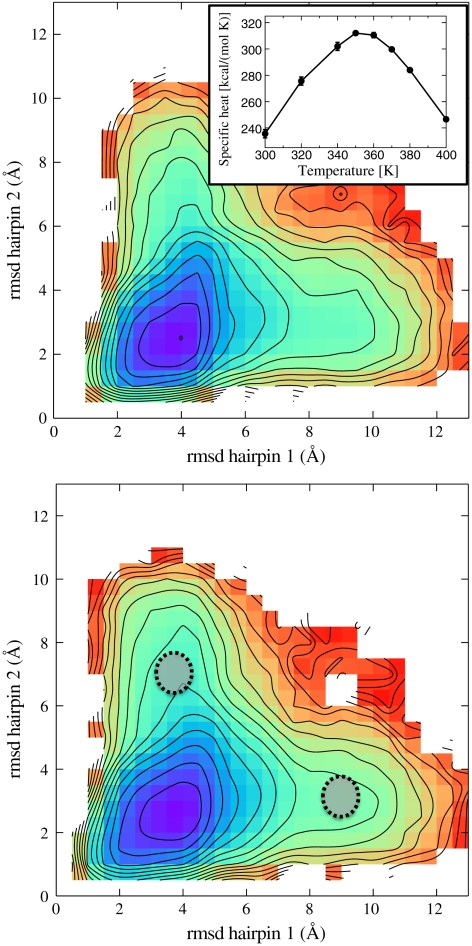
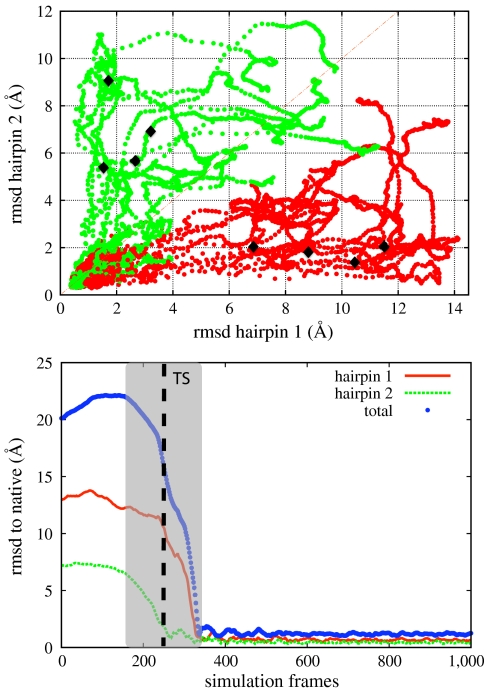
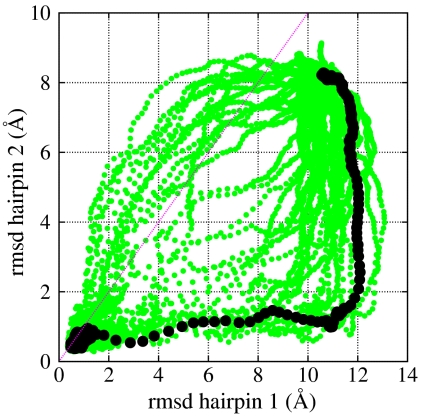
We investigate the folding mechanism of the WW domain Fip35 using a realistic atomistic force field by applying the Dominant Reaction Pathways approach. We find evidence for the existence of two folding pathways, which differ by the order of formation of the two hairpins. This result is consistent with the analysis of the experimental data on the folding kinetics of WW domains and with the results obtained from large-scale molecular dynamics simulations of this system. Free-energy calculations performed in two coarse-grained models support the robustness of our results and suggest that the qualitative structure of the dominant paths are mostly shaped by the native interactions. Computing a folding trajectory in atomistic detail only required about one hour on 48 Central Processing Units. The gain in computational efficiency opens the door to a systematic investigation of the folding pathways of a large number of globular proteins.
Conflict of interest statement
The authors declare no conflict of interest.
Figures
References
-
- Snow CD, Sorin EJ, Rhee YM, Pande VS. How well can simulation predict protein folding kinetics and thermodynamics? Annu Rev Bioph Biom. 2005;34:43–69. - PubMed
-
- Mirny L, Shakhnovich E. Protein folding theory: from lattice to all atom models. Annu Rev Bioph Biom. 2001;30:361–396. - PubMed
-
- Onuchic JN, Wolynes PG. Theory of protein folding. Curr Opin Struc Biol. 2004;14:70–75. - PubMed
-
- Kubelka J, Hofrichter J, Eaton W. The protein folding ‘speed limit’. Curr Opin Struc Biol. 2004;14:76–88. - PubMed
Publication types
MeSH terms
LinkOut - more resources
Full Text Sources
