Epilepsy in Tanzanian children: association with perinatal events and other risk factors
- PMID: 22308971
- PMCID: PMC3467761
- DOI: 10.1111/j.1528-1167.2011.03395.x
Epilepsy in Tanzanian children: association with perinatal events and other risk factors
Abstract
Purpose: To define the prevalence and risk factors for epilepsy in children in a rural district of Tanzania by conducting a community-based case-control study.
Methods: Children aged 6-14 years with active epilepsy (at least two unprovoked seizures in the last 5 years) were identified in a cross-sectional survey in Tanzania. Cases were compared with age-matched controls.
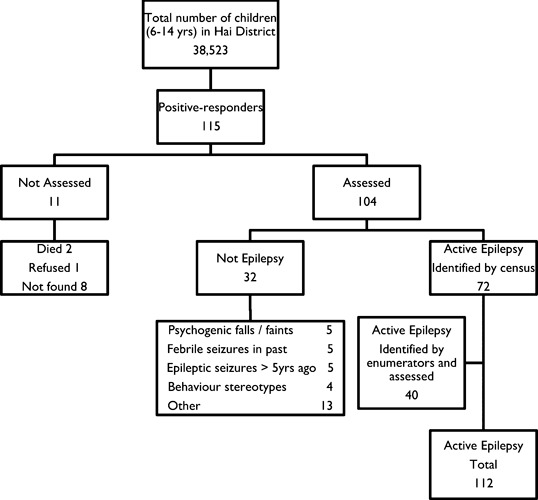
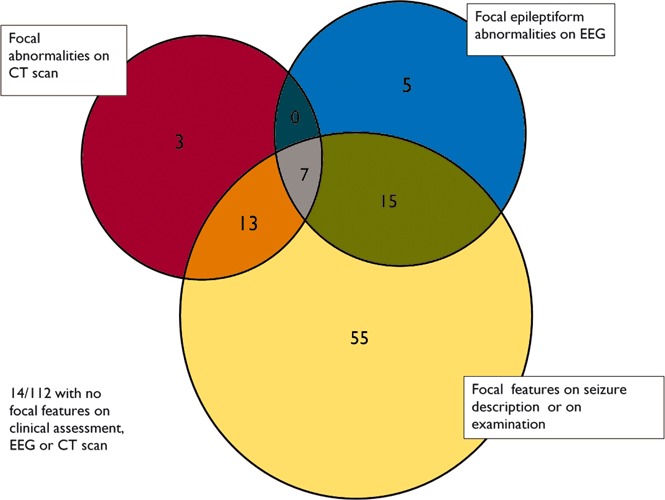
Key findings: Overall 112 children with epilepsy (CWE) were identified; the unadjusted prevalence of epilepsy was 2.91 per 1,000 (95% confidence interval [95% CI] 2.4-3.5). The main seizure types were focal motor with secondary generalization in 73 (65.2%) of 112 and generalized convulsive seizures in 19 (16.9%) of 112. Adverse perinatal events were present in 16 (14%) of 112 cases but in no controls. In multivariate analysis, epilepsy was associated with number of parents who were resident at home (odds ratio [OR] 6.2 for none vs. both resident, 95% CI 1.5-25.5), history of adverse perinatal events (OR 14.9, 95% CI 1.4-151.3), family history of afebrile seizures (OR 5.7, 95% CI 1.0-27.5), and poor scholastic attainment (OR 8.6, 95% CI 4.0-18.4). Electroencephalography (EEG) and computed tomography (CT) scans were abnormal in 44 (44%) of 101 and 26 (29%) of 90 cases, respectively. Overall, 98 (88%) of 112 cases had focal features on assessment.
Significance: In this study from sub-Saharan Africa, CWE predominantly had focal features that support the suggestion that most epilepsy in this region has a symptomatic etiology. Adverse perinatal events were strongly associated with epilepsy. Genetic and social factors may also be important. Epilepsy may be preventable in a significant proportion of children with better antenatal and perinatal care.
Wiley Periodicals, Inc. © 2012 International League Against Epilepsy.
Figures
References
-
- Abell SC, von Briesen PD, Watz LS. Intellectual evaluations of children using human figure drawings: an empirical investigation of two methods. J Clin Psychol. 1996;52:67–74. - PubMed
-
- Adult Morbidity and Mortality Project Team. Suitability of participatory methods to generate variables for inclusion in an income poverty index. Dar es Salaam: Ministry of Health of Tanzania; 2003.
-
- AMMP. Tanzania Ministry of Health adult Morbidity and Mortality Project (AMMP) Dar es Salaam: Ministry of Health of Tanzania; 1997. Enumeration and description of project surveillance areas.
-
- Berg AT, Testa FM, Levy SR, Shinnar S. Neuroimaging in children with newly diagnosed epilepsy: a community-based study. Pediatrics. 2000;106:527–532. - PubMed
-
- Bergamasco B, Benna P, Ferrero P, Gavinelli R. Neonatal hypoxia and epileptic risk: a clinical prospective study. Epilepsia. 1984;25:131–136. - PubMed