


Review
doi: 10.1038/oby.2012.19.
Epub 2012 Feb 7.
Obesity, insulin resistance, and Alzheimer's disease
Affiliations
- PMID: 22310232
- PMCID: PMC4314950
- DOI: 10.1038/oby.2012.19
Item in Clipboard
Review
Obesity, insulin resistance, and Alzheimer's disease
Obesity (Silver Spring).
2012 Aug.
No abstract available
Conflict of interest statement
The authors declared no conflict of interest. © 2012 The Obesity Society
Figures
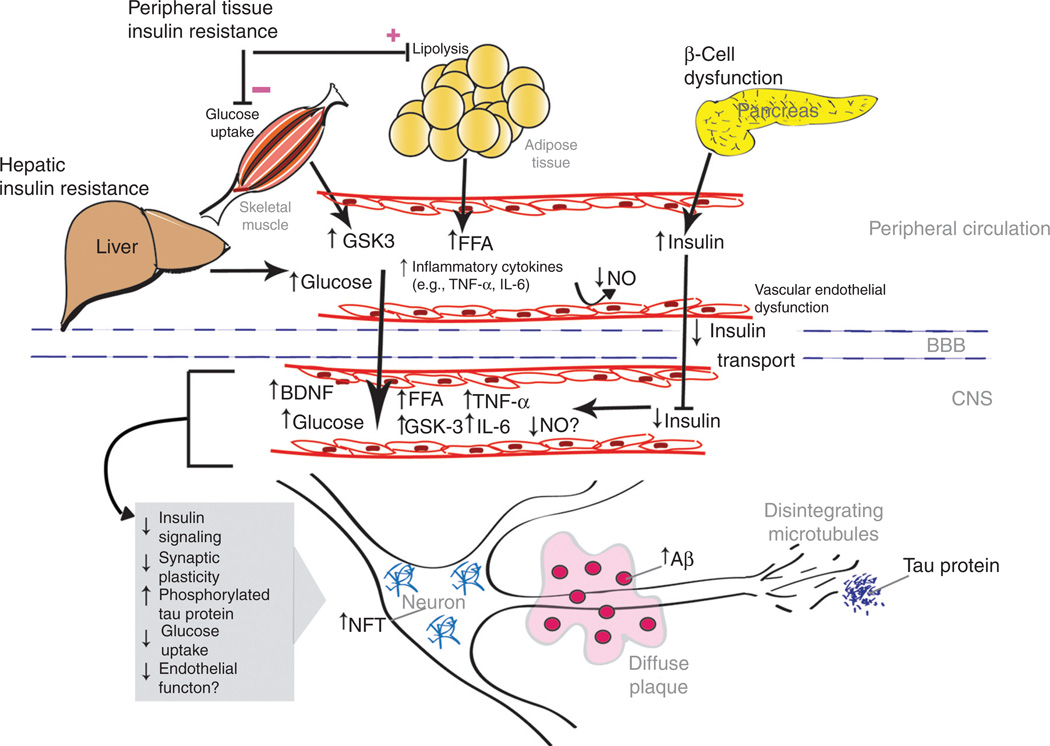
Peripheral disorders on the spectrum of obesity, insulin resistance, and hyperinsulinemia may promote a state of central insulin deficiency and resistance that contributes to the development and progression of cognitive impairment and Alzheimer’s disease through multiple potential mechanisms. Prolonged peripheral hyperinsulinemia decreases insulin transport into the CNS, which may result in central insulin deficiency, resistance, and impaired signaling. These abnormalities may have diverse effects including decreased glucose metabolism and synaptic plasticity, as well as accumulation of Aβ and NFT that characterize Alzheimer’s disease. Decreased availability of NO may both impair synaptic plasticity and promote endothelial dysfunction. Known peripheral effects of obesity, insulin resistance and hyperinsulinemia, including endothelial dysfunction and elevations of FFA, TNF-α, and GSK-3, may extend to the CNS. FFA and TNF-α may promote intracranial endothelial dysfunction and stimulate accumulation of Aβ and NFT. Aβ, β-amyloid; BBB, blood–brain barrier; BDNF, brain-derived neurotrophic factor; CNS, central nervous system; FFA, free fatty acids; GSK-3, glycogen synthase kinase-3; IL-6, interleukin-6; NFT, neurofibrillary tangles; NO, nitric oxide; TNF-α, tumor necrosis factor-α.
References
-
- Flegal KM, Carroll MD, Ogden CL, Curtin LR. Prevalence and trends in obesity among US adults, 1999–2008. JAMA. 2010;303:235–241. - PubMed
-
- Ogden CL, Carroll MD, Flegal KM. High body mass index for age among US children and adolescents, 2003–2006. JAMA. 2008;299:2401–2405. - PubMed
-
- Stefan N, Kantartzis K, Machann J, et al. Identification and characterization of metabolically benign obesity in humans. Arch Intern Med. 2008;168:1609–1616. - PubMed
-
- Profenno LA, Porsteinsson AP, Faraone SV. Meta-analysis of Alzheimer’s disease risk with obesity, diabetes, and related disorders. Biol Psychiatry. 2010;67:505–512. - PubMed
-
- Alzheimer’s Association. 2010 Alzheimer’s Disease Facts and Figures. 2010 - PubMed
Publication types
MeSH terms
Substances
Grants and funding
LinkOut - more resources
Full Text Sources
Medical
