


doi: 10.1038/nm.2572.
Harnessing evolutionary biology to combat infectious disease
Affiliations
- PMID: 22310693
- PMCID: PMC3712261
- DOI: 10.1038/nm.2572
Item in Clipboard
Harnessing evolutionary biology to combat infectious disease
Nat Med.
.
Abstract
Pathogens exhibit remarkable abilities to flout therapeutic intervention. This outcome is driven by evolution, either as a direct response to intervention (e.g. the evolution of antibiotic resistance), or through long-term coevolution generating host or parasite traits that interact with therapy in undesirable or unpredicted ways. To make progress, the concepts and techniques of evolutionary biology must be deeply integrated with traditional approaches to immunology and pathogen biology. An interdisciplinary approach can inform control strategies, or even patient treatment, positioning us to meet the current and future challenges of controlling infectious diseases.
Figures
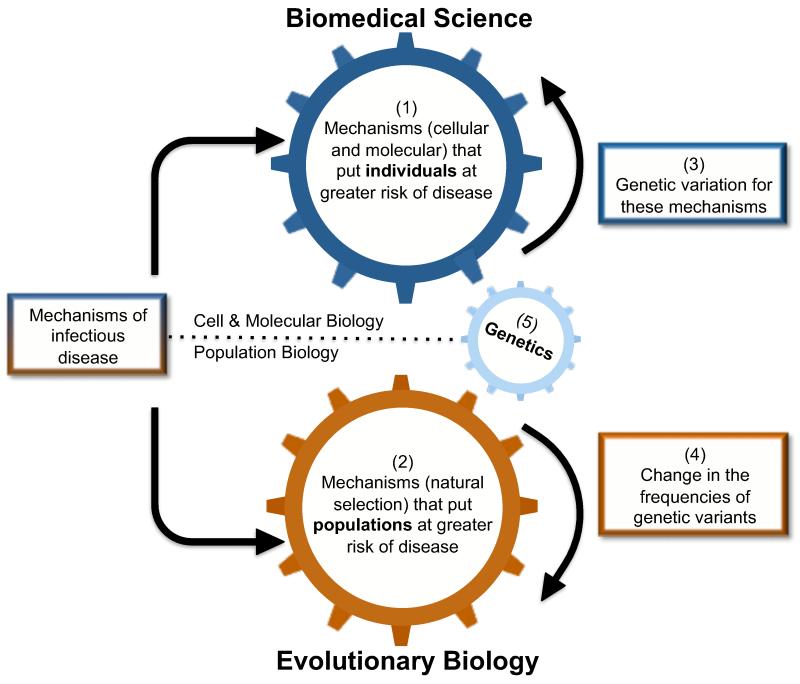
A central aim of all biomedical research is to elucidate mechanisms associated with infectious disease. Much basic biomedical research, for example immunology or pathogen biology, has its roots in cellular and molecular biology, and as such, has sought to (1) identify cellular or molecular mechanisms (e.g. pathogen virulence factors or host immune deficiencies) that place an individual at risk of contracting or expressing disease. The study of evolution (2), by contrast, is principally a form of population biology, and in the context of infectious disease, evolutionary biology seeks to identify mechanisms (prominently, natural selection) that change whole populations towards either a greater or lower average risk of infection. There has been substantial progress towards identifying (3) genetic variation for the cellular/molecular mechanisms that put individuals at greater risk of disease; evolutionary biology then studies (4) how the frequencies of these genetic variants may change over time due to natural selection. Thus, genetics (5), either molecular or quantitative, provides an important link between traditional biomedical science and evolutionary biology.
References
-
- McGreer A, Low D. Is resistance futile. Nature Medicine. 2003;9:390–392. - PubMed
-
- MacLean CR, Hall AR, Perron GG, Buckling A. The population genetics of antibiotic resistance: integrating molecular mechanisms and treatment contexts. Nature Reviews Genetics. 2010;11:405–414. - PubMed
-
- McCarroll L, et al. Insecticides and mosquito-borne disease. Nature. 2000;407:961–962. - PubMed
-
- Gandon S, Day T. Evidences of parasite evolution after vaccination. Vaccine. 2008;26:C4–C7. - PubMed
MeSH terms
Substances
Grants and funding
LinkOut - more resources
Full Text Sources
