


Glycaemic control is improved by 7 days of aerobic exercise training in patients with type 2 diabetes
- PMID: 22311420
- PMCID: PMC4500040
- DOI: 10.1007/s00125-012-2490-8
Glycaemic control is improved by 7 days of aerobic exercise training in patients with type 2 diabetes
Abstract
Aims/hypothesis: Cardiovascular events and death are better predicted by postprandial glucose (PPG) than by fasting blood glucose or HbA(1c). While chronic exercise reduces HbA(1c) in patients with type 2 diabetes, short-term exercise improves measures of insulin sensitivity but does not consistently alter responses to the OGTT. The purpose of this study was to determine whether short-term exercise training improves PPG and glycaemic control in free-living patients with type 2 diabetes, independently of the changes in fitness, adiposity and energy balance often associated with chronic exercise training.
Methods: Using continuous glucose monitors, PPG was quantified in previously sedentary patients with type 2 diabetes not using exogenous insulin (n = 13, age 53 ± 2 years, HbA(1c) 6.6 ± 0.2% (49.1 ± 1.9 mmol/mol)) during 3 days of habitual activity and during the final 3 days of a 7 day aerobic exercise training programme (7D-EX) which does not elicit measurable changes in cardiorespiratory fitness or body composition. Diet was standardised across monitoring periods, with modifications during 7D-EX to offset increases in energy expenditure. OGTTs were performed on the morning following each monitoring period.
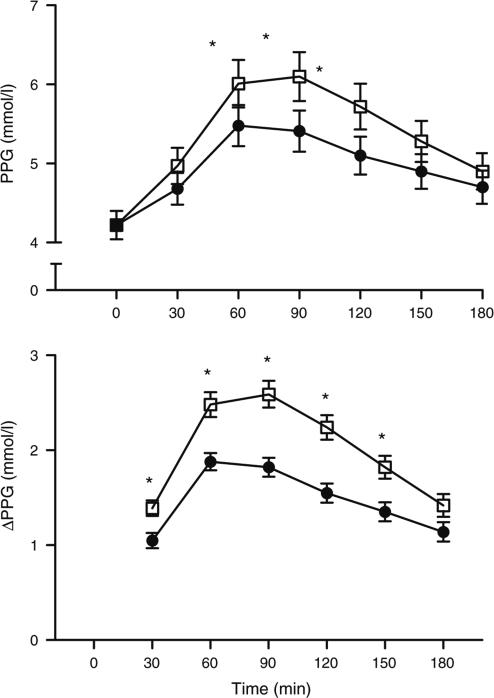
Results: 7D-EX attenuated PPG (p < 0.05) as well as the frequency, magnitude and duration of glycaemic excursions (p < 0.05). Conversely, average 24 h blood glucose did not change, nor did glucose, insulin or C-peptide responses to the OGTT.
Conclusions/interpretation: 7D-EX attenuated glycaemic variability and PPG in free-living patients with type 2 diabetes but did not significantly alter responses to the laboratory-based OGTT. These effects appeared to be independent of changes in fitness, body composition or energy balance. ClinicalTrials.gov numbers: NCT00954109 and NCT00972452.
Funding: This project was funded by the University of Missouri Institute for Clinical and Translational Sciences (CRM), NIH grant T32 AR-048523 (CRM), Diabetes Action Research and Education Foundation (JPT). Medtronic supplied CGMS sensors at a discounted rate.
Figures
References
-
- The Diabetes Control and Complications Trial Research Group The effect of intensive treatment of diabetes on the development and progression of long-term complications in insulin-dependent diabetes mellitus. N Engl J Med. 1993;329:977–986. - PubMed
-
- Patel A, MacMahon S, Chalmers J, et al. Intensive blood glucose control and vascular outcomes in patients with type 2 diabetes. N Engl J Med. 2008;358:2560–2572. - PubMed
Publication types
MeSH terms
Substances
Associated data
Grants and funding
LinkOut - more resources
Full Text Sources
Medical
Research Materials
Miscellaneous
