Revised criteria for mild cognitive impairment may compromise the diagnosis of Alzheimer disease dementia
- PMID: 22312163
- PMCID: PMC3423496
- DOI: 10.1001/archneurol.2011.3152
Revised criteria for mild cognitive impairment may compromise the diagnosis of Alzheimer disease dementia
Abstract
Objective: To evaluate the potential impact of revised criteria for mild cognitive impairment (MCI), developed by a work group sponsored by the National Institute on Aging and the Alzheimer's Association, on the diagnosis of very mild and mild Alzheimer disease (AD)dementia.
Design: Retrospective review of ratings of functional impairment across diagnostic categories.
Setting: Alzheimer's Disease Centers and the National Alzheimer's Coordinating Center.
Participants: Individuals (N=17 535) with normal cognition,MCI, or AD dementia.
Main outcome measures: The functional ratings of individuals with normal cognition, MCI, or AD dementia who were evaluated at Alzheimer's Disease Centers and submitted to the National Alzheimer's Coordinating Center were assessed in accordance with the definition of "functional independence" allowed by the revised criteria. Pairwise demographic differences between the 3 diagnostic groups were tested using t tests for continuous variables and 2 for categorical variables.
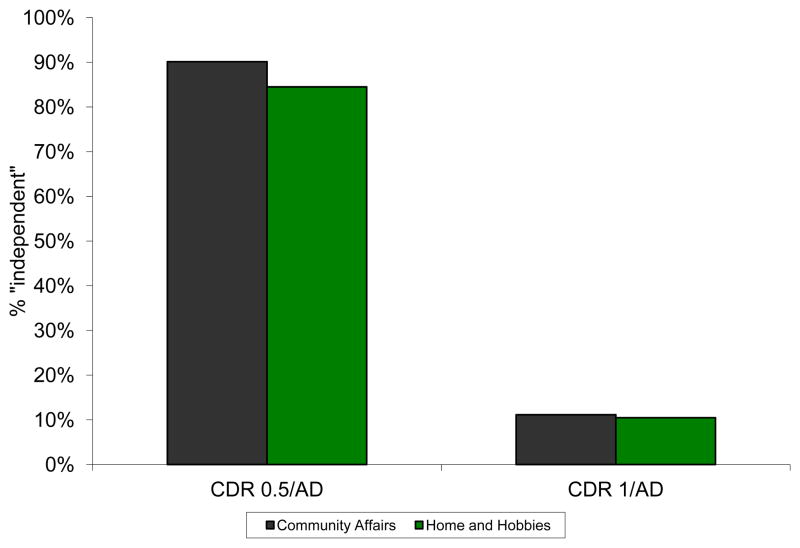
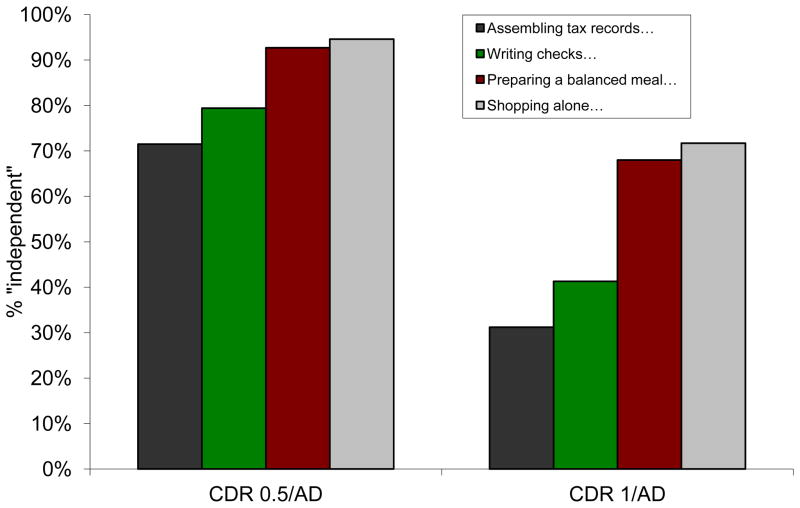
Results: Almost all (99.8%) individuals currently diagnosed with very mild AD dementia and the large majority(92.7%) of those diagnosed with mild AD dementia could be reclassified as having MCI with the revised criteria,based on their level of impairment in the Clinical Dementia Rating domains for performance of instrumental activities of daily living in the community and at home.Large percentages of these individuals with AD dementia also meet the revised "functional independence" criterion for MCI as measured by the Functional Assessment Questionnaire.
Conclusions: The categorical distinction between MCI and milder stages of AD dementia has been compromised by the revised criteria. The resulting diagnostic overlap supports the premise that "MCI due to AD" represents the earliest symptomatic stage of AD.
Figures


References
-
- Alzheimer’s Disease Education and Referral (ADEAR) Center. Connections Newsletter 12[3–4] Silver Spring, MD, National Institute on Aging; 2005. ADCs contribute significant AD research advances; p. 3.
-
- Albert MS, DeKosky ST, Dickson D, Dubois B, Feldman HH, Fox NC, Gamst A, Holtzman DM, Jagust WJ, Petersen RC, Snyder PJ, Carrillo MC, Thies W, Phelps CH. The diagnosis of mild cognitive impairment due to Alzheimer disease: Recommendations from the National Institute on Aging-Alzheimer’s Association workgroups on diagnostic guidelines for Alzheimer’s disease. Alzheimer’s & Dementia. 2011;7:270–279. - PMC - PubMed
-
- McKhann GM, Knopman DS, Chertkow H, Hynes M, Jack CR, Kawas CH, Klunk WE, Koroshetz W, Manly JJ, Mayeux R, Mohs RC, Morris JC, Rossor MN, Scheltens P, Carillo MC, Thies W, Weintraub S, Phelps CH. The diagnosis of dementia due to Alzheimer’s disease: Recommendations from the National Institute on Aging and the Alzheimer’s Association workgroup. Alzheimer’s & Dementia. 2011;7:263–269. - PMC - PubMed
-
- Sperling RA, Aisen PS, Beckett LA, Bennett DA, Craft S, Fagan AM, Iwatsubo T, Jack CR, Jr, Kaye J, Montine TJ, Park DC, Reiman EM, Rowe CC, Siemers E, Stern Y, Yaffe K, Carrillo MC, Thies W, Morrison-Bogorad M, Wagster MV, Phelps CH. Toward defining the preclinical stages of Alzheimer’s disease: Recommendations from the National Institute on Aging-Alzheimer’s Association workgroups on diagnostic guidelines for Alzheimer’s disease. Alzheimer’s & Dementia. 2011;7:280–292. - PMC - PubMed
-
- American Psychiatric Association. Diagnostic and Statistical Manual of Mental Disorders. 4. Washington, D.C: American Psychiatric Association; 1994.
Publication types
MeSH terms
Grants and funding
LinkOut - more resources
Full Text Sources
Medical
Molecular Biology Databases