


Association of tenofovir exposure with kidney disease risk in HIV infection
- PMID: 22313955
- PMCID: PMC3736566
- DOI: 10.1097/QAD.0b013e328351f68f
Association of tenofovir exposure with kidney disease risk in HIV infection
Abstract
Objective: Despite widespread HAART use, HIV disease remains associated with increased risk of kidney disease. Whether tenofovir use is associated with higher risk of kidney disease is controversial.
Design: We evaluated the association of cumulative and ever exposure to tenofovir on kidney outcomes in 10,841 HIV-infected patients from the Veterans Health Administration who initiated antiretroviral therapy from 1997 to 2007.
Methods: Cox proportional hazards and marginal structural models evaluated associations between tenofovir and time to first occurrence of proteinuria (two consecutive urine dipstick measurements ≥30 mg/dl), rapid decline in kidney function (≥3 ml/min per 1.73 m annual decline), and chronic kidney disease (CKD; estimated glomerular filtration rate <60 ml/min per 1.73 m).
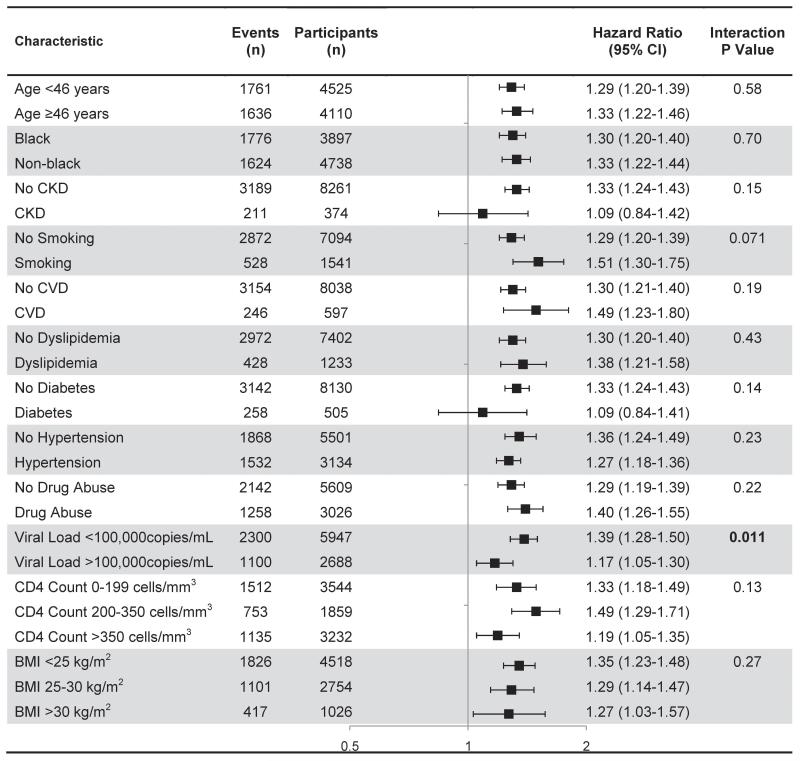
Results: Median follow-up ranged from 3.9 years (proteinuria) to 5.5 years (CKD), during which 3400 proteinuria, 3078 rapid decline, and 533 CKD events occurred. After multivariable adjustment, each year of exposure to tenofovir was associated with 34% increased risk of proteinuria [95% confidence interval (CI) 25-45, P < 0.0001], 11% increased risk of rapid decline (3-18, P = 0.0033), and 33% increased risk of CKD (18-51, P < 0.0001). Preexisting renal risk factors did not appear to worsen the effects of tenofovir. Other antiretroviral drugs showed weaker or inconsistent associations with kidney disease events. Among those who discontinued tenofovir use, risk of kidney disease events did not appear to decrease during follow-up.
Conclusion: Tenofovir exposure was independently associated with increased risk for three types of kidney disease events, and did not appear to be reversible. Because subtle kidney function decline affects long-term morbidity and mortality, the balance between efficacy and probable adverse effects requires further study.
Figures
References
-
- Fernando SK, Finkelstein FO, Moore BA, Weissman S. Prevalence of chronic kidney disease in an urban HIV infected population. Am J Med Sci. 2008;335:89–94. - PubMed
-
- Hall AM, Hendry BM, Nitsch D, Connolly JO. Tenofovir-Associated Kidney Toxicity in HIV-Infected Patients: A Review of the Evidence. Am J Kidney Dis. 2011;57:773–780. - PubMed
Publication types
MeSH terms
Substances
Grants and funding
LinkOut - more resources
Full Text Sources
Medical
