


doi: 10.1128/AAC.06297-11.
Epub 2012 Feb 6.
blaNDM-1 is a chimera likely constructed in Acinetobacter baumannii
Affiliations
- PMID: 22314529
- PMCID: PMC3346620
- DOI: 10.1128/AAC.06297-11
Item in Clipboard
blaNDM-1 is a chimera likely constructed in Acinetobacter baumannii
Antimicrob Agents Chemother.
2012 May.
Abstract
Alignment of DNA sequences found upstream of aphA6 and all bla(NDM-1) genes displays 100% identity. This identity continues 19 bp into the bla(NDM-1) gene such that the first 6 amino acids of aphA6 and bla(NDM-1) are the same. Furthermore, the percent GC content (GC%) of aphA6 is considerably lower than that of bla(NDM-1) and the GC% within the bla(NDM-1) structural gene changes dramatically after the first 19 bp. This is unequivocal evidence that bla(NDM-1) is a chimera.
Figures
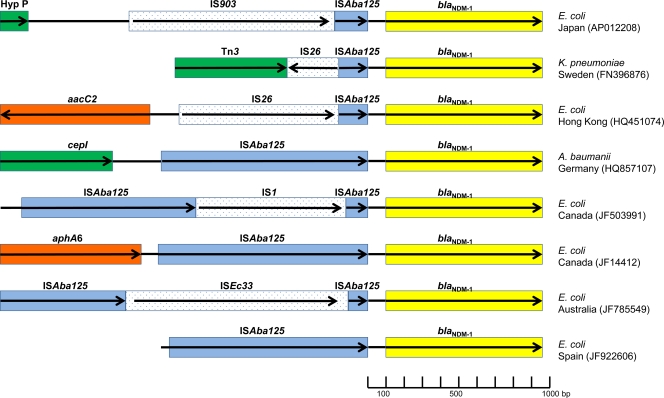
Sequence information found upstream of blaNDM-1 in various bacterial species isolated in different geographical regions. Colored blocks indicate regions of identity to various open reading frames or IS elements. The arrows indicate the direction of transcription and length of coding sections. Sections of ISAba125 are colored blue.
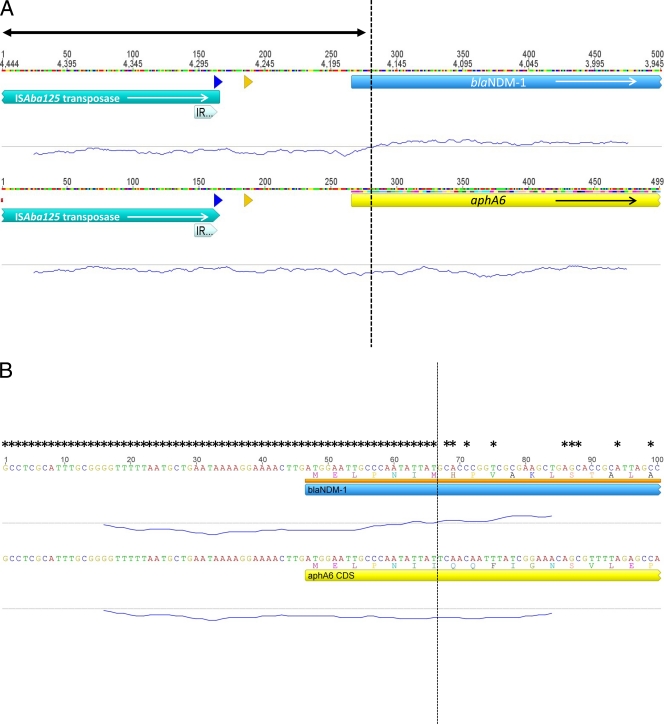
(A) Alignment of 500-bp sections of DNA, including the 5′ ends of blaNDM-1 and aphA6 genes and 260 bp of upstream sequence. Open reading frames (ORFs) are depicted as colored blocks with arrows indicating the direction of transcription. The double-ended arrow indicates the region of sequences that are 100% identical. The right inverted repeat of ISAba125 is depicted as a thick arrow at the end of the transposase ORFs. Promoter sequences are depicted as a blue arrow at −35 and a yellow arrow at −10. The trace underneath each sequence represents the GC%, which was calculated using a sliding window of 45 bp, and the dashed vertical line indicates the point at which the GC% changes from below 50% to above 50% within the blaNDM-1 sequence. (B) Amplification of 100-bp section of alignment A, indicating the shared first six amino acids of NDM-1 and AphA6 and the exact nucleotide sequence of each region. Asterisks indicate nucleotides that are identical in the two loci; the dashed vertical line indicates the exact site of the gene fusion for all other annotations as described above.
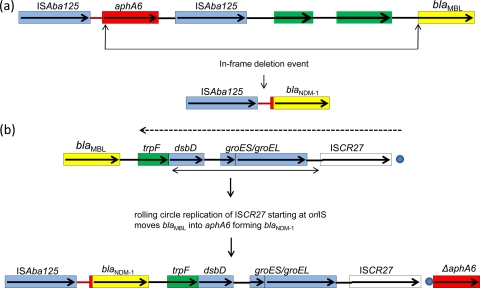
Two possible routes of blaNDM-1 construction. (a) blaNDM-1 could have been constructed by a deletion event that occurred between an upstream aphA6-ISAba125 composite transposon and an MBL blaMBL gene. This would remove all sequence between the arrows, including most of aphA6, and all sequence upstream of blaMBL. (b) A rolling-circle replication event involving the ISCR27 element starting at the oriIS site could mobilize the upstream DNA that includes blaMBL into the aphA6 composite transposon, causing an insertion into the aphA6 gene and a fusion producing blaNDM-1. Genes are depicted as colored boxes with arrows indicating the direction of their transcription and intervening DNA as horizontal lines. The intervening DNA between the aphA6 gene and the ISAba125 element is colored red. The dotted horizontal arrow indicates both the direction of rolling-circle replication of ISCR27 and the common sequence found in several blaNDM-1 plasmids and on the chromosome in A. baumanii. The filled dot indicates the oriIS, and the double-ended arrow indicates the DNA that has been mobilized from a Xanthomonas-type organism (14, 16) by ISCR27.
Comment in
-
Genetic contexts of blaNDM-1.Antimicrob Agents Chemother. 2012 Nov;56(11):6065-7; author reply 6071. doi: 10.1128/AAC.00117-12. Antimicrob Agents Chemother. 2012. PMID: 23074228 Free PMC article. No abstract available.
References
Publication types
MeSH terms
Substances
Grants and funding
LinkOut - more resources
Full Text Sources
Miscellaneous
