. 2012 Feb 21;109(8):3071-6.
doi: 10.1073/pnas.1200494109. Epub 2012 Feb 6.

Human kinome profiling identifies a requirement for AMP-activated protein kinase during human cytomegalovirus infection

Affiliations

Human kinome profiling identifies a requirement for AMP-activated protein kinase during human cytomegalovirus infection

Laura J Terry et al. Proc Natl Acad Sci U S A. .

Abstract

Human cytomegalovirus (HCMV) modulates numerous cellular signaling pathways. Alterations in signaling are evident from the broad changes in cellular phosphorylation that occur during HCMV infection and from the altered activity of multiple kinases. Here we report a comprehensive RNAi screen, which predicts that 106 cellular kinases influence growth of the virus, most of which were not previously linked to HCMV replication. Multiple elements of the AMP-activated protein kinase (AMPK) pathway scored in the screen. As a regulator of carbon and nucleotide metabolism, AMPK is poised to activate many of the metabolic pathways induced by HCMV infection. An AMPK inhibitor, compound C, blocked a substantial portion of HCMV-induced metabolic changes, inhibited the accumulation of all HCMV proteins tested, and markedly reduced the production of infectious progeny. We propose that HCMV requires AMPK or related activity for viral replication and reprogramming of cellular metabolism.


Conflict of interest statement

The authors declare no conflict of interest.

Figures
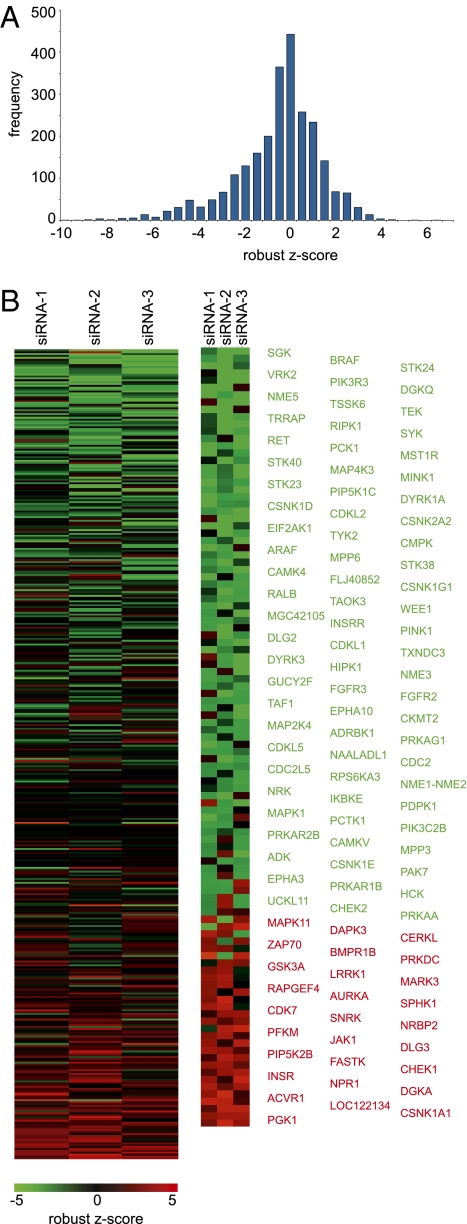
Fig. 1.
Fig. 1.
Human kinome screen identifies candidate effectors of HCMV replication. (A) Yield of infectious HCMV following transfection of each siRNA was assayed, normalized by plate, and converted to a robust z score. These robust z scores were grouped into bins of 0.5 units and plotted as a histogram to show the range of robust z scores. (B) Robust z scores for identified hits were converted to a heat map for each of the three siRNAs tested for each kinase. Log2 scale ranges from green (decreased yield of HCMV) to red (increased yield). (Right) Enlarged view of candidate hits, which are identified at Far Right. See Fig. S2 for a blue-yellow version of this panel.
Fig. 2.
Fig. 2.
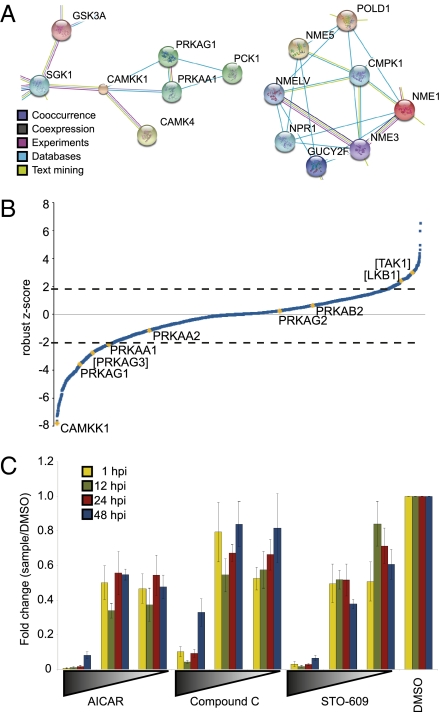
Replication of HCMV is impaired by altered AMPK activity. (A) Clusters of hits related to AMPK (Left) and nucleotide metabolism (Right) were identified from a STRING analysis of the kinase hits. Connecting lines are color coded by the type of evidence used to build the cluster. For full analysis, see Fig. S3. (B) siRNA targeting AMPK-related subunits was assayed for effects on HCMV replication. The siRNA result with the greatest absolute difference from zero for each triplicate is plotted against the distribution of robust z scores for the entire kinome screen. Genes contained within brackets did not meet our criteria for inclusion as a hit; in these cases only one of the three tested siRNAs produced a robust z score >2 or <2. (C) Confluent, serum-starved fibroblasts were infected with HCMV at a multiplicity of 0.1 IU per cell and treated with AICAR (0.01–1 mM), compound C (0.2–20 μM), STO-609 (0.1–10 μg/mL), or DMSO alone (drug vehicle) at different times postinfection. Yield of infectious virus was assayed and normalized to DMSO control.
Fig. 3.
Fig. 3.
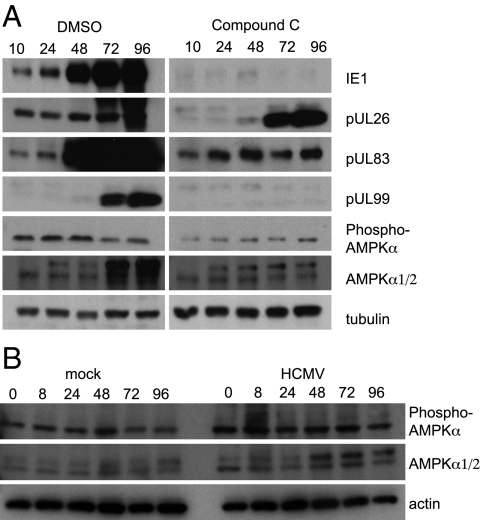
HCMV infection modestly increases total AMPK but does not change the amount of phospho-T172 AMPK. (A) Western blot assays for expression of HCMV proteins IE1, pUL26, pUL83, and pUL99 and cellular total AMPKα and phospho-T172 AMPKα in fibroblasts infected with HCMV (3 IU per cell) and treated with compound C (20 μM) or DMSO (drug vehicle). (B) Western blot assays for total AMPKα and phospho-T172 AMPKα in mock-infected or HCMV-infected fibroblasts maintained in culture under conditions as in A.
Fig. 4.
Fig. 4.
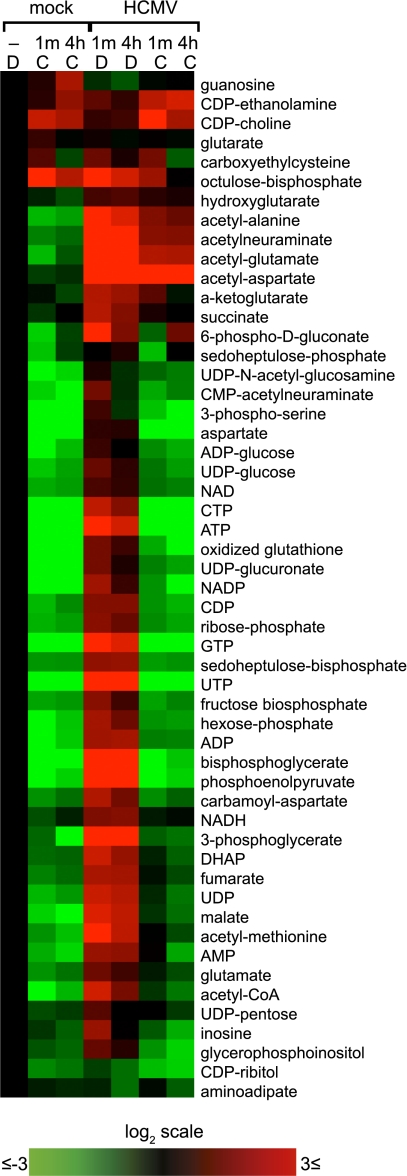
Compound C blocks establishment of the infected cell metabolome. (A) Cells were treated with compound C, (C, 20 μM) or DMSO alone (D, drug vehicle) beginning at 1 h after infection (3 IU per cell) or mock infection, and metabolites were assayed at 48 hpi. Heat map of drug-induced changes in metabolite pools is shown. Duplicate samples are shown, each normalized to mock-infected, DMSO-treated cells (Left column). Log2 scale of fold changes is shown. To view the same figure in blue-yellow color scale, see Fig. S4.

References

    1. Mocarski ES, Shenk T, Pass RF. Cytomegaloviruses. In: Knipe DM, Howley PM, editors. Fields Virology. Philadelphia: Lippincott Williams and Wilkins; 2007. pp. 2701–2772.
    1. Prichard MN. Function of human cytomegalovirus UL97 kinase in viral infection and its inhibition by maribavir. Rev Med Virol. 2009;19:215–229. - PMC - PubMed
    1. Munger J, Yu D, Shenk T. UL26-deficient human cytomegalovirus produces virions with hypophosphorylated pp28 tegument protein that is unstable within newly infected cells. J Virol. 2006;80:3541–3548. - PMC - PubMed
    1. Yurochko AD. Human cytomegalovirus modulation of signal transduction. Curr Top Microbiol Immunol. 2008;325:205–220. - PubMed
    1. Hardie DG. AMP-activated/SNF1 protein kinases: Conserved guardians of cellular energy. Nat Rev Mol Cell Biol. 2007;8:774–785. - PubMed

Publication types

MeSH terms

Substances