. 2011:2011:562831.
doi: 10.1155/2011/562831. Epub 2011 Jul 7.

The evolutionary processes of canine coronaviruses

Affiliations

The evolutionary processes of canine coronaviruses

Annamaria Pratelli. Adv Virol. 2011.

Abstract

Since the first identification of the virus in 1971, the disease caused by canine coronavirus (CCoV) has not been adequately investigated, and the role that the virus plays in canine enteric illness has not been well established. Only after the emergence in 2002 of SARS in human has new attention been focused on coronaviruses. As a consequence of the relatively high mutation frequency of RNA-positive stranded viruses, CCoV has evolved and, with the biomolecular techniques developed over the last two decades, new virus strains, serotypes, and subtypes have been identified in infected dogs. Considering the widespread nature of CCoV infections among dog populations, several studies have been carried out, focusing upon the epidemiological relevance of these viruses and underlining the need for further investigation into the biology of CCoVs and into the pathogenetic role of the infections. This paper reports the evolutionary processes of CCoVs with a note onto recent diagnostic methods.


Figures
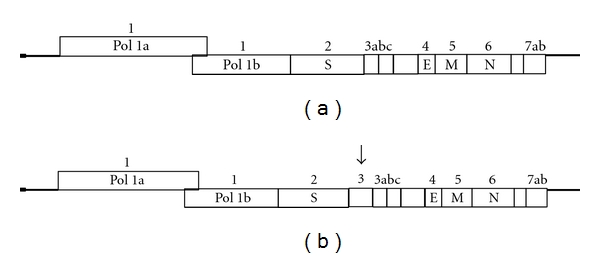
Figure 1
Figure 1
Genetic structure of CCoV type 2 (a) and CCoV type 1 (b). The numbers above the bars indicate ORFs. The names in the bars indicate the protein encoded by the corresponding ORF. The structural proteins are marked by various letters, while the nonstructural proteins are represented by unfilled boxes. The arrow (b) indicates the accessory gene, ORF 3, unique to CCoV type 1.
Figure 2
Figure 2
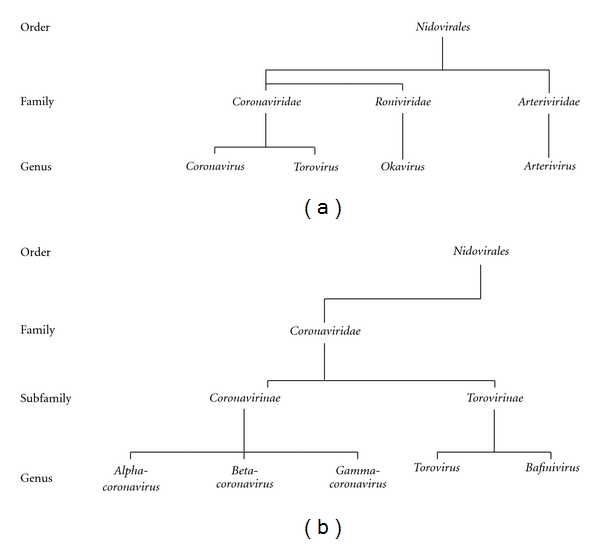
Current taxonomic organization of the Nidovirales and of the Coronaviridae family (a) and envisaged revision proposed to the ICTV Executive Committee (b).
Figure 3
Figure 3
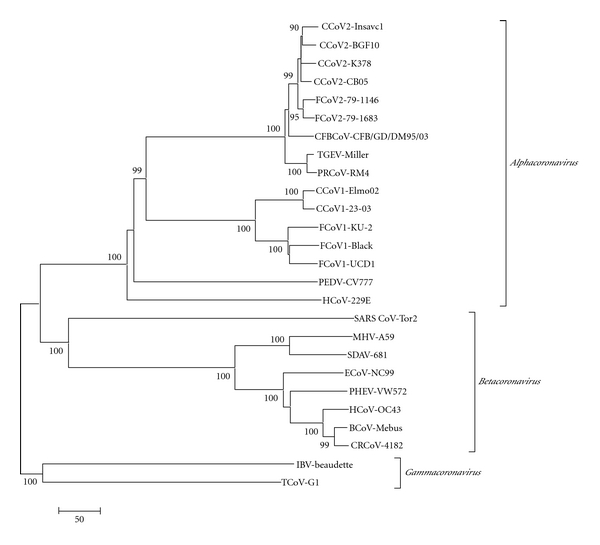
Phylogenetic tree of the spike protein of coronaviruses. CoV strains employed for tree construction are reported (GenBank accession numbers are reported in parentheses). Alphacoronaviruses: CCoV type 2 Insavc (D13096), CCoV type 2 K378 (X77047), CCoV type 2 BGF10 (AY342160), CCoV type 2 CB/05 (DQ112226), CCoV type 1 Elmo/02 (AY307020), CCoV type 1 23/03 (AY307021), FCoV type 2 79-1146 (X06170), FCoV type 2 79-1683 (X80799), FCoV type 1 KU-2 (D32044), FCoV type 1 Black (AB088223), FCoV type 1 UCD1 (AB088222), TGEV Miller (S51223), PRCoV RM4 (Z24675), PEDV CV777 (NC_003436), HCoV-229E (NC_002645), CFBCoV CFB/GD/DM95/03 (EF192156). Betacoronaviruses: SARS-CoV tor2 (NC_004718), BCoV-Mebus (U00735), CRCoV 4182 (DQ682406), HCoV OC43 (NC_005147), PHEV VW572 (DQ011855), MHV A59 (AY700211), SDAV 681 (AF207551), ECoV NC99 (NC010327). Gammacoronaviruses: IBV Beaudette (DQ830981), TCoV G1 (AY342357). Phylogenetic tree was generated by the neighbour-joining method in the Mega3 program [51], and statistical support was provided by bootstrapping >1,000 replicates. Scale bar indicates amino acid substitutions per site. Dog CoVs are grey shaded.

References

    1. Lai MMC, Holmes KV. Coronaviridae: the viruses and their replication. In: Knipe DM, Howley PM, Griffin DE, et al., editors. Fields Virology. Vol. 1. Philadelphia, Pa, USA: Lippincott Williams & Wilkins; 2001. pp. 1163–1185.
    1. de Groot RJ, Van Leen RW, Dalderup MJM, Vennema H, Horzinek MC, Spaan WJM. Stably expressed FIPV peplomer protein induces cell fusion and elicits neutralizing antibodies in mice. Virology. 1989;171(2):493–502. - PMC - PubMed
    1. Vennema H, Godeke GJ, Rossen JWA, et al. Nucleocapsid-independent assembly of coronavirus-like particles by co-expression of viral envelope protein genes. EMBO Journal. 1996;15(8):2020–2028. - PMC - PubMed
    1. Locker JK, Rose JK, Horzinek MC, Rottier PJM. Membrane assembly of the triple-spanning coronavirus M protein. Individual transmembrane domains show preferred orientation. Journal of Biological Chemistry. 1992;267(30):21911–21918. - PMC - PubMed
    1. Collins AR, Knobler RL, Powell H, Buchmeier MJ. Monoclonal antibodies to murine hepatitis virus-4 (strain JHM) define the viral glycoprotein responsible for attachment and cell-cell fusion. Virology. 1982;119(2):358–371. - PMC - PubMed