Review
. 2012 Jan;2(1):a009381.
doi: 10.1101/cshperspect.a009381.

Inflammation and adaptive immunity in Parkinson's disease

Affiliations
Review

Inflammation and adaptive immunity in Parkinson's disease

R Lee Mosley et al. Cold Spring Harb Perspect Med. 2012 Jan.

Abstract

The immune system is designed to protect the host from infection and injury. However, when an adaptive immune response continues unchecked in the brain, the proinflammatory innate microglial response leads to the accumulation of neurotoxins and eventual neurodegeneration. What drives such responses are misfolded and nitrated proteins. Indeed, the antigen in Parkinson's disease (PD) is an aberrant self-protein, although the adaptive immune responses are remarkably similar in a range of diseases. Ingress of lymphocytes and chronic activation of glial cells directly affect neurodegeneration. With this understanding, new therapies aimed at modulating the immune system's response during PD could lead to decreased neuronal loss and improved clinical outcomes for disease.


Figures
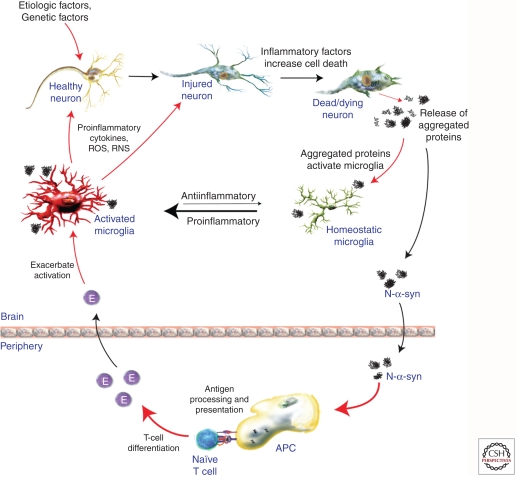
Figure 1.
Figure 1.
Immune contributions to PD pathogenesis. Reactive microgliosis is a prominent feature of neurodegenerative diseases such as PD. Microglia are sensitive to changes in their microenvironment, which include factors released from damaged/dying neurons such as modified and aggregated proteins (i.e., α-synculein found in Lewy bodies). Activated microglia may respond to these factors by secreting proinflammatory factors and ROS/RNS that perpetuate neuronal injury and death. Furthermore, modified α-synuclein (e.g., N-α-synunclein) may drain to the periphery where an adaptive immune response is mounted against these antigens. Although increased numbers of lymphocytes are found in the SN of PD patients’ brains, their exact role is not yet known. However, experimental evidence suggests that effector T-cell (E) responses contribute to microglia activation and accelerate neurodegeneration. Taken together, the innate and adaptive immune responses operative in PD may accelerate neurodegeneration and are an active area of research.
Figure 2.
Figure 2.
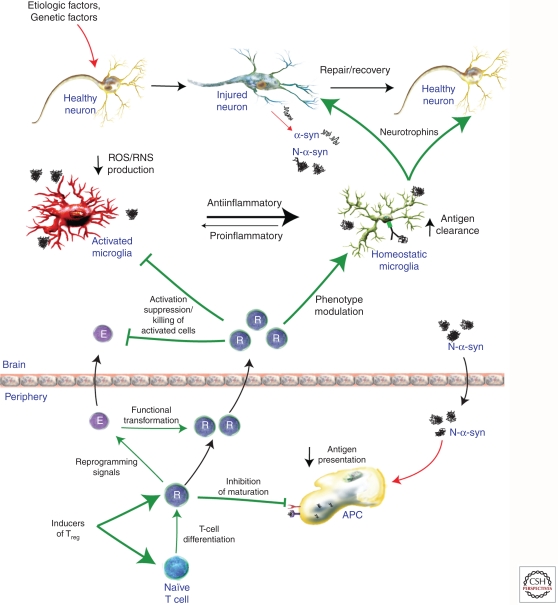
Adaptive immunity for therapeutic gain. Regulatory T cells (Treg, R) work to control excessive inflammation and may be harnessed to control neuroinflammation in PD and other neurodegenerative diseases. Treg can modulate microglia and other immune cells away from proinflammatory responses to anti-inflammatory/homeostatic functions. Therefore, strategies aimed at inducing, boosting, or reprogramming Treg responses (e.g., functional transformation of Teff [E] to Treg, increasing nTreg numbers, or activating Treg in an antigen-specific manner) show promise as possible disease-modifying therapies. Treg can modulate immune responses via several mechanisms, including suppressing microglia activation, inducing microglia phenotypic switching (toward anti-inflammatory), killing activated cells (e.g., Teff and microglia), and inhibition of APC maturation and antigen presentation. All together, Treg may suppress innate and adaptive proinflammatory, neurotoxic immune responses and boost homeostatic, neurotrophic immune responses resulting in slowing of neurodegeneration and allowing repair of damaged neurons. Such strategies may help to slow or halt the progression of PD.

References

    1. Abramsky O, Litvin Y 1978. Autoimmune response to dopamine-receptor as a possible mechanism in the pathogenesis of Parkinson’s disease and schizophrenia. Perspect Biol Med 22: 104–114 - PubMed
    1. Aloisi F, Ria F, Columba-Cabezas S, Hess H, Penna G, Adorini L 1999. Relative efficiency of microglia, astrocytes, dendritic cells and B cells in naive CD4+ T cell priming and Th1/Th2 cell restimulation. Eur J Immunol 29: 2705–2714 - PubMed
    1. Appel SH, Smith RG, Alexianu M, Engelhardt J, Mosier D, Colom L, Stefani E 1994. Neurodegenerative disease: Autoimmunity involving calcium channels. Ann NY Acad Sci 747: 183–194 - PubMed
    1. Arai H, Furuya T, Mizuno Y, Mochizuki H 2006. Inflammation and infection in Parkinson’s disease. Histol Histopathol 21: 673–678 - PubMed
    1. Baba Y, Kuroiwa A, Uitti RJ, Wszolek ZK, Yamada T 2005. Alterations of T-lymphocyte populations in Parkinson disease. Parkinsonism Relat Disord 11: 493–498 - PubMed