


Smooth muscle caldesmon modulates peristalsis in the wild type and non-innervated zebrafish intestine
- PMID: 22316291
- PMCID: PMC3919438
- DOI: 10.1111/j.1365-2982.2011.01844.x
Smooth muscle caldesmon modulates peristalsis in the wild type and non-innervated zebrafish intestine
Abstract
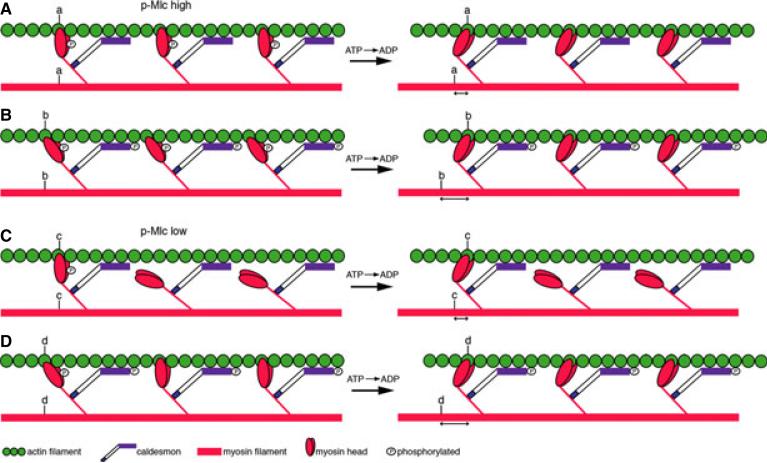
Background: The high molecular weight isoform of the actin-binding protein Caldesmon (h-CaD) regulates smooth muscle contractile function by modulating cross-bridge cycling of myosin heads. The normal inhibitory activity of h-CaD is regulated by the enteric nervous system; however, the role of h-CaD during intestinal peristalsis has never been studied.
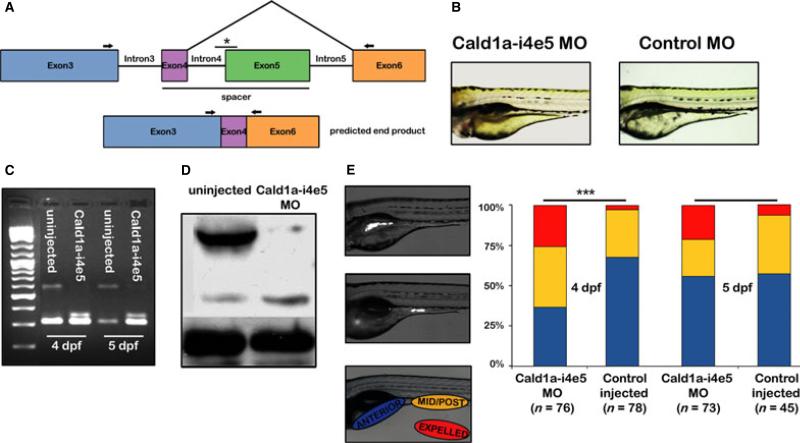
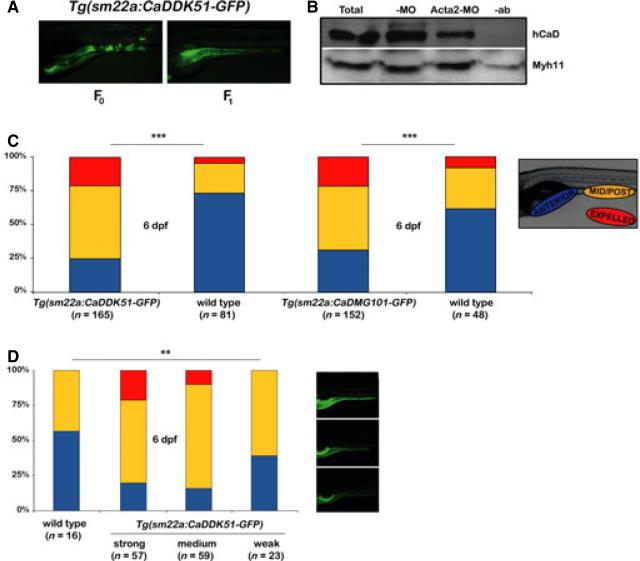
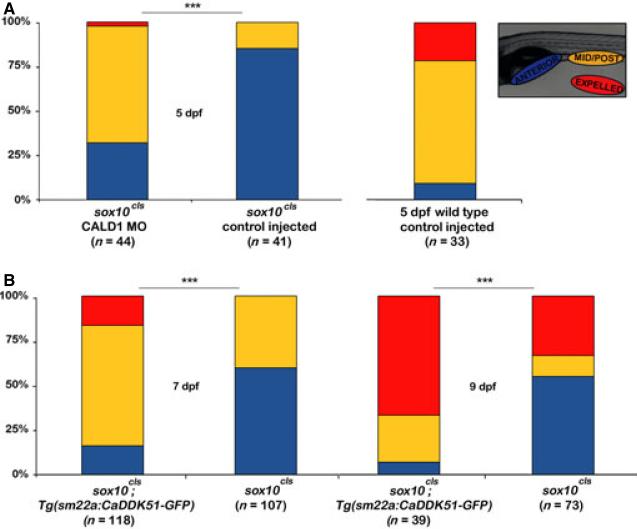
Methods: We identified a zebrafish paralog of the human CALD1 gene that encodes an h-CaD isoform expressed in intestinal smooth muscle. We examined the role of h-CaD during intestinal peristalsis in zebrafish larvae by knocking down the h-CaD protein using an antisense morpholino oligonucleotide. We also developed transgenic zebrafish that express inhibitory peptides derived from the h-CaD myosin and actin-binding domains, and examined their effect on peristalsis in wild-type zebrafish larvae and sox10 (colourless) mutant larvae that lack enteric nerves.
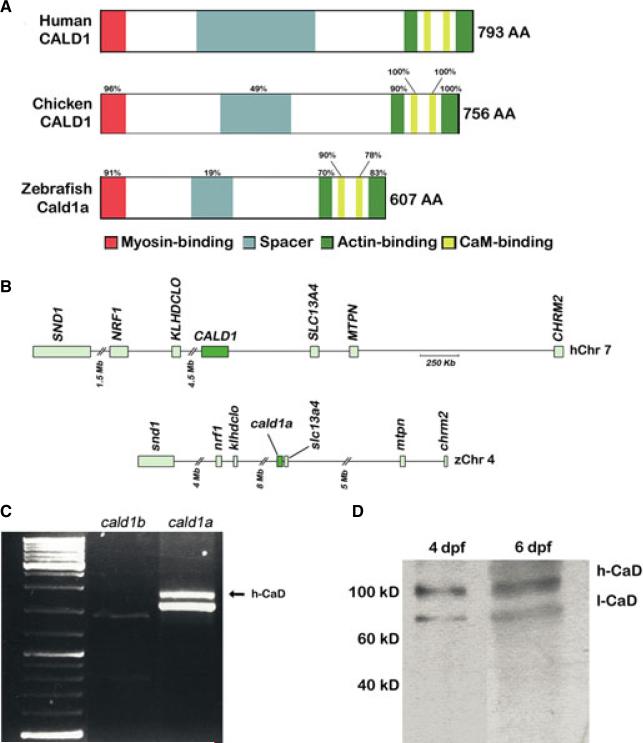
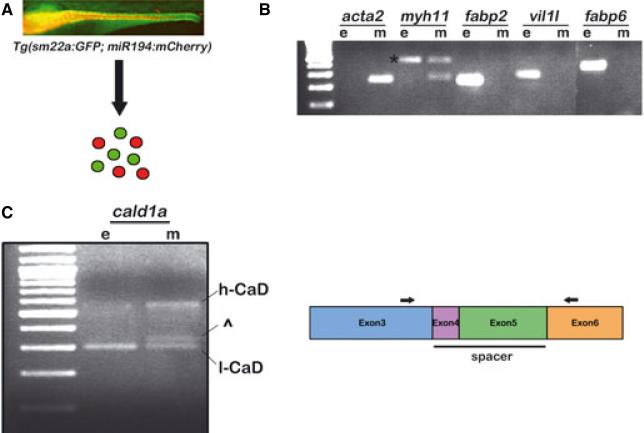
Key results: Genomic analyses identified two zebrafish Caldesmon paralogs. The cald1a ortholog encoded a high molecular weight isoform generated by alternative splicing whose intestinal expression was restricted to smooth muscle. Propulsive intestinal peristalsis was increased in wild-type zebrafish larvae by h-CaD knockdown and by expression of transgenes encoding inhibitory myosin and actin-binding domain peptides. Peristalsis in the non-innervated intestine of sox10 (colourless) larvae was partially restored by h-CaD knockdown and expression of the myosin-binding peptide.
Conclusions & inferences: Disruption of the normal inhibitory function of h-CaD enhances intestinal peristalsis in both wild-type zebrafish larvae and mutant larvae that lack enteric nerves, thus confirming a physiologic role for regulation of smooth muscle contraction at the actin filament.
© 2012 Blackwell Publishing Ltd.
Figures
References
-
- Kamm KE, Stull JT. The function of myosin and myosin light chain kinase phosphorylation in smooth muscle. Annu Rev Pharmacol Toxicol. 1985;25:593–620. - PubMed
-
- Murphy RA. Contraction in smooth muscle cells. Annu Rev Physiol. 1989;51:275–83. - PubMed
-
- Siegman MJ, Butler TM, Mooers SU, Michalek A. Ca2+ can affect Vmax without changes in myosin light chain phosphorylation in smooth muscle. Pflugers Arch. 1984;401:385–90. - PubMed
-
- Gerthoffer WT. Dissociation of myosin phosphorylation and active tension during muscarinic stimulation of tracheal smooth muscle. J Pharmacol Exp Ther. 1987;240:8–15. - PubMed
-
- Haeberle JR, Hott JW, Hathaway DR. Regulation of isometric force and isotonic shortening velocity by phosphorylation of the 20,000 dalton myosin light chain of rat uterine smooth muscle. Pflugers Arch. 1985;403:215–9. - PubMed
Publication types
MeSH terms
Substances
Grants and funding
LinkOut - more resources
Full Text Sources
Molecular Biology Databases
Miscellaneous
